EUR/USD hits one-week highs beyond 1.1570 as sentiment brightens
- EUR/USD pierces the range top at 1.1570 amid a brighter market mood.
- Eurozone Services PMI has been revised slightly higher in March.
- Investors hold their breath ahead of Trump's deadline for destroying Iran.

The Euro (EUR) has brushed off previous weakness to extend its recovery against the US Dollar (USD) to reach fresh weekly highs above 1.1570 on Tuesday's European morning session. The market sentiment has improved, with European equities turning positive after a negative opening, and Eurozone services activity revised up, which has provided some support for the common currency.
Eurozone HCOB Services Purchasing Managers' Index (PMI) has been revised to 50.2 on Tuesday from the 50.1 preliminary reading, although it remains significantly below February's 51.9 reading. Among country members, Spain's services activity stands out with a 53.3 reading, although France's services contracted for the third consecutive month, and Germany's expansion was revised down to 50.9 from preliminary estimations of 51.2.
Investors' appetite for risk remains limited as the US deadline to Iran draws closer. US President Donald Trump reiterated his threats on Monday, warning Tehran that the US could destroy the country tonight if the Strait of Hormuz is not reopened before Tuesday, at 8 PM Easter Time (00:00 GMT on Wednesday).
Previously, the US and Iran rejected the 45-day ceasefire proposal offered by Pakistan, and Tehran came out with an alternative plan, considered “significant” by Trump but not good enough.
Before that, the European Central Bank’s (ECB) Governing Council member, Dimitar Radev, affirmed that it is still “too early” to say whether the bank will hike rates in April, as they might need some data amid the elevated level of uncertainty.
Technical Analysis: Pushing against the range top
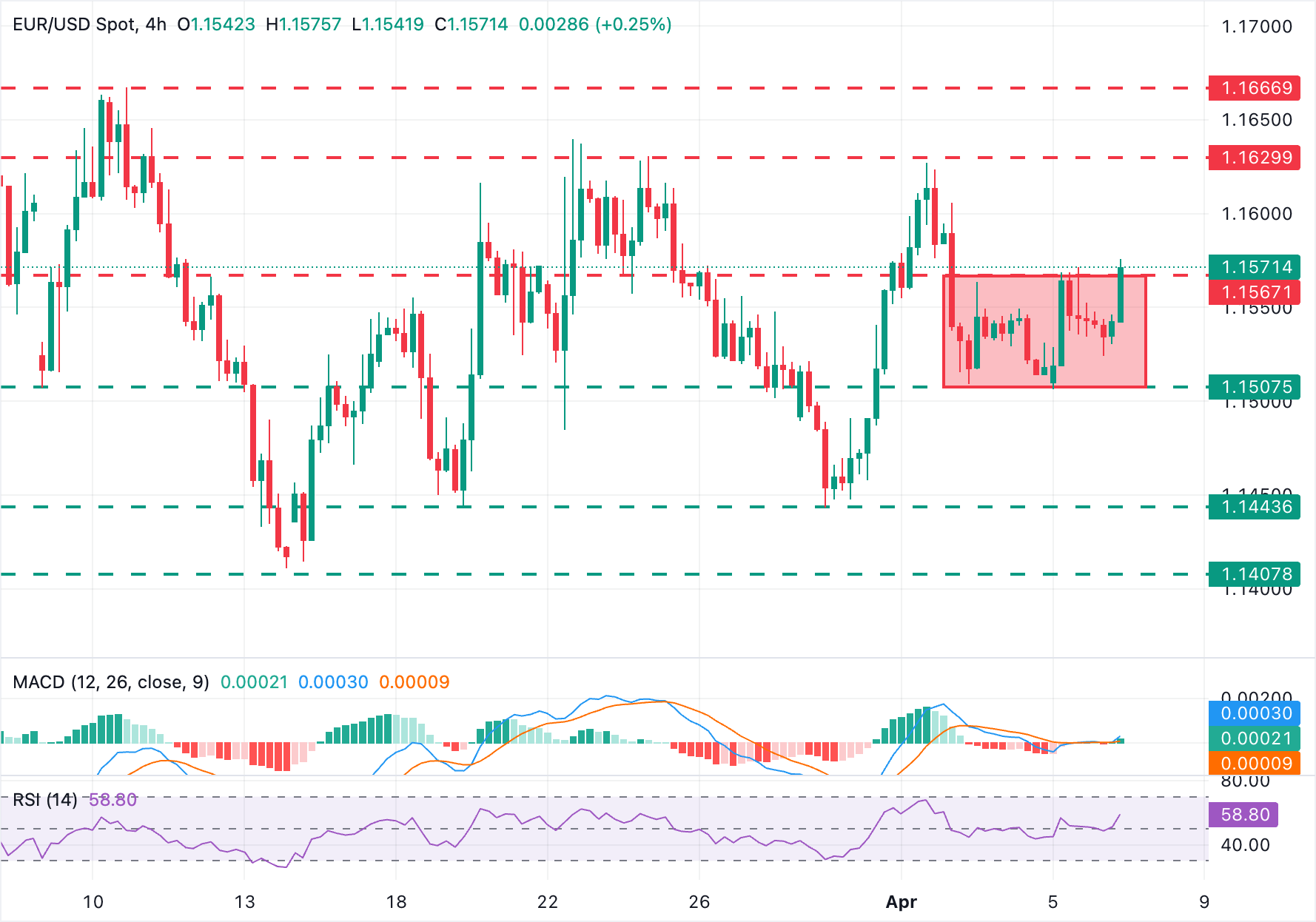
The EUR/USD has turned higher, with technical indicators in the 4-hour chart suggesting an incipient bullish momentum. The Relative Strength Index (RSI) nears 60 after having remained flat around the 50 level, and the Moving Average Convergence Divergence (MACD) histogram is popping up above zero, although the MACD line remains practically flat.
A confirmation above the near-term channel's top, at the 1.1570 area, would expose the late March and early April highs, in the area between 1.1630 and 1.1640. Further up, the March 10 high, at 1.1667, emerges as a plausible target.
Immediate support emerges at the 1.1505 area, which held bears on April 2 and 6. A confirmation below here would expose the March 30 and 31 lows near 1.1440, ahead of the multi-month lows, at 1.1411 hit in mid-March.
(The technical analysis of this story was written with the help of an AI tool.)
Economic Indicator
HCOB Services PMI
The Services Purchasing Managers Index (PMI), released on a monthly basis by S&P Global and Hamburg Commercial Bank (HCOB), is a leading indicator gauging business activity in the Eurozone services sector. As the services sector dominates a large part of the economy, the Services PMI is an important indicator gauging the state of overall economic conditions. The data is derived from surveys of senior executives at private-sector companies from the services sector. Survey responses reflect the change, if any, in the current month compared to the previous month and can anticipate changing trends in official data series such as Gross Domestic Product (GDP), industrial production, employment and inflation. The index varies between 0 and 100, with levels of 50.0 signaling no change over the previous month. A reading above 50 indicates that the services economy is generally expanding, a bullish sign for the Euro (EUR). Meanwhile, a reading below 50 signals that activity among services providers is generally declining, which is seen as bearish for EUR.
Read more.Last release: Tue Apr 07, 2026 08:00
Frequency: Monthly
Actual: 50.2
Consensus: 50.1
Previous: 50.1
Source: S&P Global
Economic Indicator
HCOB Composite PMI
The Composite Purchasing Managers’ Index (PMI), released on a monthly basis by S&P Global and Hamburg Commercial Bank (HCOB), is a leading indicator gauging private-business activity in the Eurozone for both the manufacturing and services sectors. The data is derived from surveys to senior executives. Each response is weighted according to the size of the company and its contribution to total manufacturing or services output accounted for by the sub-sector to which that company belongs. Survey responses reflect the change, if any, in the current month compared to the previous month and can anticipate changing trends in official data series such as Gross Domestic Product (GDP), industrial production, employment and inflation. The index varies between 0 and 100, with levels of 50.0 signaling no change over the previous month. A reading above 50 indicates that the private economy is generally expanding, a bullish sign for the Euro (EUR). Meanwhile, a reading below 50 signals that activity is generally declining, which is seen as bearish for EUR.
Read more.Last release: Tue Apr 07, 2026 08:00
Frequency: Monthly
Actual: 50.7
Consensus: 50.5
Previous: 50.5
Source: S&P Global
Author

Guillermo Alcala
FXStreet
Graduated in Communication Sciences at the Universidad del Pais Vasco and Universiteit van Amsterdam, Guillermo has been working as financial news editor and copywriter in diverse Forex-related firms, like FXStreet and Kantox.