EUR/USD edges up, nears 1.1800 ahead of US-Iran peace talks
- EUR/USD bounces up from 1.1770 and reaches session highs above 1.1790
- Markets remain moderately optimistic, ahead of a new round of US-Iran peace talks.
- Concerns about the impact of high Oil prices for a protracted period are likely to weigh on the Euro.

The Euro (EUR) edges higher against the US Dollar (USD) on Friday's European trading session, as the latter loses ground amid a moderate risk appetite. The pair picks up from session lows at 1.1770, reaching levels above 1.1790 at the time of writing, although it remains within previous ranges and below Thursday's highs of 1.1825.
Traders keep cutting back holdings of the safe-haven US Dollar, amid a moderate optimism about the resolution of Iran’s war. US President Donald Trump announced on Thursday a ten-day ceasefire in Lebanon, and confirmed that Washington and Tehran could resume peace talks this weekend.
Nevertheless, the nuclear issue seems to be a key hurdle for a steady peace deal. A news report by Reuters, citing Iranian sources, affirms that US and Iranian negotiators have scaled back their ambitions for this weekend’s talks and are now seeking a temporary memorandum to prevent a return to conflict.
Beyond that, closure of the Strait of Hormuz is another point of friction and maintains Oil prices more than 30% above pre-war levels. The Eurozone is strongly dependent on Crude imports; the energy shock triggered by the war in the Middle East has boosted inflationary levels in the region, which, coupled with weakening economic activity, is raising concerns about stagflation. If these fears increase, the Euro is likely to suffer.
Technical Analysis: Consolidating gains below 1.1825
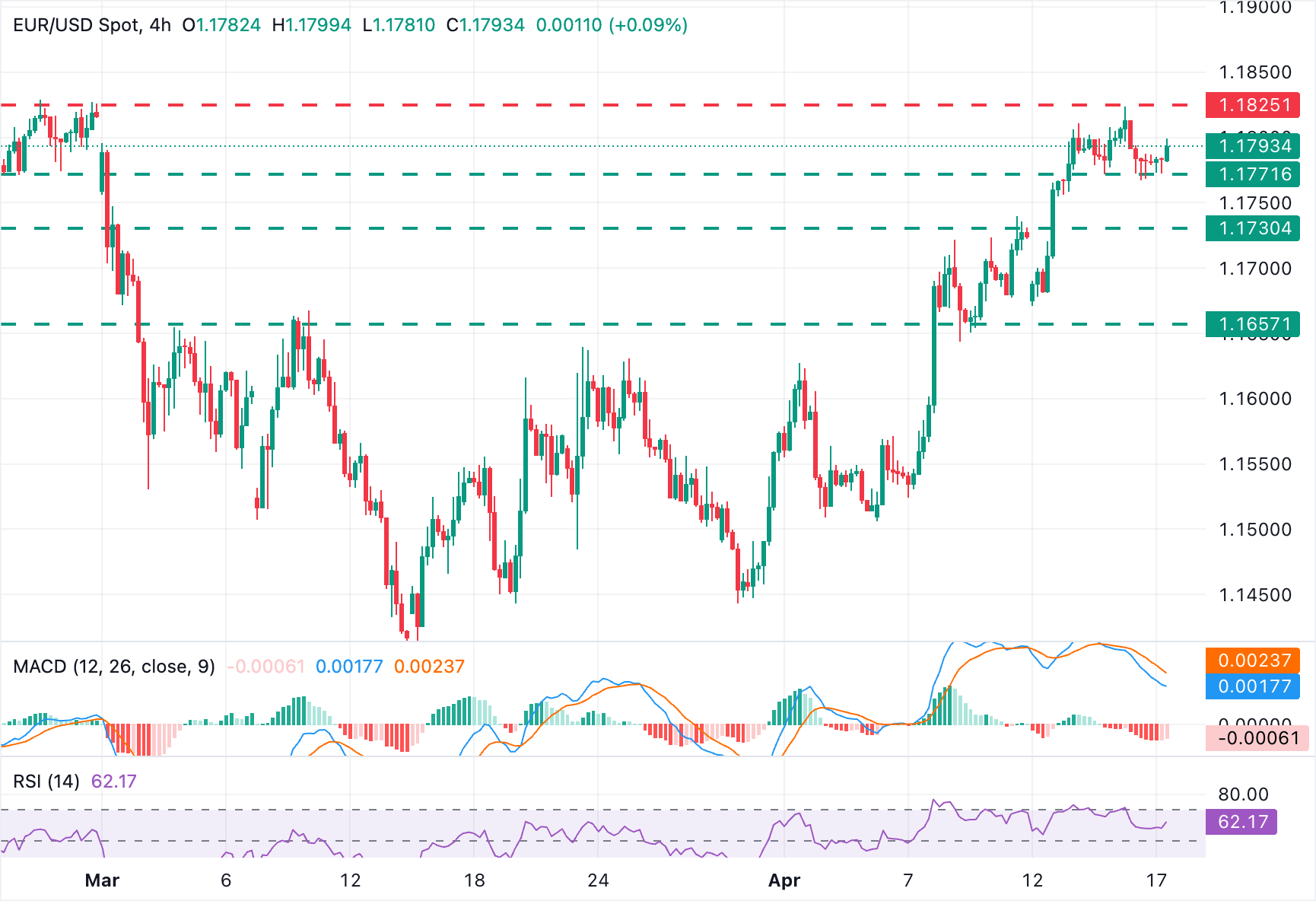
EUR/USD maintains the near-term bullish bias intact after rallying nearly 2.5% over the last three weeks, although technical indicators on the 4-hour chart are showing signs of weakness. The Relative Strength Index (RSI) has eased back to levels around 60, while the Moving Average Convergence Divergence (MACD) remains marginally negative, suggesting upside momentum is cooling but not yet reversing decisively.
Support at Thursday's lows around the 1.1770 area is holding bears for now, and closing the path towards the previous tops, between 1.1720 and 1.1740, and the 1.1650 support area (near April 8, 12 lows). A confirmation below that level would negate the bullish structure.
On the upside, immediate resistance remains at the late February highs around 1.1825. Further up, the February 10 and 11 highs, near 1.1930, are likely to be targeted.
(The technical analysis of this story was written with the help of an AI tool.)
Risk sentiment FAQs
In the world of financial jargon the two widely used terms “risk-on” and “risk off'' refer to the level of risk that investors are willing to stomach during the period referenced. In a “risk-on” market, investors are optimistic about the future and more willing to buy risky assets. In a “risk-off” market investors start to ‘play it safe’ because they are worried about the future, and therefore buy less risky assets that are more certain of bringing a return, even if it is relatively modest.
Typically, during periods of “risk-on”, stock markets will rise, most commodities – except Gold – will also gain in value, since they benefit from a positive growth outlook. The currencies of nations that are heavy commodity exporters strengthen because of increased demand, and Cryptocurrencies rise. In a “risk-off” market, Bonds go up – especially major government Bonds – Gold shines, and safe-haven currencies such as the Japanese Yen, Swiss Franc and US Dollar all benefit.
The Australian Dollar (AUD), the Canadian Dollar (CAD), the New Zealand Dollar (NZD) and minor FX like the Ruble (RUB) and the South African Rand (ZAR), all tend to rise in markets that are “risk-on”. This is because the economies of these currencies are heavily reliant on commodity exports for growth, and commodities tend to rise in price during risk-on periods. This is because investors foresee greater demand for raw materials in the future due to heightened economic activity.
The major currencies that tend to rise during periods of “risk-off” are the US Dollar (USD), the Japanese Yen (JPY) and the Swiss Franc (CHF). The US Dollar, because it is the world’s reserve currency, and because in times of crisis investors buy US government debt, which is seen as safe because the largest economy in the world is unlikely to default. The Yen, from increased demand for Japanese government bonds, because a high proportion are held by domestic investors who are unlikely to dump them – even in a crisis. The Swiss Franc, because strict Swiss banking laws offer investors enhanced capital protection.
,
Author

Guillermo Alcala
FXStreet
Graduated in Communication Sciences at the Universidad del Pais Vasco and Universiteit van Amsterdam, Guillermo has been working as financial news editor and copywriter in diverse Forex-related firms, like FXStreet and Kantox.