EUR/USD edges up, nearing 1.1700 despite the cautious market mood
- EUR/USD ticks up to the 1.1680 area from session lows near 1.1650.
- A fragile ceasefire in the Iran war is keeping investors on edge.
- The minutes of the last Fed meeting showed more openness for interest rate hikes.

The (EUR) is showing a mild bullish tone against the US Dollar (USD) heading into Thursday’s US session opening, trading in the 1.1680 area after bouncing from 1.1650 earlier on the day. The pair, however, remains well below Wednesday’s highs, at 1.1721, as optimism about the ceasefire ebbed after Tehran closed the Strait of Hormuz following massive Israeli attacks on Lebanon.
The Iranian authorities complained about violations of the ceasefire proposal while the US and Israel affirm that Lebanon is not part of the agreement, and US President Donald Trump threatened action if Tehran fails to comply with the deal. Despite the tensions, both parties have announced that they will send delegations for direct talks in Pakistan, which keeps peace hopes alive for now.
The Fed turns more hawkish
Apart from that, a moderate hawkish tilt on the minutes of March’s Federal Open Market Committee (FOMC) has contributed to the US Dollar’s rebound. Federal Reserve (Fed) policymakers acknowledged that progress towards the 2% inflation target will be longer than previously thought, and for the first time since the bank started cutting rates in September 2024, some committee members raised the possibility of monetary tightening.
Later on Thursday, the US Personal Consumption Expenditures (PCE) Price Index, but above all, Friday’s Consumer Prices Index (CPI), which refers to March, will reveal the inflationary impact of the Iran war, and might give further insight into the central bank’s monetary policy path.
In Europe, German Industrial Production figures revealed that factory output declined against expectations in February, while the trade surplus contracted less than expected, with imports and exports increasing beyond forecasts. The impact of these figures on the Euro has been marginal.
Technical Analysis: The near-term bias remains bullish
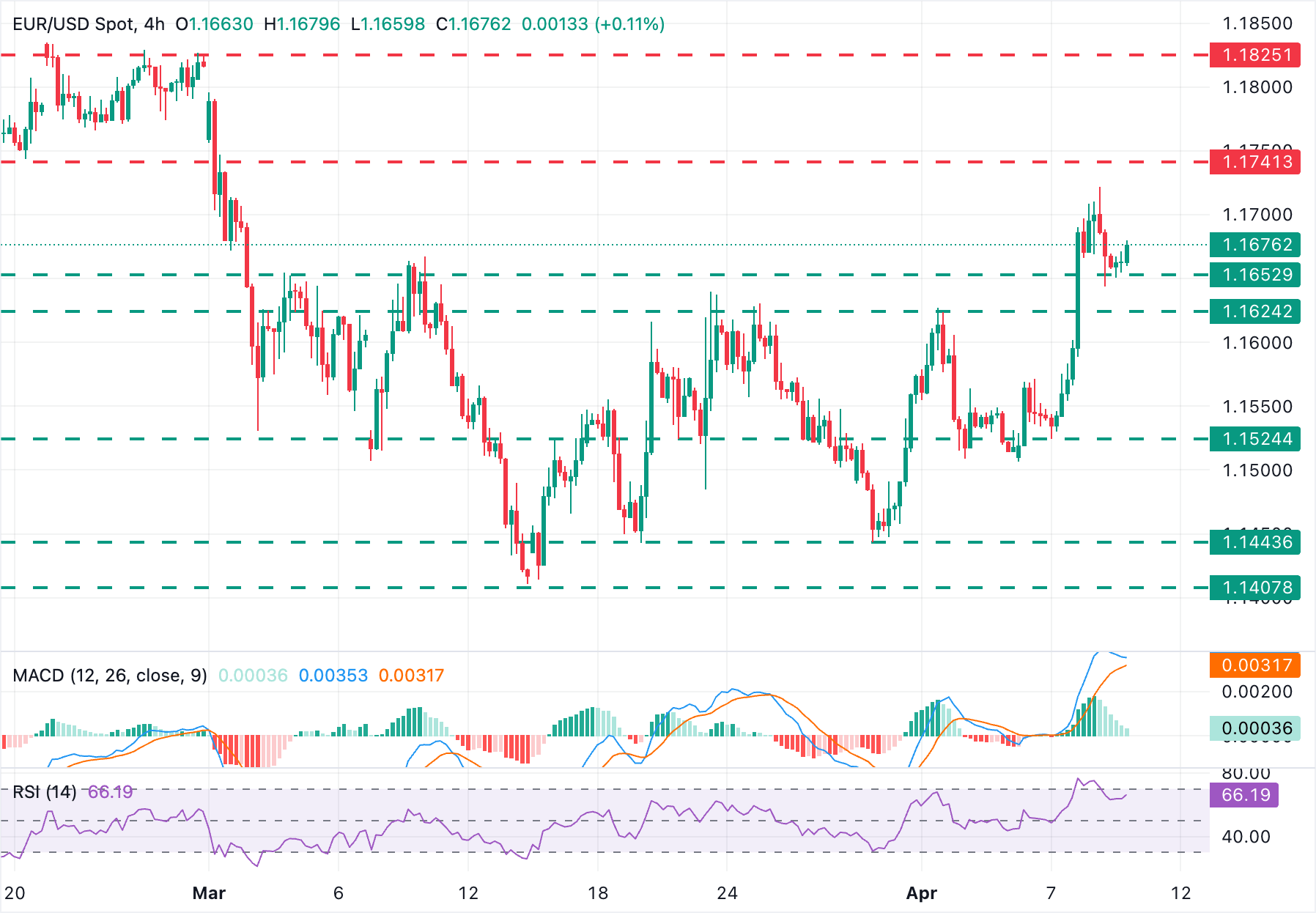
EUR/USD maintains a constructive near-term bias, despite the recent pullback, as it holds most of the gains taken over the previous three days.
The 4-hour Relative Strength Index (RSI) is hovering in bullish territory, and the Moving Average Convergence Divergence (MACD) remains marginally positive, which together suggest that upward momentum is still in play.
On the topside, the area between Wednesday's high at 1.1721 and the February 19 low near 1.1740 is likely to challenge bulls ahead of the late-February highs, around 1.1830. Bears remain capped above previous highs, in the 1.1630-1.1640 area, so far closing the path towards the weekly lows, at 1.1505.
(The technical analysis of this story was written with the help of an AI tool.)
(This story was corrected on April 9 at 11:10 GMT to say that the Fed kicked off its easing cycle in September 2024 and not in August 2024 as previously stated.)
Euro FAQs
The Euro is the currency for the 20 European Union countries that belong to the Eurozone. It is the second most heavily traded currency in the world behind the US Dollar. In 2022, it accounted for 31% of all foreign exchange transactions, with an average daily turnover of over $2.2 trillion a day. EUR/USD is the most heavily traded currency pair in the world, accounting for an estimated 30% off all transactions, followed by EUR/JPY (4%), EUR/GBP (3%) and EUR/AUD (2%).
The European Central Bank (ECB) in Frankfurt, Germany, is the reserve bank for the Eurozone. The ECB sets interest rates and manages monetary policy. The ECB’s primary mandate is to maintain price stability, which means either controlling inflation or stimulating growth. Its primary tool is the raising or lowering of interest rates. Relatively high interest rates – or the expectation of higher rates – will usually benefit the Euro and vice versa. The ECB Governing Council makes monetary policy decisions at meetings held eight times a year. Decisions are made by heads of the Eurozone national banks and six permanent members, including the President of the ECB, Christine Lagarde.
Eurozone inflation data, measured by the Harmonized Index of Consumer Prices (HICP), is an important econometric for the Euro. If inflation rises more than expected, especially if above the ECB’s 2% target, it obliges the ECB to raise interest rates to bring it back under control. Relatively high interest rates compared to its counterparts will usually benefit the Euro, as it makes the region more attractive as a place for global investors to park their money.
Data releases gauge the health of the economy and can impact on the Euro. Indicators such as GDP, Manufacturing and Services PMIs, employment, and consumer sentiment surveys can all influence the direction of the single currency. A strong economy is good for the Euro. Not only does it attract more foreign investment but it may encourage the ECB to put up interest rates, which will directly strengthen the Euro. Otherwise, if economic data is weak, the Euro is likely to fall. Economic data for the four largest economies in the euro area (Germany, France, Italy and Spain) are especially significant, as they account for 75% of the Eurozone’s economy.
Another significant data release for the Euro is the Trade Balance. This indicator measures the difference between what a country earns from its exports and what it spends on imports over a given period. If a country produces highly sought after exports then its currency will gain in value purely from the extra demand created from foreign buyers seeking to purchase these goods. Therefore, a positive net Trade Balance strengthens a currency and vice versa for a negative balance.
Author

Guillermo Alcala
FXStreet
Graduated in Communication Sciences at the Universidad del Pais Vasco and Universiteit van Amsterdam, Guillermo has been working as financial news editor and copywriter in diverse Forex-related firms, like FXStreet and Kantox.