EUR/USD churns sideways on Tuesday's upbeat European data
- EUR/USD stuck near familiar lows as Euro bidders look for a foothold.
- European data came in mostly better than expected.
- Broader markets continue to chew on rate cut expectations.

EUR/USD cycled Tuesday’s opening bids in a tight pattern as investors await further indications of when central banks will begin making rate cuts with broader markets hinging their focus on interest rate activity.
European economic data came in better than expected, but still broadly exposing a weakened domestic European economy, and momentum remains limited with the US Dollar (USD) seeing a soft pullback heading into the midweek.
Daily digest market movers: EUR/USD pinned into low side as momentum drains from both sides
- EUR/USD sees little Tuesday momentum as both the US Dollar and the Euro (EUR) recede.
- The pair remains trapped below 1.0800 after last week’s late backslide.
- German Factory Orders unexpectedly climbed 8,.9% versus the forecast flat hold at 0.0%.
- Annualized European Retail Sales also beat expectations by falling less than expected.
- YoY Retail Sales declined 0.8% versus the forecast -0.9%.
- The previous period saw a sharp upside revision from -1.1% to -0.4%.
- Markets shrugged off a steeper-than-expected decline in MoM Retail Sales, which fell -1.1% in December compared to the forecast -1.0%, declining from the previous month’s 0.3% increase (revised upwards from -0.3%).
- Federal Reserve (Fed) policymaker and Minneapolis Fed President Neel Kashkari hit newswires stating that most of the US’ disinflation pressure is coming from a stabilized supply side.
- Fed Kashkari also noted that the yield curve isn’t a reliable indicator of recession since most disinflation isn’t coming from Fed policies.
- Fed’s Kashkari: remains hopeful that the US will avoid recession, doesn’t see recession as his “base case”.
Euro price today
The table below shows the percentage change of Euro (EUR) against listed major currencies today. Euro was the strongest against the US Dollar.
| USD | EUR | GBP | CAD | AUD | JPY | NZD | CHF | |
| USD | -0.09% | -0.48% | -0.42% | -0.58% | -0.46% | -0.37% | -0.05% | |
| EUR | 0.08% | -0.40% | -0.36% | -0.50% | -0.39% | -0.29% | 0.03% | |
| GBP | 0.49% | 0.39% | 0.05% | -0.09% | 0.00% | 0.09% | 0.43% | |
| CAD | 0.40% | 0.33% | -0.06% | -0.17% | -0.05% | 0.05% | 0.36% | |
| AUD | 0.58% | 0.48% | 0.09% | 0.17% | 0.12% | 0.21% | 0.51% | |
| JPY | 0.47% | 0.38% | -0.02% | 0.04% | -0.13% | 0.10% | 0.40% | |
| NZD | 0.39% | 0.30% | -0.10% | -0.03% | -0.20% | -0.09% | 0.33% | |
| CHF | 0.06% | -0.03% | -0.43% | -0.37% | -0.53% | -0.41% | -0.31% |
The heat map shows percentage changes of major currencies against each other. The base currency is picked from the left column, while the quote currency is picked from the top row. For example, if you pick the Euro from the left column and move along the horizontal line to the Japanese Yen, the percentage change displayed in the box will represent EUR (base)/JPY (quote).
Technical analysis: EUR/USD stuck near familiar bottoms in low-momentum trading
EUR/USD recently fell into fresh near-term lows after backsliding 1.6% from last week’s peak bids near 1.0897, and the pair remains trapped on the bottom end of the 200-hour Simple Moving Average (SMA) near 1.0820, and the EUR/USD remains pinned below the 1.0800 handle.
Tuesday’s flat cycle sees the EUR/USD adrift in bear country after the pair tumbled out of a recent congestion zone between the 50-day and 200-day SMAs near 1.0900 and 1.0850 respectively. The immediate technical floor is from December’s bottom bids near 1.0740.
EUR/USD hourly chart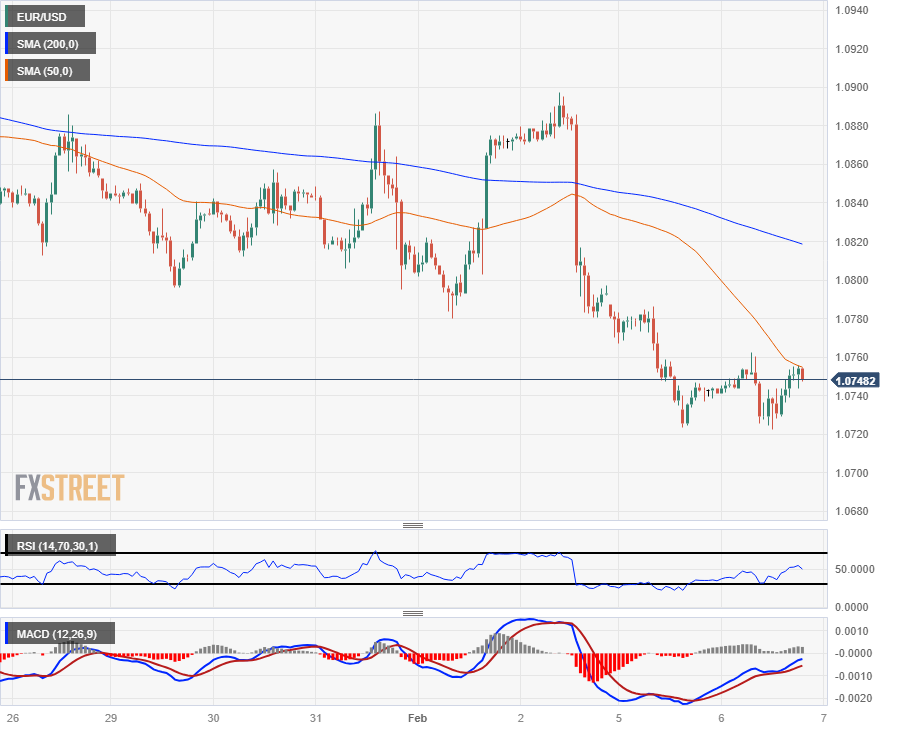
EUR/USD daily chart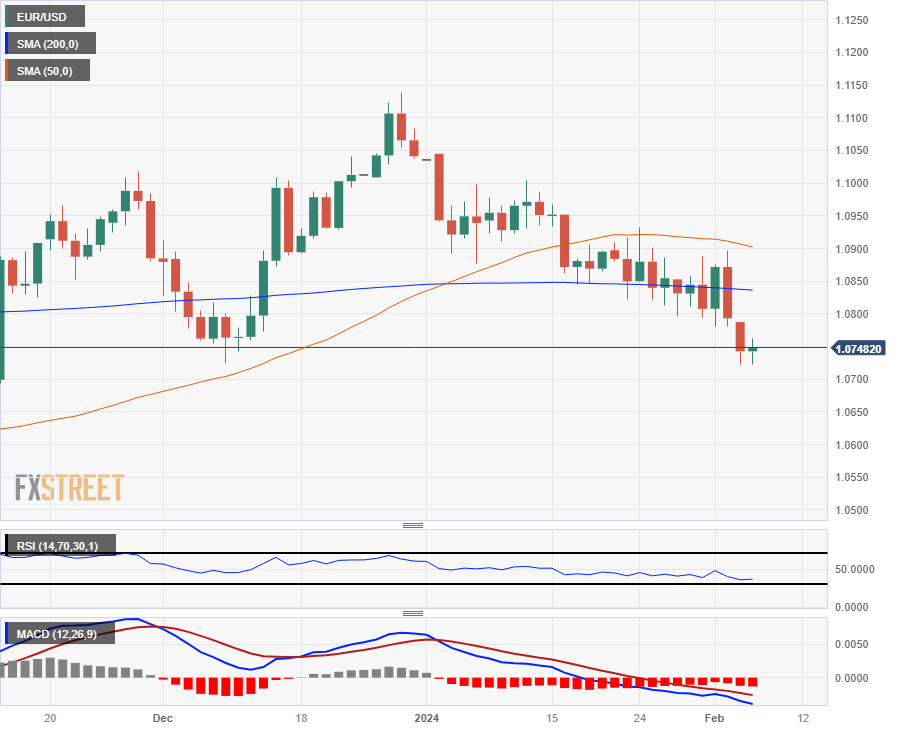
ECB FAQs
What is the ECB and how does it influence the Euro?
The European Central Bank (ECB) in Frankfurt, Germany, is the reserve bank for the Eurozone. The ECB sets interest rates and manages monetary policy for the region.
The ECB primary mandate is to maintain price stability, which means keeping inflation at around 2%. Its primary tool for achieving this is by raising or lowering interest rates. Relatively high interest rates will usually result in a stronger Euro and vice versa.
The ECB Governing Council makes monetary policy decisions at meetings held eight times a year. Decisions are made by heads of the Eurozone national banks and six permanent members, including the President of the ECB, Christine Lagarde.
What is Quantitative Easing (QE) and how does it affect the Euro?
In extreme situations, the European Central Bank can enact a policy tool called Quantitative Easing. QE is the process by which the ECB prints Euros and uses them to buy assets – usually government or corporate bonds – from banks and other financial institutions. QE usually results in a weaker Euro.
QE is a last resort when simply lowering interest rates is unlikely to achieve the objective of price stability. The ECB used it during the Great Financial Crisis in 2009-11, in 2015 when inflation remained stubbornly low, as well as during the covid pandemic.
What is Quantitative tightening (QT) and how does it affect the Euro?
Quantitative tightening (QT) is the reverse of QE. It is undertaken after QE when an economic recovery is underway and inflation starts rising. Whilst in QE the European Central Bank (ECB) purchases government and corporate bonds from financial institutions to provide them with liquidity, in QT the ECB stops buying more bonds, and stops reinvesting the principal maturing on the bonds it already holds. It is usually positive (or bullish) for the Euro.
Author

Joshua Gibson
FXStreet
Joshua joins the FXStreet team as an Economics and Finance double major from Vancouver Island University with twelve years' experience as an independent trader focusing on technical analysis.

















