|

EUR/USD falls back from 1.0980, reverses Monday’s early rise on broad-market Greenback selloff

  • The Euro rose in early Monday trading on rising market sentiment.
  • Eurozone economic data managed to mostly beat already-low expectations.
  • EU unemployment on the docket for Tuesday.

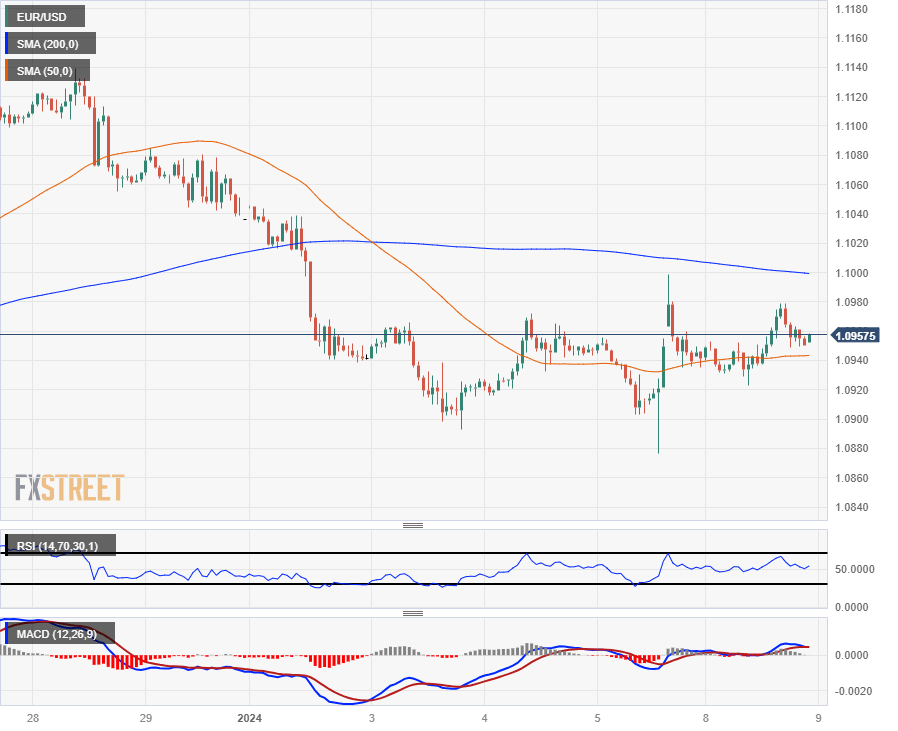
The EUR/USD climbed on Monday, falling just short of 1.0980 before sliding back into 1.0950 in a consolidation pattern that is becoming familiar in the early stages of 2024.

Eurozone Retail Sales for the year through November declined less than expected, falling 1.1% versus the forecast 1.5% decline, compared to October’s YoY figure of -0.8% (revised upwards from -1.2%).

The Eurozone Sentix Investor Confidence index for January rebounded from -16.8 to -15.8, while the Eurozone Consumer Confidence survey index unexpectedly rose from -15.1 to -15.0, versus the market forecast for a steady hold at -15.1.

Eurozone Retail Sales for November also slid exactly as much as investors were expecting, printing at -0.3% compared to October’s print of 0.4% (revised upwards from 0.1%).

Tuesday will see an update on the Eurozone Unemployment Rate for November, which is forecast to hold steady at 6.5%, while broader markets will be focused on Thursday’s upcoming US Consumer Price Index (CPI) inflation print.

Thursday’s US Consumer Price Index (CPI) inflation print is expected to show slight declines in the near-term core figures, but annualized headline inflation continues to prove sticky, with the CPI for the year through December forecast to tick upwards slightly from 3.1% to 3.2%. Core YoY CPI, meanwhile, is forecast to slip from 4% to 3.8%, and December’s MoM Core CPI is expected to hold steady at 0.3%.

Markets will be looking for signs that inflation will continue to ease, with some investor hopefuls looking for an increasing pace in the reduction of price growth, in order to push the Federal Reserve (Fed) into the next rate cutting cycle sooner rather than later.

EUR/USD Technical Outlook

The EUR/USD rose into 1.0980 on Monday, falling just short of the near-term level and sliding back towards 1.0950 as the pair struggles in near-term consolidation. Intraday action continues to get capped under the 200-hour Simple Moving Average (SMA) near the 1.1000 major handle.

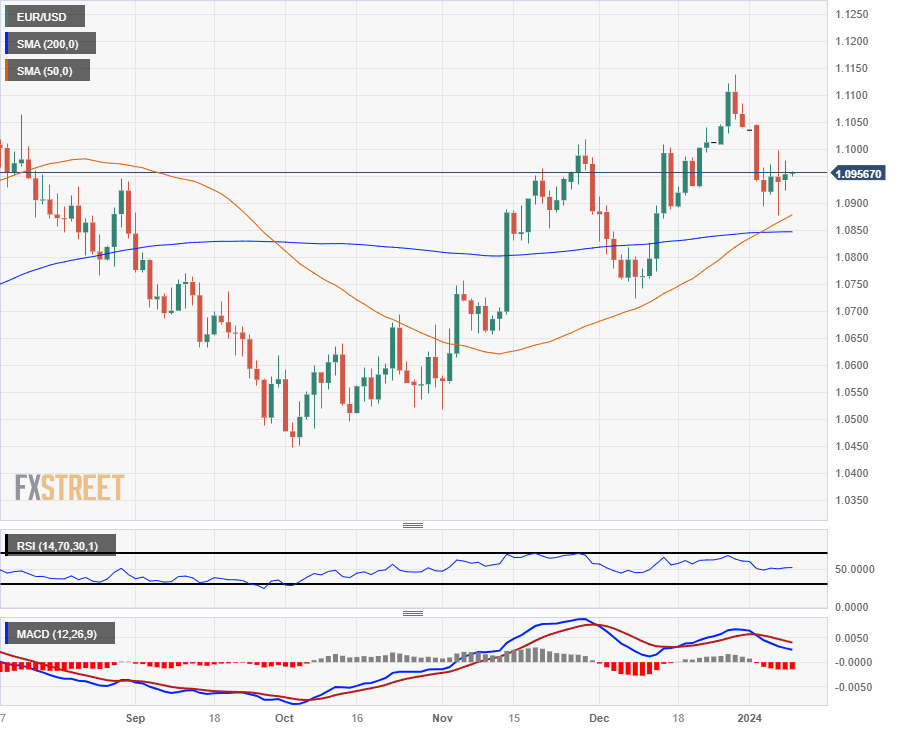
A bullish crossover of the 50-day and 200-day SMAs near 1.0850 is building out a technical floor beneath daily candlesticks, and the near-term ceiling is parked at December’s swing high just shy of 1.1150.

EUR/USD Hourly Chart
EUR/USD Daily Chart
EUR/USD Technical Levels

EUR/USD

Overview
Today last price1.095
Today Daily Change0.0011
Today Daily Change %0.10
Today daily open1.0939
 
Trends
Daily SMA201.0962
Daily SMA501.0865
Daily SMA1001.0762
Daily SMA2001.0847
 
Levels
Previous Daily High1.0998
Previous Daily Low1.0877
Previous Weekly High1.1046
Previous Weekly Low1.0877
Previous Monthly High1.114
Previous Monthly Low1.0724
Daily Fibonacci 38.2%1.0923
Daily Fibonacci 61.8%1.0952
Daily Pivot Point S11.0878
Daily Pivot Point S21.0817
Daily Pivot Point S31.0756
Daily Pivot Point R11.0999
Daily Pivot Point R21.106
Daily Pivot Point R31.1121

Author

Joshua Gibson

Joshua joins the FXStreet team as an Economics and Finance double major from Vancouver Island University with twelve years' experience as an independent trader focusing on technical analysis.


More from Joshua Gibson
Share:

Editor's Picks

AUD/USD hangs close to monthly lows, still defends 0.7100 ahead of Fed decision

AUD/USD retains its negative bias for the third straight day, defending 0.7100 while trading close to a monthly low in Wednesday's Asian session on Wednesday. The US Dollar stands firm near a two-week high as the anticipated Fed rate hike and oil-driven inflation fears continue to push US bond yields to a multi-year high. Furthermore, escalating Middle East tensions benefit the safe-haven buck and weigh on the risk-sensitive Aussie.

USD/JPY holds firm above 155.00, awaits Fed policy announcements

USD/JPY climbs to a fresh one-week high above 155.00 in the Asian session on Wednesday amid a bullish US Dollar. Oil-driven inflation fears, along with the anticipated Fed rate hike, continue to support surging US bond yields. Moreover, rising US-Iran tensions underpin the USD's reserve currency status. The pair, however, remains below the mid-155.00s as bulls seem hesitant ahead of the Fed decision later today and the BoJ meeting, starting on Thursday.

Gold  eases towards $4,300 in the Fed's aftermath

Gold retains intraday gains but eases from its intraday peak following the Federal Reserve's decision to hike rates by 25 bps as expected. The XAU/USD pair briefly surpassed the $4,360 level, now moving closer to the $4,300 mark.

XRP Price Forecast: XRP clings to 50-day EMA support after CLARITY Act setback
Ripple (XRP) trades lower around $1.28 on Wednesday, as investors broadly assess the impact of the failed United States (US) Senate vote on the CLARITY Act and the upcoming Federal Reserve (Fed) monetary decision. The remittance token has trimmed early-week gains that tagged highs around $1.50 on Monday and now holds key moving-average support.
WTI pulls back below $100 as Saudi Arabia steps up efforts to restore Oil flows
West Texas Intermediate (WTI) Oil falls on Wednesday as Saudi Arabia steps up efforts to restore flows through its East-West pipeline, which was damaged by a drone attack last week. The prospect of a partial restart eases some supply concerns in a market already strained by disruptions across the Middle East.
How Japan became the World's Banker and why that era may be ending

Japan's ultra-low interest rates helped finance trillions of dollars in global investments for more than a decade, making the Japanese Yen one of the world’s cheapest sources of funding. With the Bank of Japan expected to tighten policy again this week, that advantage may be entering a new phase. While most major economies raised interest rates, Japan remained the world's outlier.