EUR/USD bounces past 1.0500 post-Payrolls
- EUR/USD keeps the trade around the 1.0500 level on Friday.
- US Non-farm Payrolls came in on the strong side in December.
- The jobless rate ticked lower to 3.5%, bettering consensus.

EUR/USD remains on the defensive near the 1.0500 neighbourhood in the wake of the release of US NFP on Friday.
EUR/USD trims losses post-NFP
EUR/USD saw its downside curtailed after the US economy created 223K jobs during December, leaving behind previous estimates for a gain of 200K jobs. Furthermore, the November reading was revised down to 256K (from 263K).
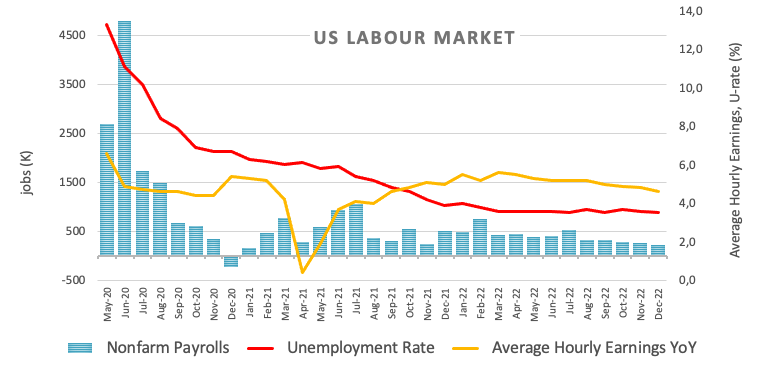
Additional results showed the Unemployment Rate deflating to 3.5% and the key Average Hourly Earnings – a proxy for inflation via wages – increasing at a monthly 0.3% and 4.6% over the last twelve months. Finally, the Participation Rate improved slightly to 62.3% (from 62.2%).
Later in the NA session, the focus of attention should gyrate to the release of Factory Orders and the ISM Non-Manufacturing seconded by speeches by FOMC’s Bostic, Cook and Barkin.
What to look for around EUR
EUR/USD faces some heightened downside near the 1.0500 mark or multi-week lows.
Looking at the broader scenario, the shared currency is expected to closely follow dollar dynamics, the impact of the energy crisis on the region and the Fed-ECB divergence.
Back to the euro area, the increasing speculation of a potential recession in the bloc emerges as an important domestic headwind facing the euro in the short-term horizon.
Key events in the euro area this week: Germany Retail Sales, EMU Flash Inflation Rate, EMU Retail Sales.
Eminent issues on the back boiler: Continuation of the ECB hiking cycle vs. increasing recession risks. Impact of the war in Ukraine and the protracted energy crisis on the region’s growth prospects and inflation outlook. Risks of inflation becoming entrenched.
EUR/USD levels to watch
So far, the pair is losing 0.16% at 1.0504, and the breach of 1.0496 (monthly low January 6) would target 1.0443 (weekly low December 7) en route to 1.0311 (200-day SMA). On the other hand, the next up barrier emerges at 1.0713 (weekly high December 30) ahead of 1.0736 (monthly high December 15) and finally 1.0773 (monthly high June 27).
Author

Pablo Piovano
FXStreet
Born and bred in Argentina, Pablo has been carrying on with his passion for FX markets and trading since his first college years.

















