EUR/USD rallies past 1.1800 with US producer inflation on focus
- EUR/USD rallies to levels past 1.1800 for the first time since the Iran war started.
- Hopes of further peace talks between the US and Iran are boosting risk appetite on Tuesday.
- The focus now shifts to the US PPI data for further insight into the Fed's monetary policy stance.

The Euro (EUR) extends gains against the US Dollar (USD) for the seventh consecutive day on Tuesday. News reports hinting at the possibility of another round of peace talks between the US and Iran have boosted risk appetite, pushing the pair beyond 1.1800, its highest level since the war in the Middle East started late February.
News reports from various sources hint at ongoing contacts between Iran and the US, fuelling speculation about a new round of negotiations between Tehran and Washington. Reuters added to those expectations on Tuesday, reporting that US and Iranian delegations could return to Pakistan to resume peace talks.
Investors' focus will shift now, at least momentarily, to the US Producer Price Index (PPI) figures from March, which are expected to show a similar trend as the consumer price figures seen on Friday: If market expectations are met, they will provide further reasons for Federal Reserve (Fed) hawks to call for higher interest rates.
Earlier on Tuesday, German and Spanish inflation figures confirmed the impact of the war in Iran, ahead of the European Central Bank President, Christine Lagarde’s conference at the IMF meeting later on Tuesday.
Technical Analysis: Bulls aim for the 1.1825 area
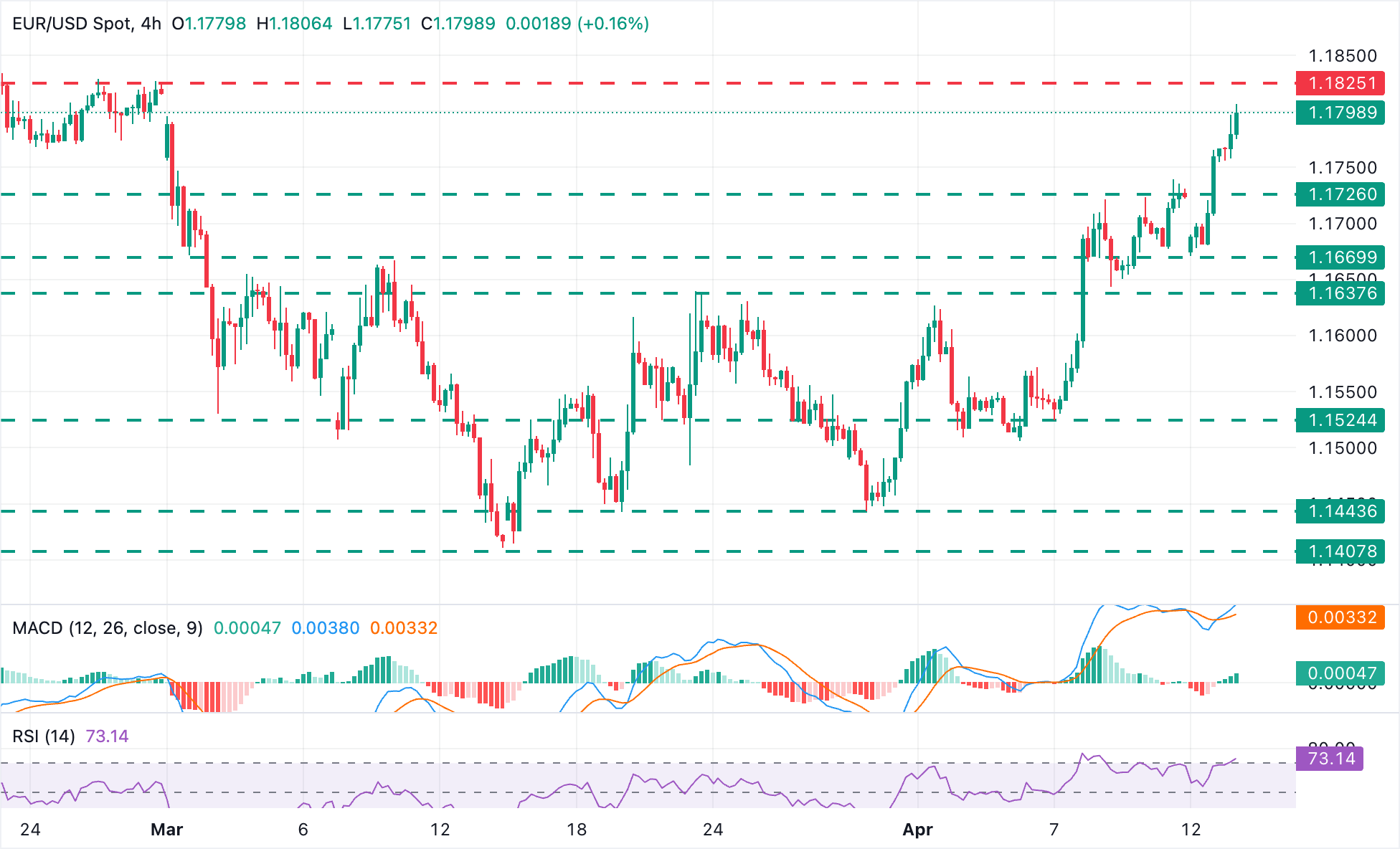
EUR/USD keeps trading higher with technical indicators at positive levels. The 4-hour Moving Average Convergence Divergence (MACD), on the other hand, is showing an expanding positive histogram, revealing persistent buying pressure, although the Relative Strength Index (RSI) has entered overbought territory, which often precedes a bearish correction.
Initial resistance is located at the 1.1825 area, which capped gains on February 26 and 27, and is likely to challenge bulls ahead of the February 9, 10, and 11 highs, around 1.1930.
On the downside, immediate support lies at the previous top, at the 1.1720-1.1730 area, ahead of the April 8 and 9 lows, near 1.1650, and the ascending trendline support from late March lows, now at 1.1610.
(The technical analysis of this story was written with the help of an AI tool.)
Economic Indicator
Producer Price Index (YoY)
The Producer Price Index released by the Bureau of Labor statistics, Department of Labor measures the average changes in prices in primary markets of the US by producers of commodities in all states of processing. Changes in the PPI are widely followed as an indicator of commodity inflation. Generally speaking, a high reading is seen as positive (or bullish) for the USD, whereas a low reading is seen as negative (or bearish).
Read more.Next release: Tue Apr 14, 2026 12:30
Frequency: Monthly
Consensus: 4.6%
Previous: 3.4%
Source: US Bureau of Labor Statistics
Economic Indicator
Producer Price Index ex Food & Energy (YoY)
The Producer Price Index ex Food & energy released by the Bureau of Labor statistics, Department of Labor measures the average changes in prices in primary markets of the US by producers of commodities in all states of processing. Those volatile products such as food and energy are excluded in order to capture an accurate calculation. Generally speaking, a high reading is seen as positive (or bullish) for the USD, whereas a low reading is seen as negative (or bearish).
Read more.Next release: Tue Apr 14, 2026 12:30
Frequency: Monthly
Consensus: 4.2%
Previous: 3.9%
Source: US Bureau of Labor Statistics
Author

Guillermo Alcala
FXStreet
Graduated in Communication Sciences at the Universidad del Pais Vasco and Universiteit van Amsterdam, Guillermo has been working as financial news editor and copywriter in diverse Forex-related firms, like FXStreet and Kantox.