EUR/GBP Price Forecast: Supported by converging SMAs but capped below 0.8750
- EUR/GBP edges lower as diplomatic efforts to end the US–Iran war lift sentiment and support risk-sensitive currencies.
- GBP shows relative strength against the Euro, keeping the cross under pressure near recent highs.
- Technically, EUR/GBP maintains a mildly bullish bias while holding above key moving averages, with RSI and MACD in positive territory.

EUR/GBP trades with a negative bias on Monday as diplomatic efforts to end the US-Iran war lift market sentiment and support risk-sensitive currencies, with the British Pound (GBP) relatively outperforming the Euro (EUR).
At the time of writing, the cross is trading around 0.8720, though it lacks strong follow-through selling and remains confined near the upper end of last week’s range.
According to Axios, the United States and Iran, along with regional mediators, are discussing a potential 45-day ceasefire that could help end the war. Separately, Reuters reported that both sides have received a proposal for a two-step deal, starting with a ceasefire followed by broader negotiations, which could come into effect as early as Monday and include reopening the Strait of Hormuz.
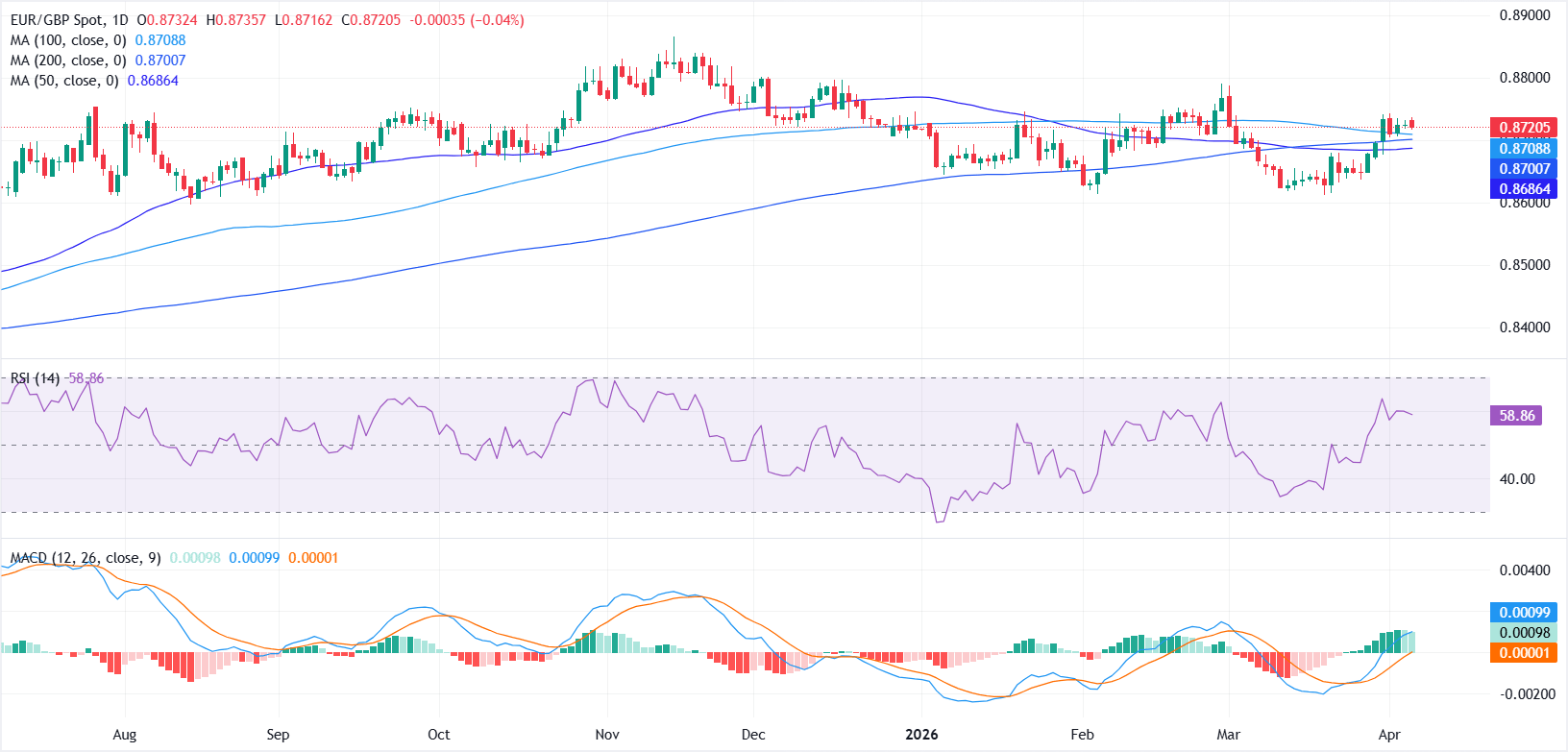
From a technical perspective, EUR/GBP shows a mildly bullish near-term bias as spot holds just above the flat 50-day Simple Moving Average (SMA) near 0.8686, while the 100-day SMA around 0.8709 and the 200-day SMA near 0.8701 converge just below current levels, forming a tentative support cluster that could cap downside attempts.
The Relative Strength Index (RSI) at 59 signals firm but not stretched upside momentum, consistent with a grind higher rather than a sharp breakout. The Moving Average Convergence Divergence (MACD) line stands above the Signal line in marginally positive territory, and the modestly positive histogram reinforces a controlled bullish tone rather than an aggressive trend.
On the upside, immediate resistance is seen at 0.8750, and a break above this level would strengthen the bullish case, opening the door toward the March swing high at 0.8789, close to the 0.8800 psychological mark.
On the downside, initial support is seen in the 0.8686-0.8708 moving average cluster. A break below this zone could weaken the near-term structure and expose the 0.8650 level, with further downside opening toward the 0.8600 psychological mark.
Euro Price Today
The table below shows the percentage change of Euro (EUR) against listed major currencies today. Euro was the strongest against the US Dollar.
| USD | EUR | GBP | JPY | CAD | AUD | NZD | CHF | |
|---|---|---|---|---|---|---|---|---|
| USD | -0.32% | -0.38% | -0.14% | -0.27% | -0.48% | -0.51% | -0.33% | |
| EUR | 0.32% | -0.04% | 0.15% | 0.05% | -0.17% | -0.21% | -0.03% | |
| GBP | 0.38% | 0.04% | 0.19% | 0.07% | -0.12% | -0.18% | 0.03% | |
| JPY | 0.14% | -0.15% | -0.19% | -0.11% | -0.34% | -0.39% | -0.20% | |
| CAD | 0.27% | -0.05% | -0.07% | 0.11% | -0.20% | -0.24% | -0.06% | |
| AUD | 0.48% | 0.17% | 0.12% | 0.34% | 0.20% | -0.06% | 0.15% | |
| NZD | 0.51% | 0.21% | 0.18% | 0.39% | 0.24% | 0.06% | 0.21% | |
| CHF | 0.33% | 0.03% | -0.03% | 0.20% | 0.06% | -0.15% | -0.21% |
The heat map shows percentage changes of major currencies against each other. The base currency is picked from the left column, while the quote currency is picked from the top row. For example, if you pick the Euro from the left column and move along the horizontal line to the US Dollar, the percentage change displayed in the box will represent EUR (base)/USD (quote).
Author

Vishal Chaturvedi
FXStreet
I am a macro-focused research analyst with over four years of experience covering forex and commodities market. I enjoy breaking down complex economic trends and turning them into clear, actionable insights that help traders stay ahead of the curve.