EUR/CHF weakens as Euro slides on 'unbalanced' transatlantic deal
- The Euro comes under broad pressure amid skepticism surrounding the weekend’s US‑EU trade pact.
- Markets see the deal as economically skewed in favor of the United States, increasing long-term pressure on European export sectors.
- France’s Prime Minister calls the deal an act of “submission,” while the Trade Minister warns Europe must not settle for “being less than an economic power.”

The Euro (EUR) weakens against the Swiss Franc (CHF) on Monday as markets assess the broader implications of the newly announced US‑EU trade framework. The Euro is under broad pressure, as investors view the deal as one-sided and economically burdensome for the European Union (EU).
The EUR/CHF cross extends its intraday descent during the American trading hours, pressured by persistent Euro weakness and steady demand for the Swiss Franc. At the time of writing, the pair is hovering around 0.9315, down nearly 0.22% on the day.
The agreement, announced Sunday following talks between US President Donald Trump and European Commission President Ursula von der Leyen, imposes a flat 15% tariff on a wide range of EU exports, replacing the previously threatened 30% levy. In return, the EU has committed to purchasing $250 billion in US liquefied natural gas (LNG) annually, totaling roughly $750 billion over three years. The deal also outlines a $600 billion EU investment package in the US, focusing on strategic sectors such as clean energy, defense equipment, and manufacturing. However, the agreement leaves existing steel and aluminum tariffs at 50%, officials hinted that a quota-based system could replace them in future negotiations.
While the deal helped avoid an immediate trade war, many fear it could hurt the long-term competitiveness of major European industries. The agreement has already sparked criticism within the EU, especially from France, adding to market uncertainty.
French Prime Minister François Bayrou described the agreement as an act of “submission” and a “dark day for Europe,” warning that the EU’s long-term sovereignty and economic leverage may have been compromised. Trade Minister Laurent Saint-Martin told FranceInter radio on Monday that he did not want Paris “to settle with what happened yesterday because that would be accepting that Europe is not an economic power.” “This deal is not balanced, so we will have to keep working,” he said.
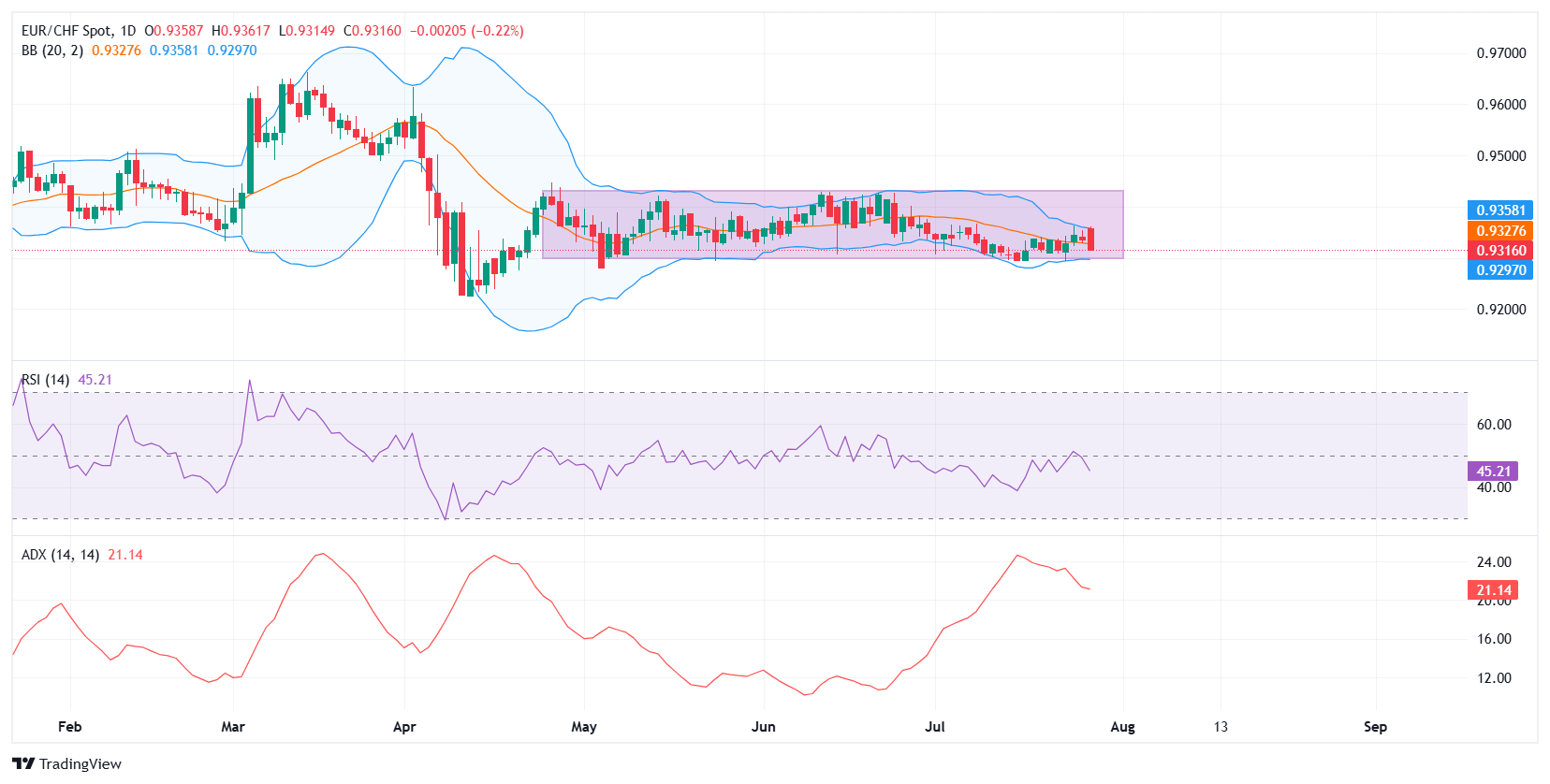
From a technical perspective, EUR/CHF is edging lower, trading around 0.9316, as bearish momentum resurfaces following a rejection near the upper Bollinger Band at 0.9358. Despite the modest decline, the broader trend remains muted, reflecting the pair’s prolonged period of consolidation.
On a wider perspective, EUR/CHF has been stuck in a narrow range between 0.9430 and 0.9300 since late April, unable to sustain directional momentum in either direction. Repeated attempts to break above the 0.9430 ceiling have failed, while dips toward the 0.9300 floor have consistently found buyers. Bollinger Bands are compressing, a sign of declining volatility and potential for an eventual breakout. The Relative Strength Index (RSI) stands at 45.84, showing a slight bearish tilt without entering oversold territory, while the Average Directional Index (ADX) at 21.14 signals weak trend strength, in line with the range-bound structure.
A sustained break below the 0.9300 support level would mark a bearish shift, potentially exposing downside levels around 0.9250. On the flip side, a bounce from current levels and a close above the 20-day Simple Moving Average (SMA), which also serves as the middle Bollinger Band, could see the cross reattempt the upper range boundary near 0.9430, with the next resistance seen at the psychological 0.9500 level.
Euro FAQs
The Euro is the currency for the 19 European Union countries that belong to the Eurozone. It is the second most heavily traded currency in the world behind the US Dollar. In 2022, it accounted for 31% of all foreign exchange transactions, with an average daily turnover of over $2.2 trillion a day. EUR/USD is the most heavily traded currency pair in the world, accounting for an estimated 30% off all transactions, followed by EUR/JPY (4%), EUR/GBP (3%) and EUR/AUD (2%).
The European Central Bank (ECB) in Frankfurt, Germany, is the reserve bank for the Eurozone. The ECB sets interest rates and manages monetary policy. The ECB’s primary mandate is to maintain price stability, which means either controlling inflation or stimulating growth. Its primary tool is the raising or lowering of interest rates. Relatively high interest rates – or the expectation of higher rates – will usually benefit the Euro and vice versa. The ECB Governing Council makes monetary policy decisions at meetings held eight times a year. Decisions are made by heads of the Eurozone national banks and six permanent members, including the President of the ECB, Christine Lagarde.
Eurozone inflation data, measured by the Harmonized Index of Consumer Prices (HICP), is an important econometric for the Euro. If inflation rises more than expected, especially if above the ECB’s 2% target, it obliges the ECB to raise interest rates to bring it back under control. Relatively high interest rates compared to its counterparts will usually benefit the Euro, as it makes the region more attractive as a place for global investors to park their money.
Data releases gauge the health of the economy and can impact on the Euro. Indicators such as GDP, Manufacturing and Services PMIs, employment, and consumer sentiment surveys can all influence the direction of the single currency. A strong economy is good for the Euro. Not only does it attract more foreign investment but it may encourage the ECB to put up interest rates, which will directly strengthen the Euro. Otherwise, if economic data is weak, the Euro is likely to fall. Economic data for the four largest economies in the euro area (Germany, France, Italy and Spain) are especially significant, as they account for 75% of the Eurozone’s economy.
Another significant data release for the Euro is the Trade Balance. This indicator measures the difference between what a country earns from its exports and what it spends on imports over a given period. If a country produces highly sought after exports then its currency will gain in value purely from the extra demand created from foreign buyers seeking to purchase these goods. Therefore, a positive net Trade Balance strengthens a currency and vice versa for a negative balance.
Author

Vishal Chaturvedi
FXStreet
I am a macro-focused research analyst with over four years of experience covering forex and commodities market. I enjoy breaking down complex economic trends and turning them into clear, actionable insights that help traders stay ahead of the curve.