|

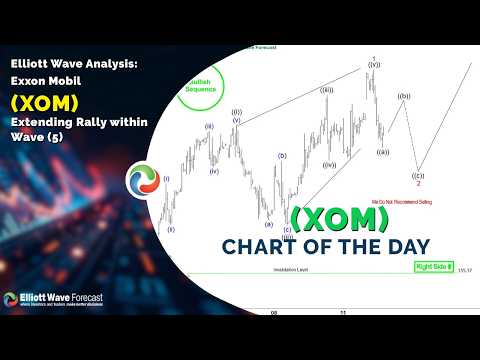
Elliott Wave analysis: Exxon Mobil (XOM) extending rally within wave (5) [Video]

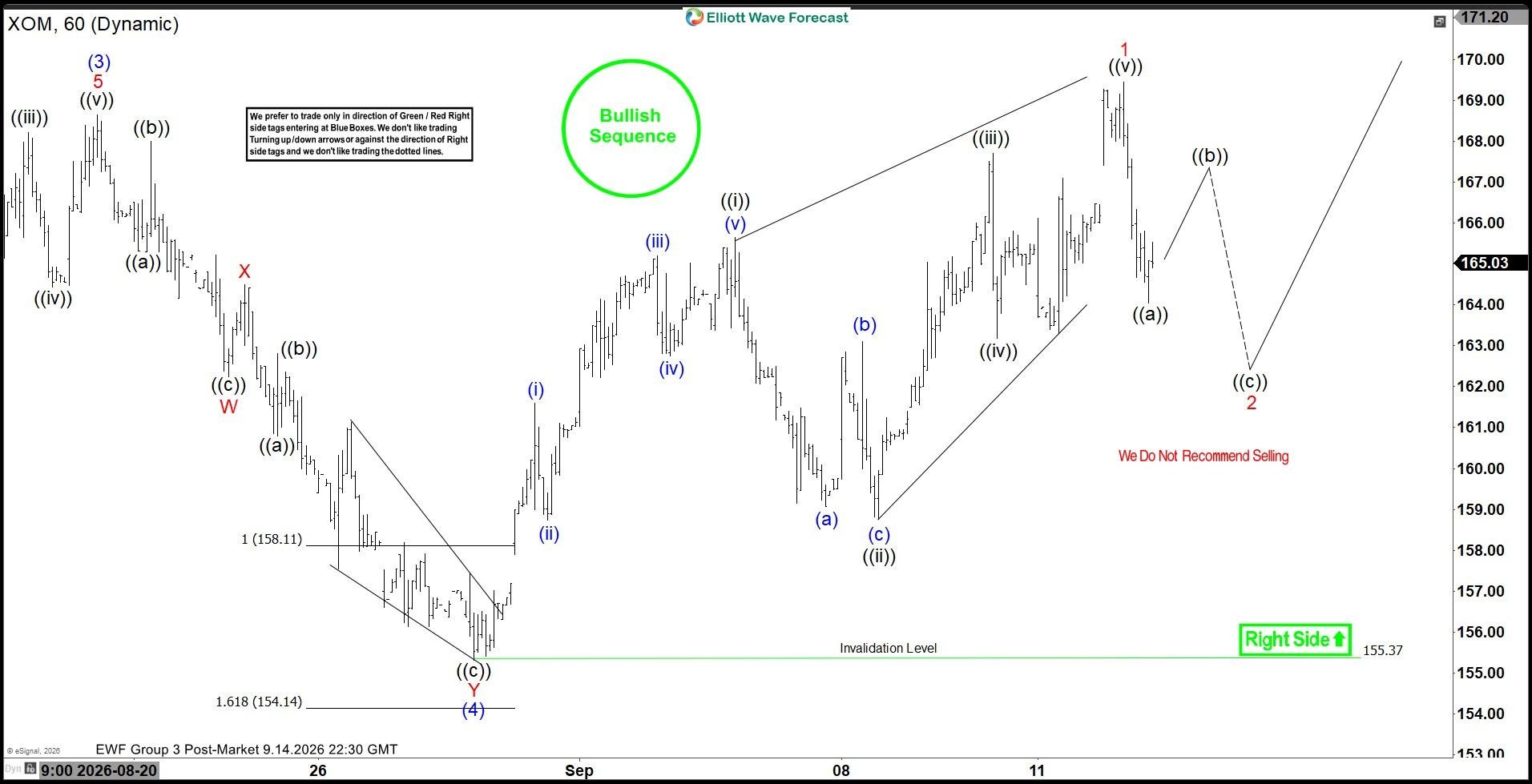
The short‑term Elliott Wave outlook for Exxon Mobil (XOM) indicates that the rally from the June 25, 2026 low is unfolding as a five‑wave diagonal. From that point, wave (1) concluded at $159.42, followed by a corrective pullback in wave (2) that ended at $149.09. The stock then advanced in wave (3), reaching $168.64. The subsequent pullback in wave (4) developed as a double three structure, with wave W finishing at $162.25, wave X rallying to $165.40, and wave Y declining to $155.37. This sequence completed wave (4) at a higher degree.

The advance has since resumed in wave (5). Within this leg, the rally unfolded as a diagonal. Wave ((i)) ended at $165.65, while the dip in wave ((ii)) terminated at $158.75. The third wave, ((iii)), carried prices higher to $167.70, before a modest pullback in wave ((iv)) concluded at $163.18. The final push in wave ((v)) reached $169.45, thereby completing wave 1 of a higher degree. At present, expectations favor a corrective pullback in wave 2. This retracement is anticipated to correct the cycle from the August 28, 2026 low, likely unfolding in either three or seven swings before the rally resumes.

Exxon Mobil 60-minute Elliott Wave chart
Chart

XOM Elliott Wave [Video]

Youtube preview

Author

Elliott Wave Forecast Team

Elliott Wave Forecast Team

ElliottWave-Forecast.com

More from Elliott Wave Forecast Team
Share:

Editor's Picks

AUD/USD flatlines near 0.6965 as less hawkish RBA counters USD weakness

AUD/USD holds steady above a two-week low, trading near 0.6965 in the Asian session on Wednesday as early midterm election results heighten political uncertainty and weigh heavily on the US Dollar. Moreover, reviving safe-haven demand triggers a fresh leg down in US bond yields, offsetting Fed hike bets and exerting additional pressure on the buck. However, a less hawkish RBA caps the Aussie.

USD/JPY declines below 158.00 as USD weakens on midterm election results

USD/JPY comes under heavy selling pressure on Wednesday, dropping below 158.00 during the Asian session as the US Dollar slumps to a one-month low amid heightened political uncertainty after early US midterm vote counts. Moreover, the prospect of gridlock in Washington drives safe-haven flows, triggering a fresh leg down in US bond yields and further weighing on the buck.

Gold continues scaling new weekly highs; eyes $4,050 as US sticks to elections-led losses

Gold builds on its strong intraday move up, hitting a series of new weekly tops, and climbing back close to the $4,050 level during the first half of the European session amid a broadly weaker US Dollar. Democrats’ wins in the House and Senate raise the prospect of gridlock in Washington. Moreover, heightened political uncertainty drove investors to safe-haven assets, exerting some downward pressure on US bond yields. This is seen weighing on the Greenback and supporting the precious metal.

Bitcoin tests critical support, Ethereum struggles below resistance, XRP extends losses
Bitcoin (BTC), Ethereum (ETH) and Ripple (XRP) remain under pressure on Wednesday as bearish momentum continues to weigh on prices. BTC approaches key support around $76,466, and a decisive close below could open the door to deeper losses. Meanwhile, ETH struggles below key resistance while XRP faces rejection at the upper trendline of a falling channel pattern, all hinting at deeper losses.
ADP Employment Report expected to show slower job growth in October

The Automatic Data Processing Research Institute is due to release October’s private-sector employment report on Wednesday. The market consensus anticipates a moderate slowdown in job creation, with the ADP Employment Change expected to show 69K new private jobs in October, down from 90K in September.

The 2% inflation target came from a throwaway remark. It now moves trillions
The Federal Reserve's 2% inflation goal grew out of an off-the-cuff remark by a New Zealand politician in 1988. Bond investors still price long-term US debt as if 2% holds, so a change in how the Fed measures inflation would move markets.