Earnings: Tesla’s Robotaxi underwhelms as Google continues to spend big on AI
Tesla and Google were the earnings highlights on Wednesday night, and the two companies had very different stories to tell the market. At Tesla they are tightening their belts, while Google is still on a large AI splurge.
Starting with Tesla, it reported weaker than expected revenue, earnings per share and net income. Revenue was $22.49bn, while net income was $1.39bn. Gross profit margin was slightly higher than Q1 at 17.2%; however, free cash flow tumbled and fell to $146mn, down from $664mn in Q1, and it is down some 89% compared to a year ago.
Tesla sold 384,122 vehicles in Q2, vs 443,956 a year ago, as sales of its cyber truck were a flop. Lower vehicle sales does not bode well for demand for the new model Y, and sales of model Ys were down 12% compared to a year ago, although this is better than declines for some of its other vehicles. The company said that production of its newest vehicles are on track to be ready for sale in 2025, however these will most likely be a Q4 story, and details about the new models was not offered.
Other highlights in this earnings report included the cut to capex spending for 2025, this has been reduced to $9bn from $10bn in Q1. The 10% drop suggests that the company is focused on turning around its fortunes, as it focuses on getting the fundamentals back on track. If sales are falling, then there needs to be cuts elsewhere, this is a sensible approach and could be welcomed by investors.
In the past, Tesla has been a key beneficiary of regulatory credit revenue, as it sells its credits on. However, this rich source of revenue could be drying up. Tesla’s sales of these credits has slowed sharply and weighed on revenue in Q2. It generated $439mn in regulatory credit revenue last quarter, down from $595mn in Q1. There are fears this could fall even further and be nonexistent by 2027. Tesla also said that the President’s spending bill and tariffs could hurt demand later this year.
Robotaxi plans underwhelm
Although Elon Musk said that he was working on a new master plan for Tesla, the stock price slipped in after-market trading and was down 3.7%. Part of the decline in the share price was due to news about the Robotaxi, which underwhelmed investors. There was no clear indication that the company has boosted the fleet size of the Robotaxi, or expanded their reach from Austin Texas, although the company has big ambitions. It aims for Robotaxis to reach half of the US population this year.
There is concern about how much revenue will be generated by Robotaxis, as Musk hinted on the earnings call, Robotaxis will be less of a standalone business and more of an advertising platform for all of Tesla’s self-driving AI technologies. This seems like a different proposition for what the market was expecting, and it could be a tough day ahead for Tesla’s share price.
Alphabet: The AI race is ongoing
Alphabet also reported earnings tonight, and it topped analyst estimates. Revenue for last quarter was $81.72bn, analysts had been looking for $79.59bn, earnings per share was $2.80, vs. $2.57 and gross profit margin was also higher than Q1, at 59.5%. Net income was lower than Q1, and the company announced a significant boost to capital spending, citing growing demand for its cloud products and services. This is a $10bn increase on the previous estimate for 2025 capital spending.
Google’s AI spending is not coming to an end any time soon, the CEO also said that capital spending would rise in 2026, although he did not provide a number to go with this estimate. The question is, will this investment pay off?
2025 was seen as a key test for the AI trade, since this is when investors wanted to see AI investment start to pay off. However, Google’s earnings suggest that we are getting a boost to revenue growth, but there is also a boost to investment. The costly AI build out is not over yet.
Google’s cloud computing department posted revenue of $13.6bn, with operating income of $2.83 bn, which beat analyst estimates. Google is in an AI race and is currently in third place in the cloud computing market, behind Microsoft and Amazon. Thus, it needs to continue to spend to keep up with its peers. While investors have been impressed with Google’s flagship AI product, Gemini, it continues to trail ChatGPT, which has a significantly larger user base than Gemini.
Google also said that it is able to retain top AI talent, after some of its peers started offering huge sign on bonuses to attract the world’s top AI talent. Thus, its ambitions are clear: Google wants to be a top AI player, and it is not happy with its current third position in the Cloud space.
While the stock is higher by 1.8% in after-market trading in the US, there are concerns about the future for Google, and whether all of this investment will pay off. Google was the weakest performer in the Magnificent 7 today, and it is the third weakest performer so far this year. Although the stock price is higher by 14% in the past month, it is still down 0.22% YTD. Companies like Google who are in the process of infusing their products with AI are not dominating the AI trade, because of the huge costs involved. Today’s earnings report is unlikely to move the dial for Google’s share price, and it may continue to underperform some of its Magnificent 7 peers for the foreseeable future.
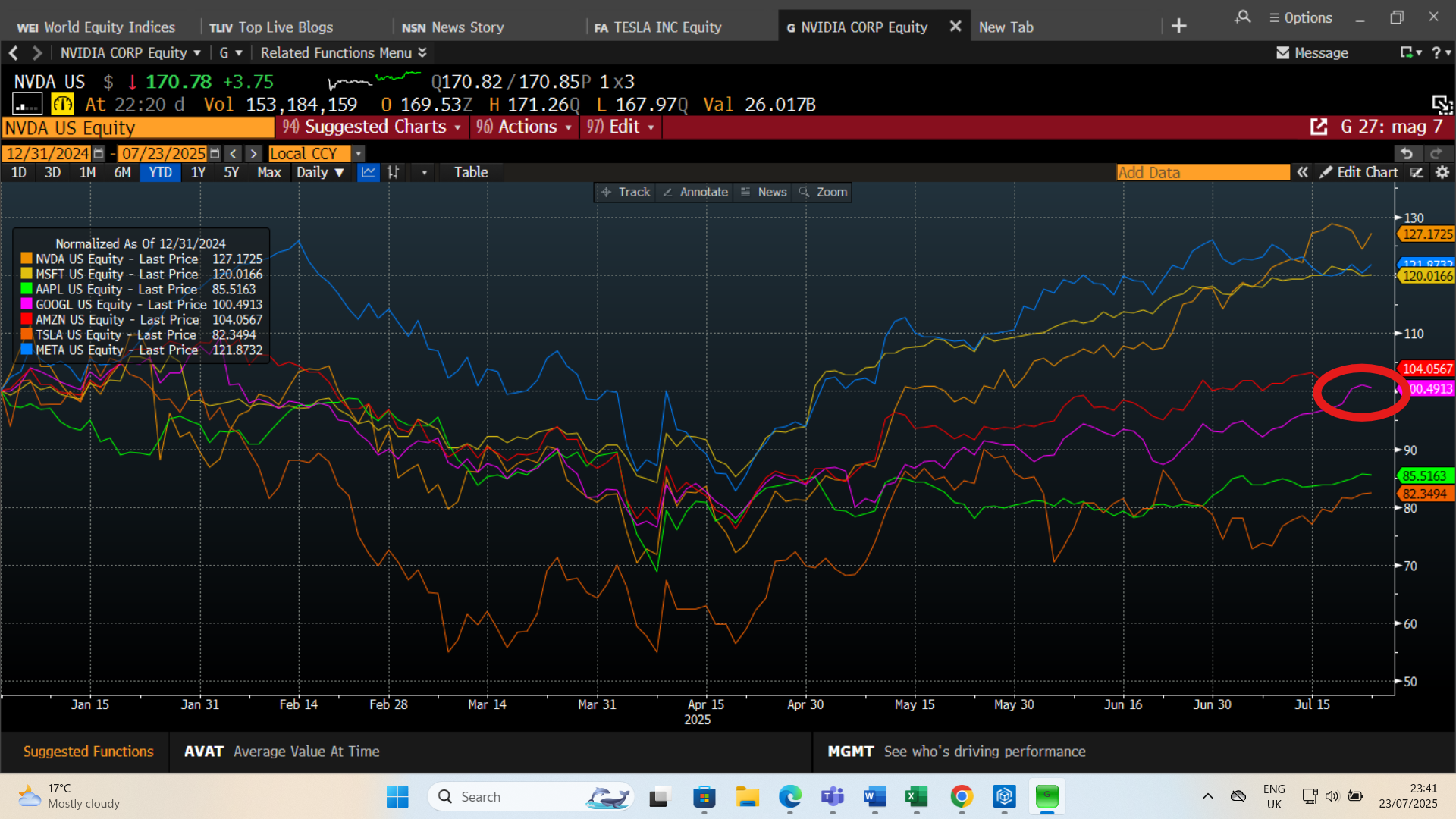
Chart 1: The Magnificent 7, 12-month chart. Source: Bloomberg and XTB
Luckily for Google, its bread-and-butter business is doing well. Youtube’s advertising revenue beat estimates and came in at $9.8bn. Its search advertising business also performed well. However, investors may question whether these strong parts of the business are being used to fund its AI ambitions at ever growing costs.
Legal wrangle is existential threat to Google
There are also still questions about Alphabet’s future. Next month a Federal judge in the US is expected to rule on whether Alphabet is maintaining illegal monopolies in search and some advertising technologies. If the company is found guilty, then it faces being broken up. If this happens, then it is hard to know how its AI plans would work, and whether they would need to be rapidly scaled back. Thus, we could see some caution creep into Google’s stock price as we lead up to this ruling.
Author

Kathleen Brooks
XTB UK
Kathleen has nearly 15 years’ experience working with some of the leading retail trading and investment companies in the City of London.