Dow Jones Industrial Average reverses as Iran deal hopes hit hard reality
- DJIA gives up early gains, slipping back below 50,000 as Iran ceasefire optimism wavers.
- S&P 500 taps a fresh intraday record before fading into the red, with Russell 2000 down nearly 1%.
- Crude Oil briefly tests below $90 a barrel as Iran's response is awaited, then trims losses.
- Initial jobless claims undershoot expectations at 200K, setting the stage for Friday's jobs report.

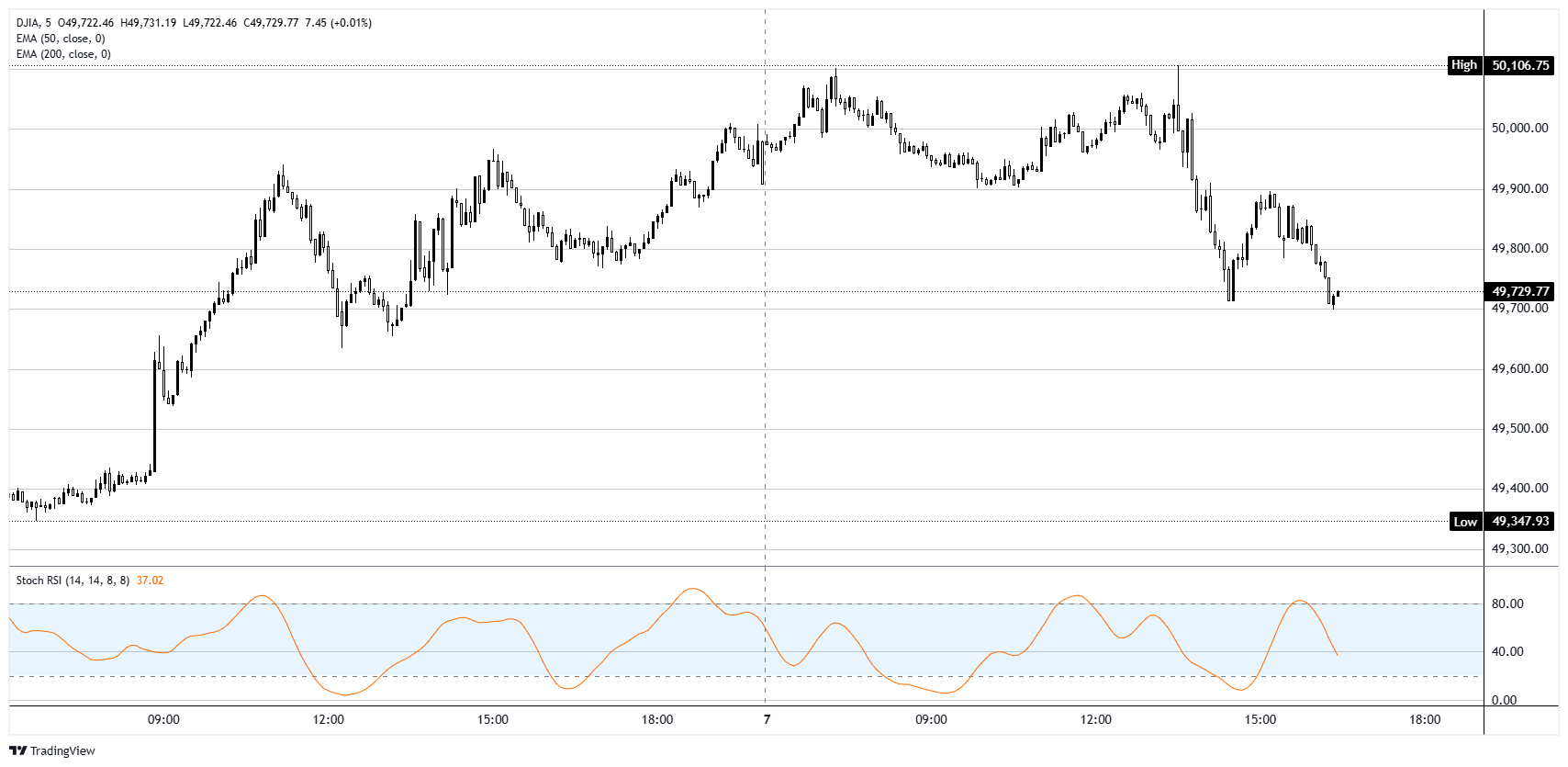
The Dow Jones Industrial Average (DJIA) was off around 0.4% in Thursday's early afternoon trade, sliding back below 50,000 after tagging an intraday high near 50,100. The S&P 500 tapped a fresh all-time intraday high before reversing to trade lower by roughly 0.3%, while the Nasdaq Composite held a much smaller loss as megacap tech offered a partial offset. Small caps fared worst, with the Russell 2000 down close to 1%. The session captured a familiar pattern of late, namely hope-based bids running into the harder edges of an unresolved geopolitical backdrop, with traders unwilling to chase records into the close.
Hope versus reality on Iran
The catalyst for the early bid was the same one that has powered most of the past week's gains, namely reports that Iran is reviewing a 14-point US proposal and is expected to deliver its response via Pakistani mediators on Thursday. The framework, a one-page memorandum, would declare an end to the war and trigger a 30-day window to negotiate the harder questions of nuclear enrichment, frozen Iranian assets, and security in the Strait of Hormuz. President Donald Trump described "very good talks" overnight, yet the same Trump warned earlier this week of strikes "at a much higher level and intensity" if Iran fails to deliver. Iran, for its part, has tied any further progress to the lifting of the US naval blockade, while its Islamic Revolutionary Guard Corps continues to insist that passage through the Strait of Hormuz is governed by Iranian "new procedures". Equities priced the headline; the substance remains conspicuously unresolved.
Crude tests $90 as the Strait stays contested
Oil futures spent much of the session lower, with West Texas Intermediate (WTI) briefly slipping below $90 a barrel before paring losses as equity sentiment soured. Brent traded near $100. The pullback reflects the same trade as equities, that is, front-running a deal, but the physical reality lags the narrative. Maersk this week confirmed that one of its US-flagged vessels transited the Strait of Hormuz under US Navy escort, but the broader Project Freedom escort operation has been paused. Iran continues to claim regulatory authority over the waterway, the US blockade remains in place, and US gasoline at the pump is still tracking near $4.54 a gallon, the highest since 2022. The market is treating the Oil slide as a discount on a deal that has not yet been delivered.
Earnings winners offset the macro pull
Single-stock earnings did some of the heavy lifting on the upside. Fortinet (FTNT) jumped roughly 15% after lifting its full-year billings and revenue guidance, easing concerns that artificial intelligence (AI) is hollowing out the cybersecurity software stack. DoorDash (DASH) added close to 10% after a Q1 beat and an upbeat Q2 order outlook. McDonald's (MCD) gained around 3% after Q1 earnings of $2.83 a share topped consensus, with the value-meal push continuing to drive traffic. Tapestry (TPR), the Coach parent, climbed about 3% after a fiscal Q3 beat and a third upward revision to its annual outlook this year. AppLovin (APP) added a more modest 4% on its own Q1 beat after a brutal first quarter for the stock. Apple (AAPL) also briefly tagged a fresh all-time intraday high before easing back.
Earnings losers and the AI supply problem
The losers told a more cautionary story. Arm Holdings (ARM) fell roughly 7% despite topping fiscal Q4 estimates, after the company flagged that it has not yet secured chip supply capacity to meet around $1 billion in incremental demand tied to its new AGI CPU. Demand, in other words, is outrunning the physical infrastructure required to deliver it. Whirlpool (WHR) slid sharply on a Q1 miss and a dividend suspension, while Shake Shack (SHAK) tumbled close to 19% on its own first-quarter miss. Zillow (Z) fell around 5% after softer-than-expected residential revenue, and IonQ (IONQ) dropped more than 8% on a wider EBITDA loss.
Jobless claims set up Friday's NFP
On the data front, Initial Jobless Claims came in at 200K for the week ended May 2, below the 205K consensus, with continuing claims easing to 1.766 million. First-quarter productivity rose just 0.8% versus a 1.1% estimate, while unit labor costs ran at 2.3%, a touch hotter than expected. The Challenger report showed April job cut announcements jumping roughly 38% YoY, with the AI-driven layoff theme dominant in tech. The composite picture is consistent with a labor market that is cooling but not breaking, which sets a reasonably high bar for Friday's Nonfarm Payrolls (NFP) print. Consensus is for a soft 62K versus 178K prior, with the Unemployment Rate seen holding at 4.3%. A material downside miss would force the market to confront a second source of reality beyond the Iran narrative, namely whether Federal Reserve (Fed) hawkishness, with Collins and Hammack both flagged hawkish in today's speeches, can survive a meaningfully weaker jobs print.
Dow Jones Industrial Average
Dow Jones FAQs
The Dow Jones Industrial Average, one of the oldest stock market indices in the world, is compiled of the 30 most traded stocks in the US. The index is price-weighted rather than weighted by capitalization. It is calculated by summing the prices of the constituent stocks and dividing them by a factor, currently 0.152. The index was founded by Charles Dow, who also founded the Wall Street Journal. In later years it has been criticized for not being broadly representative enough because it only tracks 30 conglomerates, unlike broader indices such as the S&P 500.
Many different factors drive the Dow Jones Industrial Average (DJIA). The aggregate performance of the component companies revealed in quarterly company earnings reports is the main one. US and global macroeconomic data also contributes as it impacts on investor sentiment. The level of interest rates, set by the Federal Reserve (Fed), also influences the DJIA as it affects the cost of credit, on which many corporations are heavily reliant. Therefore, inflation can be a major driver as well as other metrics which impact the Fed decisions.
Dow Theory is a method for identifying the primary trend of the stock market developed by Charles Dow. A key step is to compare the direction of the Dow Jones Industrial Average (DJIA) and the Dow Jones Transportation Average (DJTA) and only follow trends where both are moving in the same direction. Volume is a confirmatory criteria. The theory uses elements of peak and trough analysis. Dow’s theory posits three trend phases: accumulation, when smart money starts buying or selling; public participation, when the wider public joins in; and distribution, when the smart money exits.
There are a number of ways to trade the DJIA. One is to use ETFs which allow investors to trade the DJIA as a single security, rather than having to buy shares in all 30 constituent companies. A leading example is the SPDR Dow Jones Industrial Average ETF (DIA). DJIA futures contracts enable traders to speculate on the future value of the index and Options provide the right, but not the obligation, to buy or sell the index at a predetermined price in the future. Mutual funds enable investors to buy a share of a diversified portfolio of DJIA stocks thus providing exposure to the overall index.
Author

Joshua Gibson
FXStreet
Joshua joins the FXStreet team as an Economics and Finance double major from Vancouver Island University with twelve years' experience as an independent trader focusing on technical analysis.