Dow Jones Industrial Average keeps sliding as yields climb on a strong PMI
- DJIA slides toward 51,500 as the 10-year yield hits its highest since 2007.
- Flash composite PMI jumps to 58.4 from 56 in August.
- Futures price up to four more Fed hikes by mid-2027.

The strongest S&P Global flash Purchasing Managers Index (PMI) readings since 2021 have done nothing for the Dow Jones Industrial Average. Manufacturing came in at 57 against a 53.5 forecast and services at 58.7 against 56. The index trades near 51,500 with about two-thirds of its June-to-August rally gone. Its 30 companies sell into the economy the survey describes, and the index is worth less on news that the economy is growing faster.
McDonald's (MCD) is the index's biggest faller on company news, after an investor day that committed $8.5 billion to franchisee support through 2036. The S&P 500 and NASDAQ Composite are lower as well, so the rest of the selling is market-wide rather than one company's.
October hike odds went from under one in ten in August to nearly three in four
The same survey put its price gauges at their highest since October 2022, and the 10-year Treasury yield climbed above 5% to its highest since July 2007. Fed Governor Barr then said further rate increases are likely to be needed because inflation isn't clearly heading back to the 2% target. He made the case for higher borrowing costs at a Chicago Fed conference on housing affordability.
The Fed raised its rate to 3.75-4.00% on September 16, its first increase since July 2023, and decides again on October 28. Rate futures make 4.75-5.00% the most likely setting by July 2027, four more quarter-point increases, and no meeting through the end of 2027 has a cut as its most likely result. Home Depot (HD) and Sherwin-Williams (SHW) sell into a housing market that borrows at rates priced off the 10-year yield.
Governor Barr puts the AI boom on the inflation list
Governor Barr counted the boom in artificial intelligence (AI) investment among the forces pushing prices up, alongside tariffs and the war in the Middle East. The same spending took the NASDAQ Composite to a record close on Tuesday, and the Dow Jones Industrial Average fell that day.
Cleveland Fed President Hammack, who votes on rates this year, speaks on Thursday at 12:50 GMT and Friday at 18:00 GMT. Friday's University of Michigan (UoM) survey at 14:00 GMT is forecast to show consumers expecting 4.6% inflation over the next year, more than twice the 2% the Fed is raising rates to reach.
Levels and bias
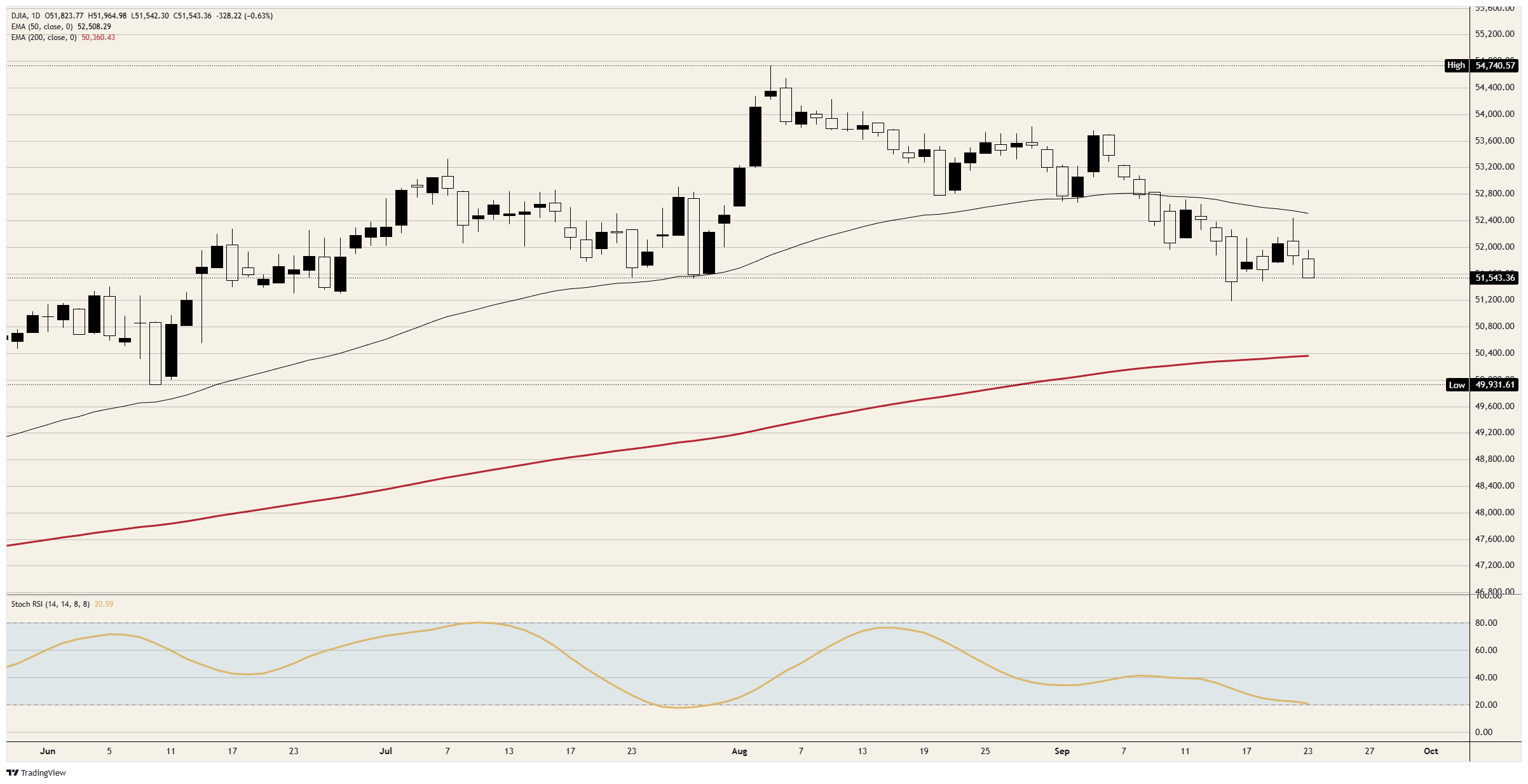
Resistance: Wednesday's high just under 52,000 is the first cap. Above it, the 50-day Exponential Moving Average (EMA) near 52,500 has capped every bounce since early September, Tuesday's high just above 52,400 included.
Support: 51,500 is the first floor, with the session low just above it and the September 18 low just under it. Below that, the September 16 low near 51,200 is the lowest since June.
Bias: The lean is short below 52,000, with the September 16 low near 51,200 as the first objective and the 51,000 handle as the second. The daily Stochastic Relative Strength Index (Stoch RSI) is near 21 and still falling, just above the 20 line that marks an oversold reading. A daily close back above 52,000 ends the short case.
Dow Jones daily chart
Dow Jones FAQs
The Dow Jones Industrial Average, one of the oldest stock market indices in the world, is compiled of the 30 most traded stocks in the US. The index is price-weighted rather than weighted by capitalization. It is calculated by summing the prices of the constituent stocks and dividing them by a factor, currently 0.152. The index was founded by Charles Dow, who also founded the Wall Street Journal. In later years it has been criticized for not being broadly representative enough because it only tracks 30 conglomerates, unlike broader indices such as the S&P 500.
Many different factors drive the Dow Jones Industrial Average (DJIA). The aggregate performance of the component companies revealed in quarterly company earnings reports is the main one. US and global macroeconomic data also contributes as it impacts on investor sentiment. The level of interest rates, set by the Federal Reserve (Fed), also influences the DJIA as it affects the cost of credit, on which many corporations are heavily reliant. Therefore, inflation can be a major driver as well as other metrics which impact the Fed decisions.
Dow Theory is a method for identifying the primary trend of the stock market developed by Charles Dow. A key step is to compare the direction of the Dow Jones Industrial Average (DJIA) and the Dow Jones Transportation Average (DJTA) and only follow trends where both are moving in the same direction. Volume is a confirmatory criteria. The theory uses elements of peak and trough analysis. Dow’s theory posits three trend phases: accumulation, when smart money starts buying or selling; public participation, when the wider public joins in; and distribution, when the smart money exits.
There are a number of ways to trade the DJIA. One is to use ETFs which allow investors to trade the DJIA as a single security, rather than having to buy shares in all 30 constituent companies. A leading example is the SPDR Dow Jones Industrial Average ETF (DIA). DJIA futures contracts enable traders to speculate on the future value of the index and Options provide the right, but not the obligation, to buy or sell the index at a predetermined price in the future. Mutual funds enable investors to buy a share of a diversified portfolio of DJIA stocks thus providing exposure to the overall index.
Author

Joshua Gibson
FXStreet
Joshua joins the FXStreet team as an Economics and Finance double major from Vancouver Island University with twelve years' experience as an independent trader focusing on technical analysis.

















