Dow Jones Industrial Average futures recover from weekend plunge, barely
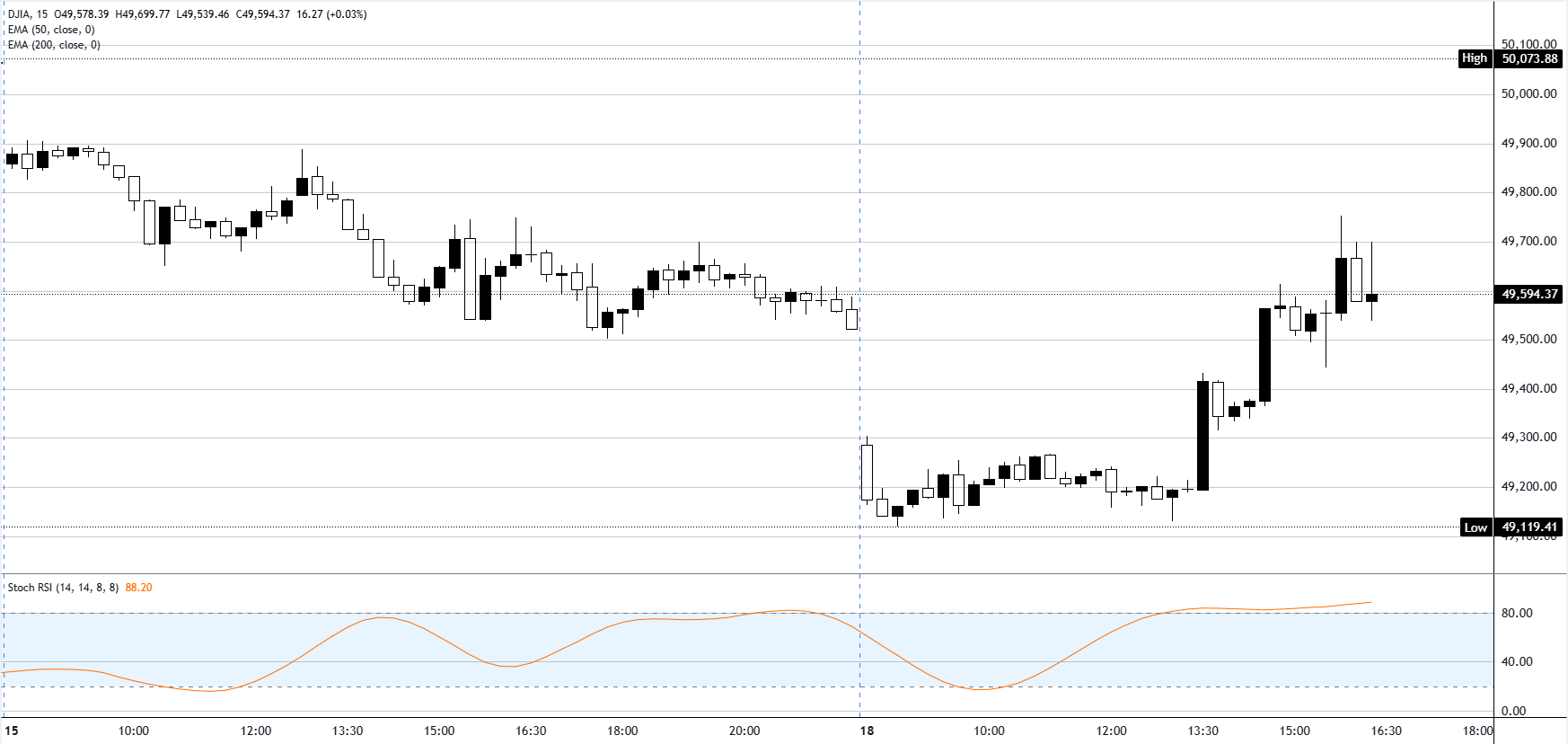
- DJIA futures recovered from session lows above 49,000 to trade close to Friday's closing levels by mid-afternoon.
- Memory chip stocks led declines after Seagate said new factories would "take too long" to meet demand.
- Brent crude held above $109 a barrel as US-Iran peace negotiations remained deadlocked.
- Thursday's flash Purchasing Managers Index releases are the only high-impact US data this week.

Dow Jones Industrial Average (DJIA) futures clawed back from a weekend-driven plunge on Monday, recovering from session lows above 49,000 to trade close to Friday's closing levels by mid-afternoon. The bounce came despite a backdrop of higher Oil prices, elevated sovereign bond yields, and unresolved US-Iran tensions. The S&P 500 and Nasdaq Composite, which both hit fresh record highs last week before Friday's sharp pullback, attempted similar recoveries but remained capped well below their recent peaks. Friday's selloff, driven by a global spike in long-end bond yields, has left investors more cautious heading into a relatively light week of US economic data, with Thursday's flash Purchasing Managers Index (PMI) releases the only meaningful high-impact print on the calendar.
Memory chips lead the early selling
Memory chip stocks led Monday's declines after Seagate (STX) tumbled 7% following comments from its CEO at a JPMorgan conference that new factories would "take too long" to come online. The remark exacerbated concerns that the memory chip industry doesn't have the capacity to meet soaring demand, pulling peer Micron (MU) down 2%. The Nasdaq-100 has been particularly vulnerable to the yield-driven repricing, with the index dropping 1.5% on Friday for its worst one-day performance since late March. Tech leadership, which had driven the broader market to fresh records last week, is now being tested by both rate dynamics and stock-specific supply concerns.
Oil and global yields keep pressure on
Oil prices extended gains as the US-Iran standoff continued to dominate the energy market. West Texas Intermediate (WTI) climbed 0.5% to trade above $105 a barrel, while Brent crude added 0.5% to hold near $109. The persistent bid in crude is reinforcing the inflation narrative, with the 30-year US Treasury yield hitting its highest level in around a year on Friday before holding largely steady on Monday. Long-end yields globally have moved in tandem, with the UK 30-year gilt at levels not seen since the late 1990s and long-dated Japanese government bonds also under pressure. The combination of higher Oil and higher yields is squeezing valuations in long-duration sectors, with mega-cap tech the most obvious casualty.
Iran tensions keep the geopolitical risk premium intact
US President Donald Trump kept the geopolitical temperature high on Sunday, warning that Iran had to "get moving" or "there won't be anything left." Peace negotiations remain deadlocked, with Axios reporting that Iran has submitted an updated peace proposal that the US still considers inadequate. The standoff has kept Oil prices supported and the Strait of Hormuz risk premium intact. Ben Fulton, CEO of WEBs Investments, told CNBC that elevated Oil prices represent a "watershed" issue that will be hard to offset, adding that stocks could remain stuck in a heavy range trade without positive developments out of the Middle East.
Thursday PMIs the main event in a quiet data week
The US economic data calendar is unusually light this week, leaving Thursday's flash PMI releases as the only meaningful catalyst for the broader macro tape. Manufacturing PMI consensus sits at 53.8 against a 54.5 prior, while Services PMI is expected at 51.3 versus 51 prior. The Composite reading will be closely watched as a real-time gauge of whether the energy-driven inflation pass-through is starting to weigh on activity. Outside of the PMIs, traders will track a steady stream of Federal Reserve (Fed) speakers including Christopher Waller on both Tuesday and Friday, plus the release of the Federal Open Market Committee (FOMC) minutes on Wednesday. Friday's University of Michigan (UoM) consumer survey will draw attention for its one-year and five-year inflation expectations components, with last week's hot inflation data already making near-term Fed rate cuts a long shot.
Dow Jones 15-minute chart
Dow Jones FAQs
The Dow Jones Industrial Average, one of the oldest stock market indices in the world, is compiled of the 30 most traded stocks in the US. The index is price-weighted rather than weighted by capitalization. It is calculated by summing the prices of the constituent stocks and dividing them by a factor, currently 0.152. The index was founded by Charles Dow, who also founded the Wall Street Journal. In later years it has been criticized for not being broadly representative enough because it only tracks 30 conglomerates, unlike broader indices such as the S&P 500.
Many different factors drive the Dow Jones Industrial Average (DJIA). The aggregate performance of the component companies revealed in quarterly company earnings reports is the main one. US and global macroeconomic data also contributes as it impacts on investor sentiment. The level of interest rates, set by the Federal Reserve (Fed), also influences the DJIA as it affects the cost of credit, on which many corporations are heavily reliant. Therefore, inflation can be a major driver as well as other metrics which impact the Fed decisions.
Dow Theory is a method for identifying the primary trend of the stock market developed by Charles Dow. A key step is to compare the direction of the Dow Jones Industrial Average (DJIA) and the Dow Jones Transportation Average (DJTA) and only follow trends where both are moving in the same direction. Volume is a confirmatory criteria. The theory uses elements of peak and trough analysis. Dow’s theory posits three trend phases: accumulation, when smart money starts buying or selling; public participation, when the wider public joins in; and distribution, when the smart money exits.
There are a number of ways to trade the DJIA. One is to use ETFs which allow investors to trade the DJIA as a single security, rather than having to buy shares in all 30 constituent companies. A leading example is the SPDR Dow Jones Industrial Average ETF (DIA). DJIA futures contracts enable traders to speculate on the future value of the index and Options provide the right, but not the obligation, to buy or sell the index at a predetermined price in the future. Mutual funds enable investors to buy a share of a diversified portfolio of DJIA stocks thus providing exposure to the overall index.
Author

Joshua Gibson
FXStreet
Joshua joins the FXStreet team as an Economics and Finance double major from Vancouver Island University with twelve years' experience as an independent trader focusing on technical analysis.