Detroit strikes back: Why legacy automakers are rewriting the EV story (TSLA vs FORD)

This week in Flip The Market, Versus Trade looks at Tesla vs Ford and the changing economics behind the electric vehicle race.
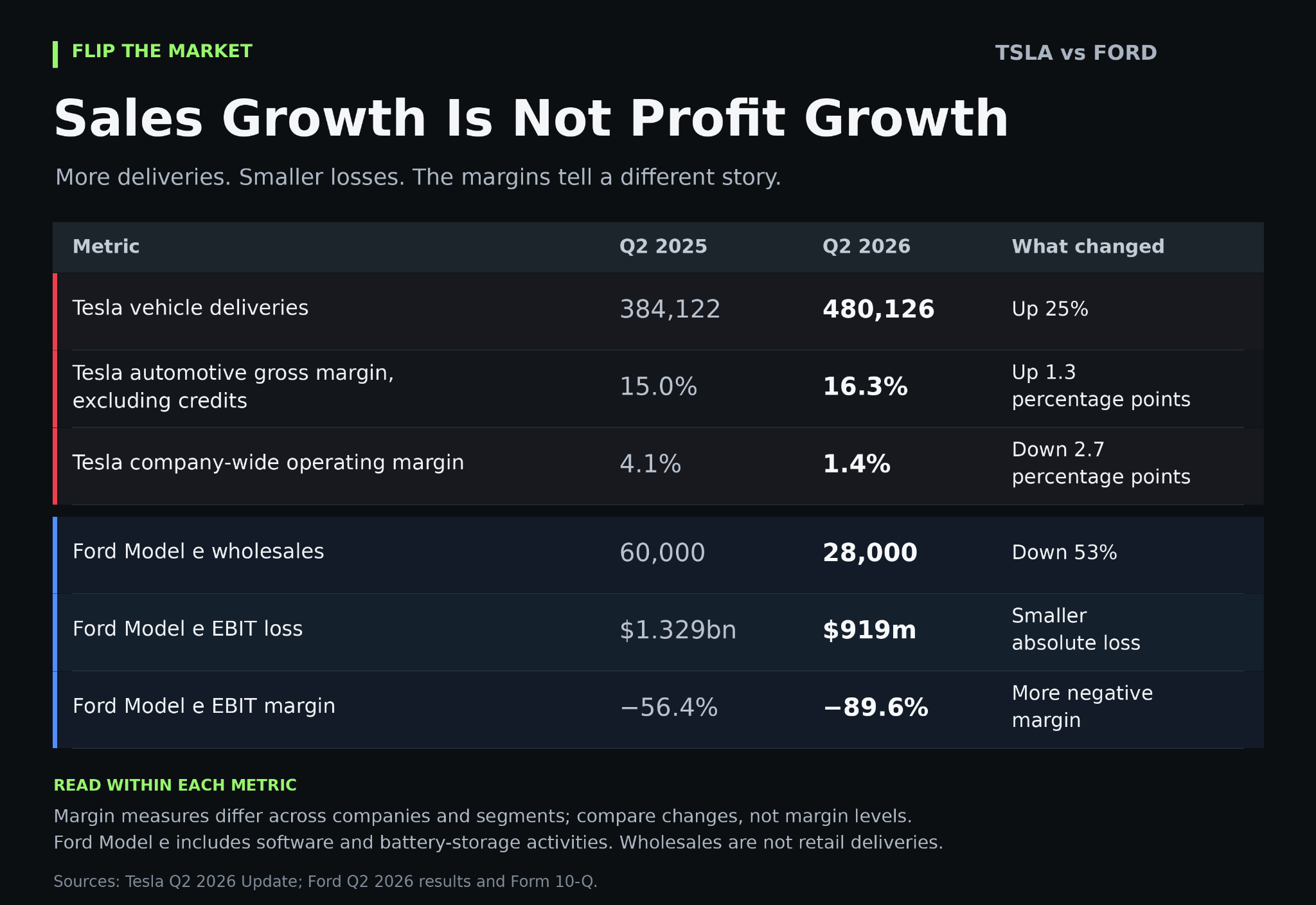
Tesla delivered more cars in Q2 2026, yet operating profit fell. Ford's Model E segment narrowed its losses while reporting lower wholesale volumes. The familiar Tesla vs legacy automakers story misses that contrast. Expanding sales and earning enough to finance the next generation of vehicles are different achievements.
Detroit's strongest argument is the established businesses supporting an expensive transition. EV profitability remains unsolved, but Ford's other segments carry the load.
Tesla automotive margins show the limits of volume
Tesla delivered 480,126 vehicles in Q2, up 25% year over year. Automotive gross margin excluding regulatory credits reached 16.3%, above 15.0% a year earlier but below 19.2% in Q1. Company-wide operating margin fell to 1.4%. Lower selling prices, including model mix, higher operating expenses, and reduced regulatory-credit revenue weighed on earnings.
The EV price war makes cost savings less straightforward. Lower electric vehicle production costs create room for discounts, but savings passed to buyers do not remain in margins.
The impact of EV price cuts on margins depends on costs falling faster than realized prices. Better EV manufacturing efficiency can make competitive pricing affordable. It cannot guarantee demand or stronger electric vehicle profit margins.
Ford EV strategy starts with what already makes money
Ford Model E profitability remains a turnaround story. Its Q2 EBIT loss narrowed to $919 million from $1.33 billion, while wholesales fell 53%. Its EBIT margin deteriorated to minus 89.6%. Model e also includes software and stationary battery-storage activities, so its result is not a pure measure of vehicle profitability.
Ford Blue and Ford Pro generated $1.1 billion and $1.7 billion in EBIT, respectively. These profits support the broader investment case, although EBIT is not cash flow, and Pro includes electric vehicles. Ford still posted a $1.3 billion net loss, including a large, predominantly noncash battery joint-venture exit charge.
How Tesla vs Ford Manufacturing plays out on the factory floor
The Tesla vs Ford manufacturing contest also reaches the factory floor. In August, Ford put the expected net assembly-speed improvement for its forthcoming Fathom pickup at 15% versus Louisville's previous products. That accounts for time reinvested in insourcing and automation. That's still a company projection. It's not a proven advantage over Tesla.
Tesla vs Ford free cash flow needs a longer view
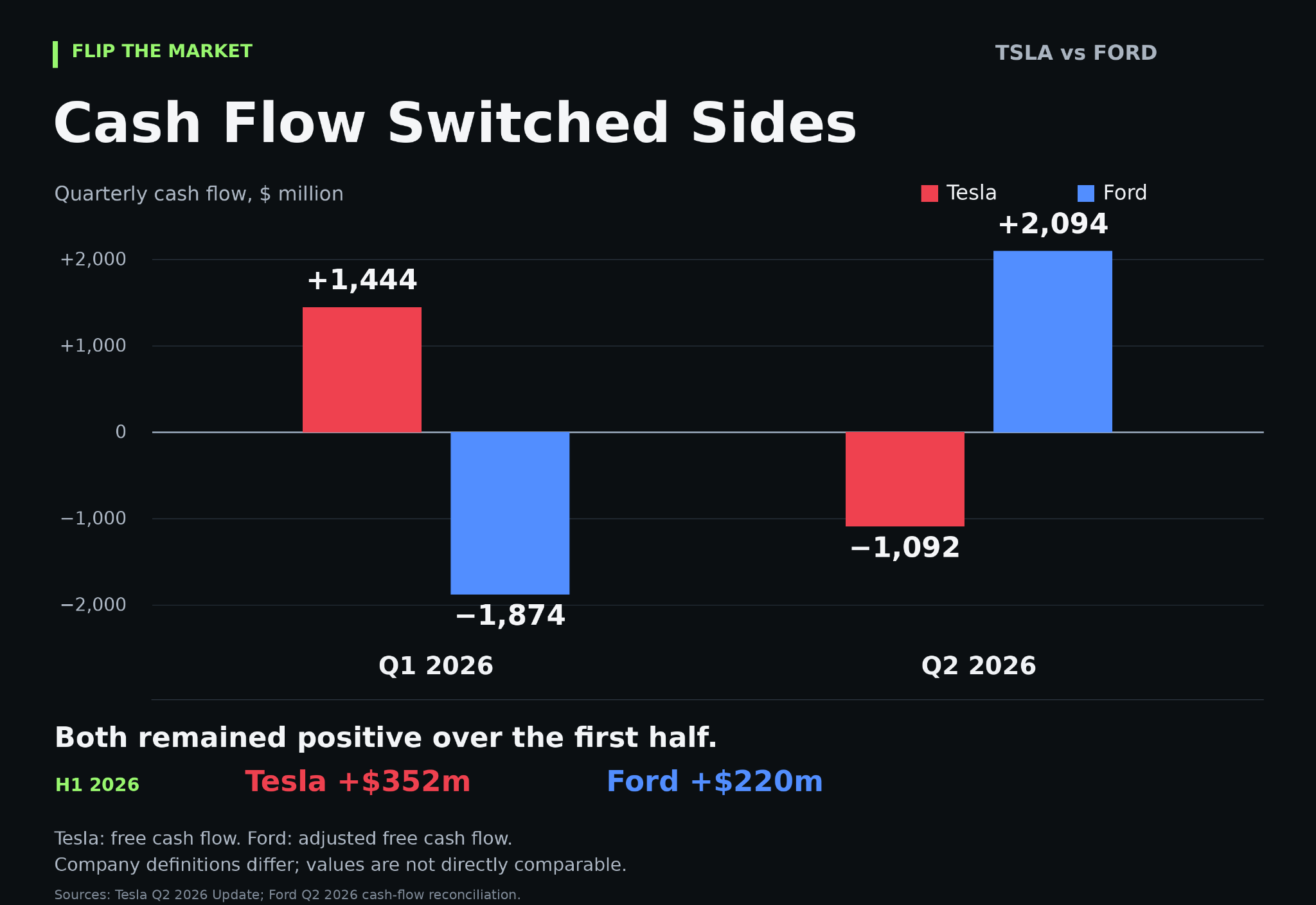
Ford generated $2.1 billion in adjusted free cash flow in Q2, but only $220 million across the first half. Tesla produced $4.7 billion in quarterly operating cash flow and spent $5.8 billion on capex, leaving negative FCF of $1.1 billion. Its first-half FCF nevertheless remained positive at $352 million.
These measures differ. Ford excludes Ford Credit's operating cash flows while including distributions from that business and other adjustments. One quarter cannot establish a durable cash-generation lead.
For legacy automakers' cash flow, the attraction is the ability to support investment through established operations. The weakness is cyclicality. So the Tesla vs Ford profitability debate includes both the cost of expansion and the resilience of the businesses funding it.
TSLA vs Ford: The next test is execution
The Tesla vs Ford valuation debate rests on which expectations become earnings. The case for Ford stock vs Tesla stock strengthens if its production reset delivers repeatable cash generation. Tesla could outperform if autonomy and energy growth justify its investment burden.
Comparing EV stocks vs traditional auto stocks means looking at two different economic problems. Legacy automakers' electric vehicles still need viable economics. For Tesla, higher deliveries must produce more than another spending cycle.
The Versus Pairs TSLA vs Ford contest is a challenge to the assumption that the company growing fastest necessarily creates the most value.
Through Versus Trade TSLA vs. Ford, Detroit's opportunity lies in making the transition less expensive. The EV race isn't won yet, and Detroit doesn't need to claim it is.
The Tesla vs. Ford comparison comes down to execution. When you put TSLA vs F side by side, the answer depends on which company turns plans into repeatable cash.
Author

Amir Razak
Versus Trade
Malaysian-born market analyst Amir Razak cuts through the noise every week, breaking down Versus Pairs and explaining what is really driving one asset ahead of another.