Crude Oil prices a deal the White House calls a lie
- Iranian state media's claim of a 14-point MOU framework on the Strait of Hormuz drove a sharp selloff in both Crude benchmarks.
- The White House publicly denied the report as a fabrication, leaving traders positioned for a deal Washington won't confirm exists.
- EIA inventory data is delayed to Thursday following the Memorial Day shift, the next near-term catalyst.

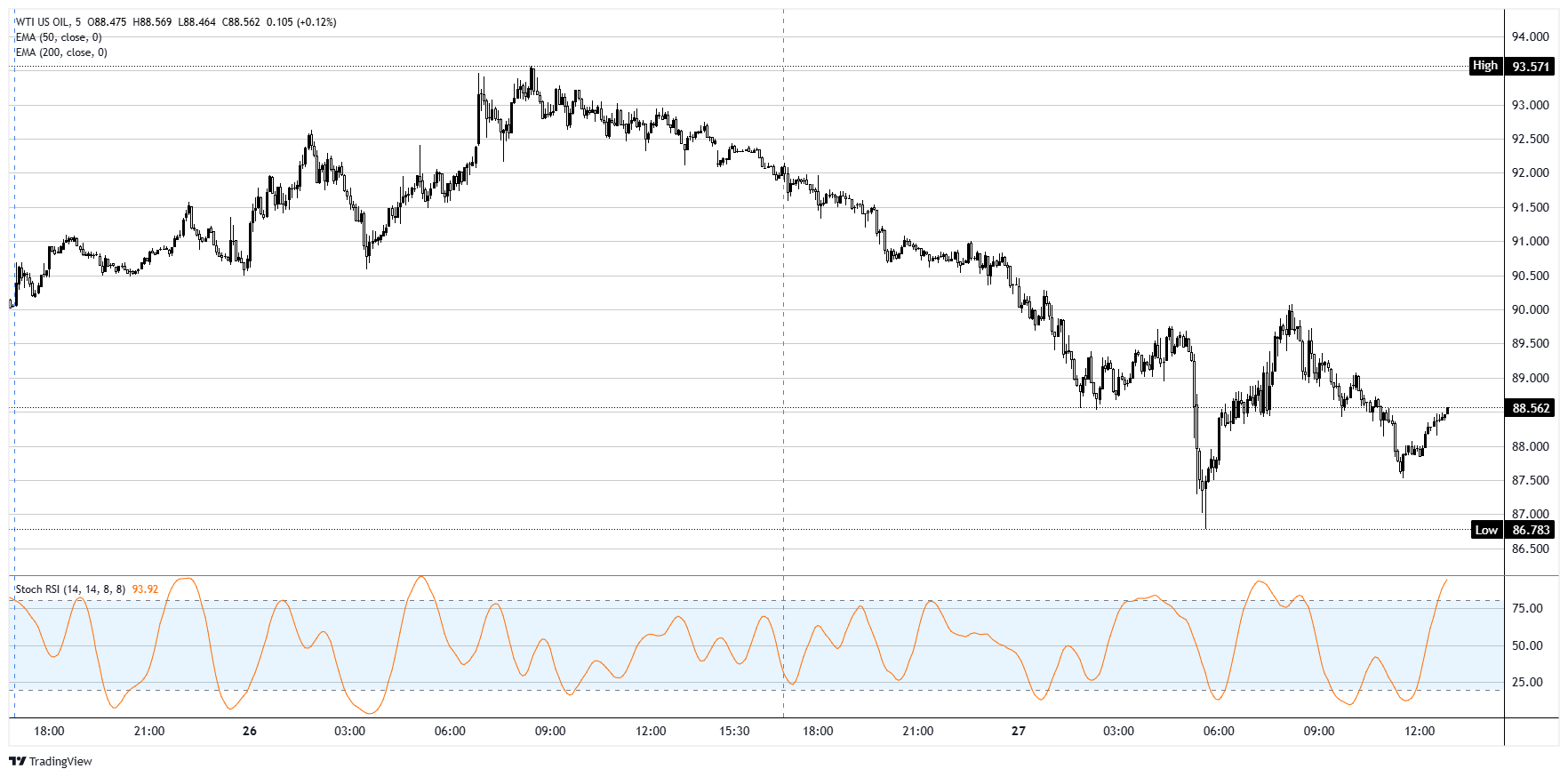
Iran's state broadcaster said Wednesday that Tehran had received an initial draft of a 14-point Memorandum of Understanding (MOU) framework with the United States, one that would reopen the Strait of Hormuz, lift the US naval blockade on Iranian ports, and pull US forces back from Iranian territory. Within hours the White House posted on X calling the report untrue and the MOU itself a complete fabrication. Crude markets, predictably, sold the headline and ignored the denial. Brent shed roughly 3% to trade close to $93.00 a barrel, while West Texas Intermediate (WTI) dropped nearly 4% to around $90.00. The market has decided peace is imminent. The principals to that peace can't agree the document exists.
A framework that can't be verified
The optimism is curious. Even by the most generous reading of the leaked terms, the MOU is a one-page outline that defers every difficult question, particularly Iranian nuclear enrichment, to a 60-day negotiation window. Tehran's media is framing the document as American capitulation. Washington insists no such document is binding. The two sides haven't reached an MOU, they're arguing about whether one was even drafted. Pricing a war's end on that basis isn't analysis, it's hope.
The plumbing won't reopen overnight
Even granting that a deal materializes this week, the Strait of Hormuz doesn't simply reopen the day a memo is signed. Iran has mined the strait, and de-mining is measured in weeks. Tankers trapped in port need to evacuate. The US would have to lift its blockade in coordinated stages. The International Energy Agency's latest read shows global oil stocks drew by roughly 250 million barrels across March and April, with OECD on-land inventories alone plummeting by 146 million barrels in April. The supply side cannot be repaired in a fortnight. Today's price action treats it like it can.
Brent leans on its rising daily 200 EMA
The technical picture reflects what the fundamentals don't quite justify. Brent has retraced almost the entirety of its May rally, trading near $93.00 against the daily 50 EMA close to $98.00 and a rising 200 EMA around $82.00. That lower line aligns roughly with where prices traded before the conflict escalated in late February, marking the cleaner structural floor for a full premium unwind. A break beneath the $92.00 handle on a daily close opens the door to a faster move toward the high $80s. To the upside, the $96.50 zone and the $100.00 handle stand as obvious resistance, levels that any reignition of strikes would clear quickly. Stoch RSI is rolling off oversold on the intraday chart, hinting at a near-term technical bounce, but daily momentum remains decisively bearish.
Trading framework
Directional bias leans lower while the peace narrative holds, but the asymmetry favors fading the selloff into structural support rather than chasing it. A daily close above $96.50 invalidates the bearish read and reopens $100.00. A break of $92.00 targets the high $80s. Treat any further framework "leak" or counter-denial as an intraday catalyst. Headlines, not technicals, will set the next leg.
EIA inventories, Thursday's print
The Energy Information Administration (EIA) Weekly Petroleum Status Report is delayed to Thursday at 14:30 GMT this week following the Memorial Day holiday shift. Last week's release showed US commercial crude inventories drawing by 1.3 million barrels, with stocks roughly 4% below the five-year average. A larger draw amid the supply disruption would offer a brief bid, though any print will likely be overwhelmed by the next headline out of the US-Iran channel.
WTI 5-minute chart
WTI Oil FAQs
WTI Oil is a type of Crude Oil sold on international markets. The WTI stands for West Texas Intermediate, one of three major types including Brent and Dubai Crude. WTI is also referred to as “light” and “sweet” because of its relatively low gravity and sulfur content respectively. It is considered a high quality Oil that is easily refined. It is sourced in the United States and distributed via the Cushing hub, which is considered “The Pipeline Crossroads of the World”. It is a benchmark for the Oil market and WTI price is frequently quoted in the media.
Like all assets, supply and demand are the key drivers of WTI Oil price. As such, global growth can be a driver of increased demand and vice versa for weak global growth. Political instability, wars, and sanctions can disrupt supply and impact prices. The decisions of OPEC, a group of major Oil-producing countries, is another key driver of price. The value of the US Dollar influences the price of WTI Crude Oil, since Oil is predominantly traded in US Dollars, thus a weaker US Dollar can make Oil more affordable and vice versa.
The weekly Oil inventory reports published by the American Petroleum Institute (API) and the Energy Information Agency (EIA) impact the price of WTI Oil. Changes in inventories reflect fluctuating supply and demand. If the data shows a drop in inventories it can indicate increased demand, pushing up Oil price. Higher inventories can reflect increased supply, pushing down prices. API’s report is published every Tuesday and EIA’s the day after. Their results are usually similar, falling within 1% of each other 75% of the time. The EIA data is considered more reliable, since it is a government agency.
OPEC (Organization of the Petroleum Exporting Countries) is a group of 12 Oil-producing nations who collectively decide production quotas for member countries at twice-yearly meetings. Their decisions often impact WTI Oil prices. When OPEC decides to lower quotas, it can tighten supply, pushing up Oil prices. When OPEC increases production, it has the opposite effect. OPEC+ refers to an expanded group that includes ten extra non-OPEC members, the most notable of which is Russia.
Author

Joshua Gibson
FXStreet
Joshua joins the FXStreet team as an Economics and Finance double major from Vancouver Island University with twelve years' experience as an independent trader focusing on technical analysis.
















