|

Copper (HG #F) continues to favor more upside near term

Copper futures (HG #F) continue to trade within a bullish Elliott Wave structure, with price maintaining an incomplete three-swing sequence from the 6.2820 low. The current rally remains constructive, suggesting buyers are still in control. As long as Copper holds above the 6.2820 invalidation level, the path of least resistance remains to the upside. The broader Elliott Wave structure continues to favor higher prices before a larger corrective pullback develops.

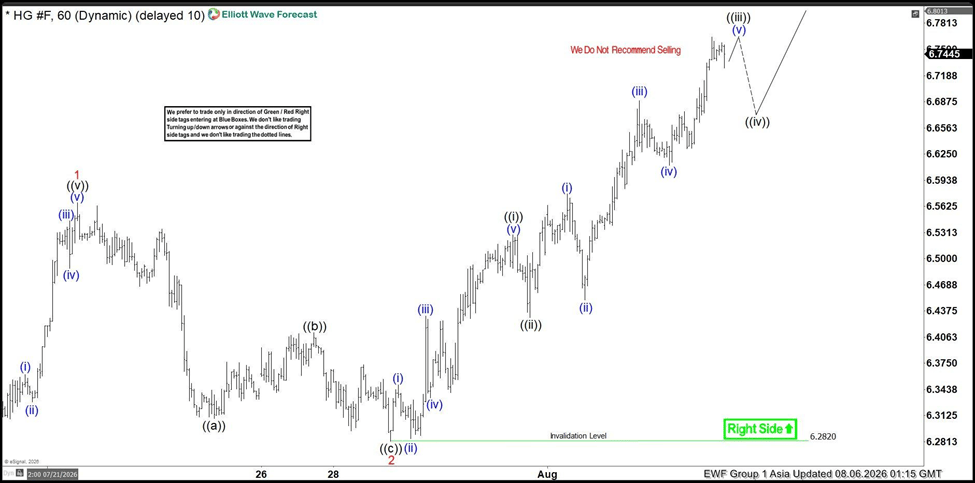
The 60-minute Elliott Wave chart shows Copper advancing within black wave ((iii)). A push toward 6.858 should complete the current five-wave impulsive sequence in wave ((iii)). Once this move finishes, we expect a corrective pullback in at least three swings as part of wave ((iv)). This pullback should present another buying opportunity, provided it remains above the 6.479 swing low and, more importantly, above the 6.2820 invalidation level.

Looking beyond the near-term correction, the higher-timeframe Elliott Wave count continues to point higher. We expect the current advance to extend toward 6.981, which represents the equal legs target for red wave 1 within wave 3. Reaching this level would complete another important phase of the larger bullish structure before any meaningful correction takes place.

Overall, our Copper Elliott Wave forecast remains bullish. Any pullback in the coming hours is expected to find support in 3, 7, or 11 swings, keeping the broader trend intact. Until key support levels break, traders should continue to favor buying pullbacks, with 6.981 remaining the next major upside objective.

HG #F 60 min Elliott Wave chart
Chart

Author

Elliott Wave Forecast Team

Elliott Wave Forecast Team

ElliottWave-Forecast.com

More from Elliott Wave Forecast Team
Share:

Editor's Picks

AUD/USD sits at three-week highs above 0.7000 on hawkish RBA-speak

AUD/USD holds a positive bias for the fourth straight day, trading above 0.7000 in the Asian session on Wednesday and at three-week highs. RBA Deputy Governor Andrew Hauser's hawkish remarks and inflation concerns underpin the pair. However, the upside appears capped as the US Dollar attracts some buyers amid looming US-Iran uncertainty.

USD/JPY remains confined in a familiar range below 158.50

USD/JPY sees some dip-buying in the Asian session on Wednesday, though it remains confined within a multi-week range near 158.50 as the uncertainty over the timing of the next BoJ rate hike keeps Japanese Yen bulls on the defensive. Meanwhile, hawkish Fed expectations, bolstered by inflation risks stemming from volatile oil prices, underpin the US Dollar. However, looming intervention fears could limit JPY losses and cap the currency pair.

Gold appears slightly bid above $4,100

Gold prices manage to reverse three consecutive daily declines, trading just above the $4,100 per troy ounce on Wednesday. The yellow metal’s recovery comes amid a humble advance in the US Dollar, mixed US Treasury yields across the board and a widespread cautious tone from the US-Iran front.

Bitcoin eyes a break above $85,000 as institutional demand returns

Bitcoin edges higher above $83,000, extending its rebound from the 50-day EMA near $80,786. US-listed BTC spot ETFs recorded over $23 million in net inflows on Tuesday, following Monday's $526 million, signaling a return of institutional demand.

What November 3 means for the Fed's rate path and the US Dollar

The USD faces a decisive period ahead of the November 3 midterm elections. While markets anticipate another interest rate increase from the Fed in December, the battle for control of Congress could reshape fiscal policy expectations and, indirectly, the path of US monetary policy in 2027.

The US Dollar fell. Gold didn't rally. That tells you everything
Gold (XAU/USD) is struggling to capitalize on a weaker US Dollar (USD), after repeatedly failing to establish itself above the $4,200 level. The precious metal remains confined to a relatively narrow trading range despite a combination of developments that would normally support higher prices.















