Coke vs Pepsi: The next inflation battle starts in the Grocery Aisle


Energy costs are still running hot on a year-over-year basis, even after cooling off in June and July. US energy prices sat 14.7% higher in July than a year earlier. Food-at-home inflation came in at 2.7%, and non-alcoholic beverages rose 4.1%. For Coca-Cola and PepsiCo, the next squeeze will likely show up where shoppers feel it first: package sizes, promotions, and shelf prices. The Pep vs. KO contest is turning into a test of whether diversification or concentrated brand power offers the stronger defense.
Grocery inflation is exposing two different business models
The familiar Pepsi vs. Coke comparison understates how differently these companies make money. Coca-Cola is mostly a beverage concentrate and brand business, supported by a global bottling system. PepsiCo combines beverages with snacks and other convenient foods, which leaves it exposed to a wider range of agricultural commodities, packaging materials, manufacturing costs, and consumer decisions.
That PepsiCo business diversification can soften weakness in any single category. International food sales or sports drinks may offset slower North American snack demand. But the same breadth creates more places for inflation to enter. Potatoes, corn, cooking oils, aluminum, plastics, and freight can all shape the inflation impact on profit margins.
PepsiCo's second-quarter 2026 results showed the tension. Organic revenue rose 2.4%, but core operating margin contracted 40 basis points to 16.8%. The company cited higher operating costs alongside pricing and productivity gains. It has also cut prices on some Lay's and Doritos products by as much as 15% in North America, a sign that pricing power vs consumer demand has become a real trade-off. PepsiCo Q2 2026 results.
Coca-Cola's pricing power still has more room to work
Coca-Cola entered this phase with cleaner margin momentum. In the second quarter, organic revenue increased 6%, including 2% growth from price and mix, while global unit case volume advanced 5%. The comparable operating margin expanded by 90 basis points to 35.6%, despite higher input costs and increased marketing investment. Lower operating expenses and currency tailwinds also helped. The result keeps Coca-Cola's pricing power at the center of the bullish KO case.
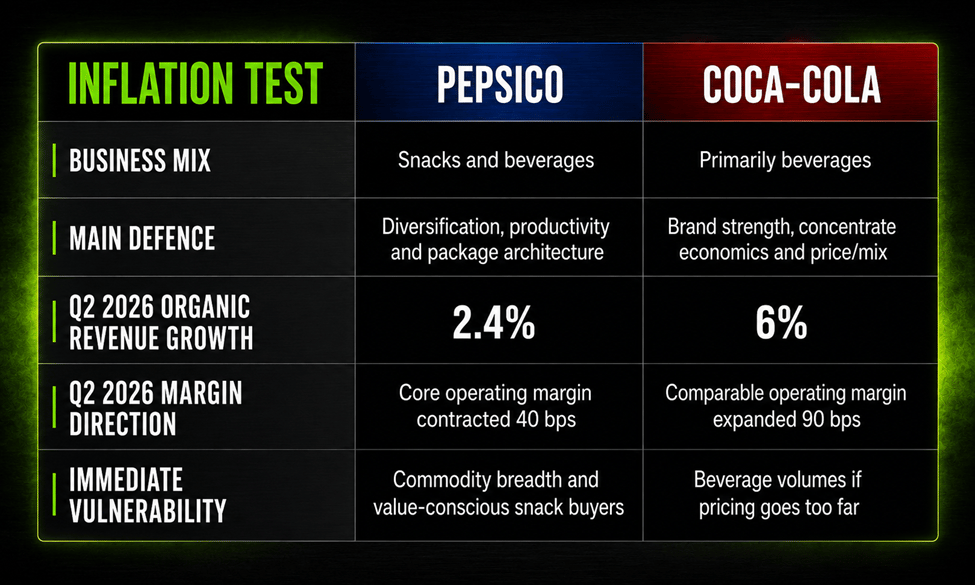
The margin measures are not directly comparable because the companies have different operating structures and report different non-GAAP metrics. Their direction is still revealing. In PepsiCo vs. Coca-Cola margins, KO expanded while PEP's core margin narrowed. The recent Coca-Cola vs. PepsiCo pricing power evidence, therefore, favors Coca-Cola, particularly while volumes continue to grow alongside price and mix.
PEP vs KO: Inflation risk comes down to the consumer
PepsiCo is not simply the weaker inflation stock. Lower pricing, smaller packs, and affordability initiatives could rebuild volume before cost pressure peaks. Its international portfolio also gives the company more growth routes than a US grocery-aisle comparison suggests. This is the strongest argument for PEP under consumer staples stocks' inflation conditions.
Still, the near-term Pep vs. KO pricing power and Pep vs. KO profit margins signals lean toward Coca-Cola. KO's asset-lighter structure and stronger recent price-volume balance suggest greater near-term resilience to food and beverage inflation, although currency movements and operating expenses will also influence the margin outcome.
For the Pepsi stock vs. Coke stock trade, PepsiCo offers broader recovery potential if affordability measures restore demand and productivity catches up with costs. Coca-Cola offers a cleaner defensive profile if grocery inflation persists. The PEP vs. KO inflation battle is therefore less about which company can raise prices and more about which can do so without changing what consumers place in their baskets.
In Versus pairs Pep vs. KO, diversification gives PepsiCo more ways to grow. Pricing discipline gives Coca-Cola the stronger position today. That makes Versus Trade Pep vs. KO a contest between a wider business and a more efficient inflation shield.
Author