Canadian Dollar snaps win streak on dueling market holiday Monday
- The Canadian Dollar snapped it’s recent win streak against the US Dollar on Monday.
- Both Canadian and US markets are dark for the long weekend holiday.
- September opens up with an early flash of potential Loonie weakness.

The Canadian Dollar (CAD) eased lower against the US Dollar (USD) on Monday, albeit on notably weak market flows, shedding under one-tenth of one percent against the Greenback. Canadian and US markets are shuttered functionally across the board thanks to a shared Labor Day holiday, and markets will be waiting for North American markets to return from their long weekend in full force on Tuesday.
The Canadian Dollar ran out of runway on Monday, snapping a four-session winning streak and posting its first loss against the Greenback in exactly one week. The Canadian economy is broadly slowing down faster than analysts expected, thanks to a slow-motion trade war with the US and US President Donald Trump’s high tariffs. Damage is expexted to continue pressing down on Canadian economic activity, and despite market hopes for further central bank interest rate cuts on both sides of the 49th parallel, the Loonie is still running largely at the mercy of broad-market US Dollar flows.
Daily digest market movers: Canadian Dollar stumbles ahead of US-data heavy week
- The Canadian Dollar ended it’s near-term winning streak against the US Dollar.
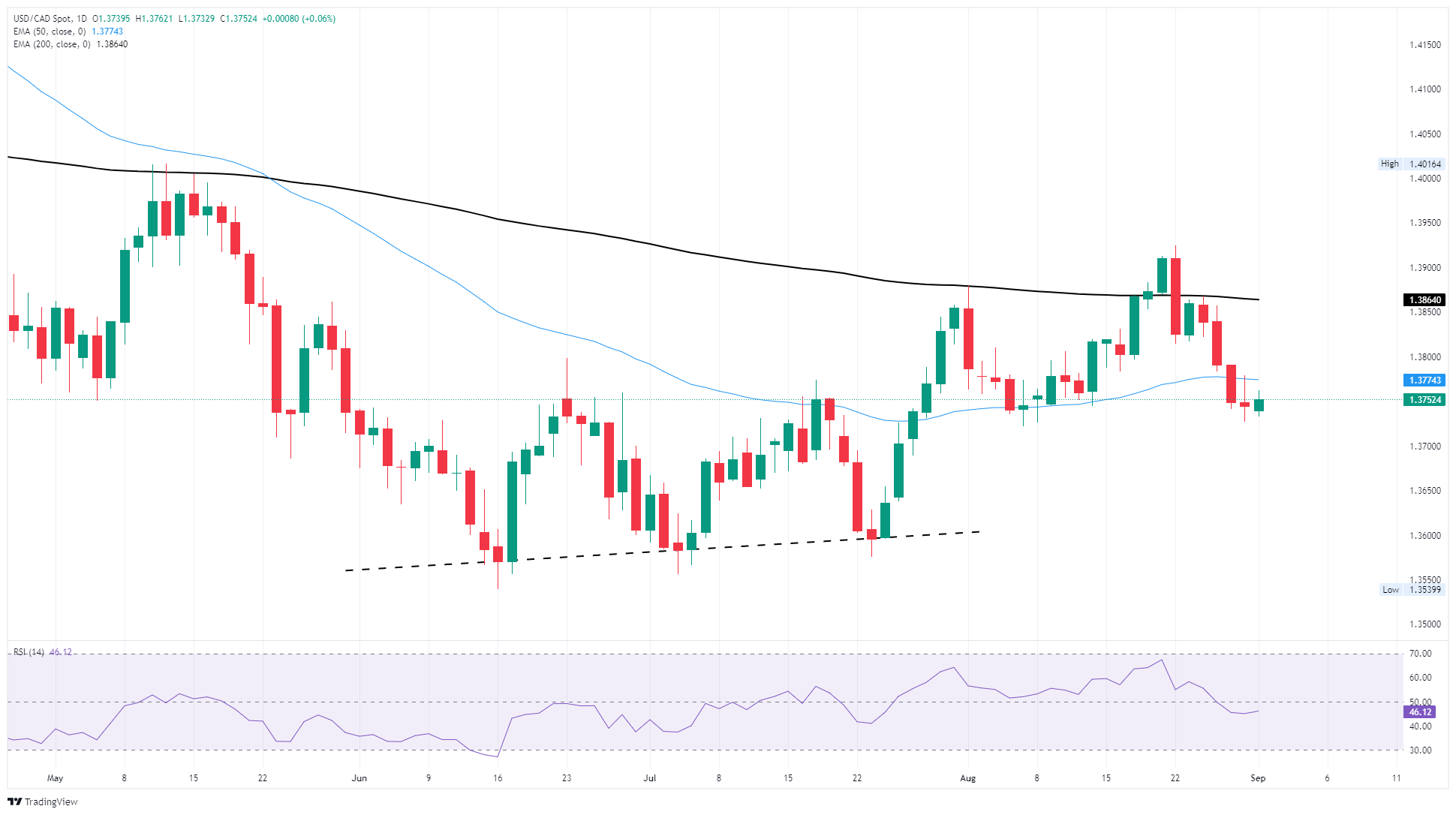
- USD/CAD has found a messy technical floor near 1.3740.
- Both Canadian and US labor data is due at the end of the week, but US Nonfarm Payrolls (NFP) will handily dominate investor attention spans as the days tick toward Friday.
- Both Canadian and US net job numbers are expected to continue slowing down, bolstering bets of central bank cuts from both the Bank of Canada (BoC) and the Federal Reserve (Fed).
- Canadian economic data remains muted through the majority of the week, leaving US data front and center.
Canadian Dollar price forecast
The Canadian Dollar’s near-term bull run looks set to draw to a close, with one-sided Greenback weakness poised to run out of runway. USD/CAD has fallen over 1.4% top-to-bottom from two-week highs near 1.3930 to fresh lows near 1.3725. The 200-day Exponential Moving Average (EMA) remains a key technical ceiling on bearish Loonie flows, but CAD momentum remains deeply constrained.
USD/CAD daily chart
Canadian Dollar FAQs
The key factors driving the Canadian Dollar (CAD) are the level of interest rates set by the Bank of Canada (BoC), the price of Oil, Canada’s largest export, the health of its economy, inflation and the Trade Balance, which is the difference between the value of Canada’s exports versus its imports. Other factors include market sentiment – whether investors are taking on more risky assets (risk-on) or seeking safe-havens (risk-off) – with risk-on being CAD-positive. As its largest trading partner, the health of the US economy is also a key factor influencing the Canadian Dollar.
The Bank of Canada (BoC) has a significant influence on the Canadian Dollar by setting the level of interest rates that banks can lend to one another. This influences the level of interest rates for everyone. The main goal of the BoC is to maintain inflation at 1-3% by adjusting interest rates up or down. Relatively higher interest rates tend to be positive for the CAD. The Bank of Canada can also use quantitative easing and tightening to influence credit conditions, with the former CAD-negative and the latter CAD-positive.
The price of Oil is a key factor impacting the value of the Canadian Dollar. Petroleum is Canada’s biggest export, so Oil price tends to have an immediate impact on the CAD value. Generally, if Oil price rises CAD also goes up, as aggregate demand for the currency increases. The opposite is the case if the price of Oil falls. Higher Oil prices also tend to result in a greater likelihood of a positive Trade Balance, which is also supportive of the CAD.
While inflation had always traditionally been thought of as a negative factor for a currency since it lowers the value of money, the opposite has actually been the case in modern times with the relaxation of cross-border capital controls. Higher inflation tends to lead central banks to put up interest rates which attracts more capital inflows from global investors seeking a lucrative place to keep their money. This increases demand for the local currency, which in Canada’s case is the Canadian Dollar.
Macroeconomic data releases gauge the health of the economy and can have an impact on the Canadian Dollar. Indicators such as GDP, Manufacturing and Services PMIs, employment, and consumer sentiment surveys can all influence the direction of the CAD. A strong economy is good for the Canadian Dollar. Not only does it attract more foreign investment but it may encourage the Bank of Canada to put up interest rates, leading to a stronger currency. If economic data is weak, however, the CAD is likely to fall.
Author

Joshua Gibson
FXStreet
Joshua joins the FXStreet team as an Economics and Finance double major from Vancouver Island University with twelve years' experience as an independent trader focusing on technical analysis.

















