Canadian Dollar slumps as Canadian CPI inflation cools further
- The Canadian Dollar shed another 0.4% against the Greenback on Tuesday.
- Canada saw a steeper-than-expected contraction in headline CPI inflation figures.
- Underlying drivers in Canadian inflation throw warning signs for consumer spending.

The Canadian Dollar (CAD) plunged to a fresh multi-year low on Tuesday, falling four-tenths of a percent against the Greenback and pushing USD/CAD to its highest bids in nearly five years, sending the pair above 1.4300 for the first time since March of 2020. Annualized Canadian Consumer Price Index (CPI) inflation figures disappointed markets, delivering a muddle picture of Canadian price growth on both sides of the equation.
Despite headline Canadian CPI easing below the 2% mark on a yearly basis, monthly inflation figures appear to remain stuck. Core CPI inflation also remains sticky, trending north of 2.7% YoY, though the Bank of Canada’s (BoC) own measure of core CPI is continuing to drift lower.
Daily digest market movers: Canadian Dollar drops further after CPI print misses the mark
- Headline Canadian CPI inflation came in at 1.9% YoY, below the expected hold at 2.0%.
- The BoC’s in-house CPI Core metric grew by 1.6% YoY, below the previous 1.7%.
- The overall backslide in main Canadian CPI figures will help to bolster expectations of another rate cut from the BoC in January, despite BoC Governor Tiff Macklem’s recent warnings that the pace of BoC rate cuts will be “more gradual” from here on out.
- Underlying core inflation remains sticky despite the drops in headline figures; while the BoC expects core inflation to average 2.3% in the fourth quarter, it is currently drifting near 2.7%.
- Mortgage interest costs eased in November, helping to soften CPI metrics, though underlying rent prices accelerated another 7.7% over the same period.
- As much as Canadians welcomed discounts on electronics and guided tour travel costs around Black Friday, another 2.6% annualized increase in grocery costs still bites into wallets as Canadians struggle to replace food with television sets.
Canadian Dollar price forecast
The Canadian Dollar has shed over 2.2% against the US Dollar in December alone and is on pace to end lower against the Greenback for a fourth straight month. As the Loonie continues to deflate against the USD, USD/CAD prices have rallied back above the 1.4300 handle, a bottom-to-top rise of nearly 7% from September’s bottom bids near 1.3420.
USD/CAD has moved steadily north in a one-sided medium-term trend, and the 50-day Exponential Moving Average (EMA) has struggled to keep up with price action as the key moving average rises into 1.3400. As Greenback bidders continues to pummel the Loonie, USD/CAD bids are headed to highs not seen since the height of the COVID pandemic above 1.4600.
USD/CAD daily chart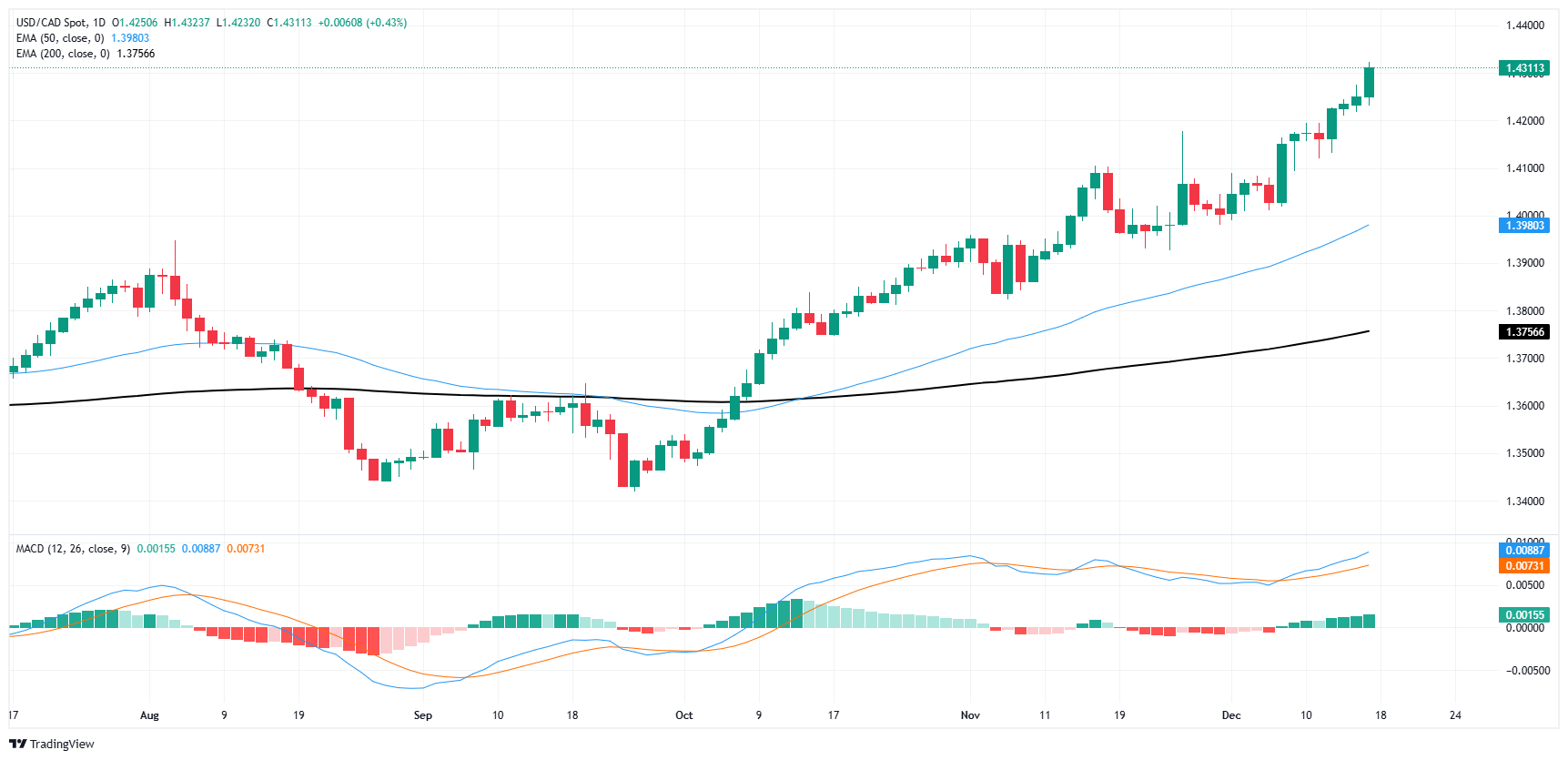
Canadian Dollar FAQs
The key factors driving the Canadian Dollar (CAD) are the level of interest rates set by the Bank of Canada (BoC), the price of Oil, Canada’s largest export, the health of its economy, inflation and the Trade Balance, which is the difference between the value of Canada’s exports versus its imports. Other factors include market sentiment – whether investors are taking on more risky assets (risk-on) or seeking safe-havens (risk-off) – with risk-on being CAD-positive. As its largest trading partner, the health of the US economy is also a key factor influencing the Canadian Dollar.
The Bank of Canada (BoC) has a significant influence on the Canadian Dollar by setting the level of interest rates that banks can lend to one another. This influences the level of interest rates for everyone. The main goal of the BoC is to maintain inflation at 1-3% by adjusting interest rates up or down. Relatively higher interest rates tend to be positive for the CAD. The Bank of Canada can also use quantitative easing and tightening to influence credit conditions, with the former CAD-negative and the latter CAD-positive.
The price of Oil is a key factor impacting the value of the Canadian Dollar. Petroleum is Canada’s biggest export, so Oil price tends to have an immediate impact on the CAD value. Generally, if Oil price rises CAD also goes up, as aggregate demand for the currency increases. The opposite is the case if the price of Oil falls. Higher Oil prices also tend to result in a greater likelihood of a positive Trade Balance, which is also supportive of the CAD.
While inflation had always traditionally been thought of as a negative factor for a currency since it lowers the value of money, the opposite has actually been the case in modern times with the relaxation of cross-border capital controls. Higher inflation tends to lead central banks to put up interest rates which attracts more capital inflows from global investors seeking a lucrative place to keep their money. This increases demand for the local currency, which in Canada’s case is the Canadian Dollar.
Macroeconomic data releases gauge the health of the economy and can have an impact on the Canadian Dollar. Indicators such as GDP, Manufacturing and Services PMIs, employment, and consumer sentiment surveys can all influence the direction of the CAD. A strong economy is good for the Canadian Dollar. Not only does it attract more foreign investment but it may encourage the Bank of Canada to put up interest rates, leading to a stronger currency. If economic data is weak, however, the CAD is likely to fall.
Author

Joshua Gibson
FXStreet
Joshua joins the FXStreet team as an Economics and Finance double major from Vancouver Island University with twelve years' experience as an independent trader focusing on technical analysis.