Canada enters a technical recession: Why the Canadian dollar now depends entirely on a weaker US Dollar

The Canadian Dollar (CAD) is facing notable headwinds following unexpected data showing that Canada’s economy has entered a technical recession. With first-quarter real Gross Domestic Product (GDP) contracting and previous growth figures revised downward, market optimism for a swift economic recovery has faded. This economic setback, paired with growing labor market slack, has led major financial institutions to heavily challenge aggressive interest-rate hike expectations from the Bank of Canada (BoC), clouding the near-term outlook for the local currency.
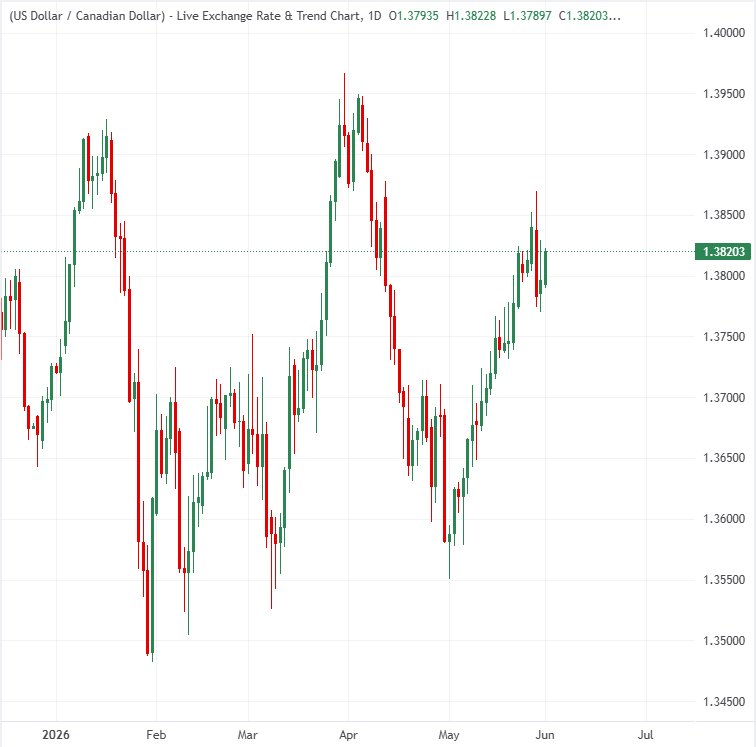
Economic stagnation dampens Bank of Canada tightening prospects
Analysts at Commerzbank point out that Canada's latest growth figures have definitively cast doubt on a near-term economic turnaround. Because of these underlying domestic struggles and a softening labor market, they argue that further monetary tightening is highly unlikely until late in the year at the earliest, suggesting that any future strength against the US Dollar will depend entirely on external factors.
Those anticipating lower USD/CAD levels should therefore continue to focus on a weaker US dollar rather than a stronger Canadian dollar.
Technical recession opens the door for USD/CAD overshoot
Strategy experts at Brown Brothers Harriman (BBH) highlight that the combination of falling crude Oil prices and the surprise contraction in Q1 GDP has heavily weighed on sentiment surrounding the Canadian currency. They believe current market pricing for upcoming BoC rate hikes is far too aggressive, creating a scenario where the USD/CAD exchange rate could surge toward major technical resistance as market expectations adjust to reality.
There is plenty of room for BoC rate hikes bets (50bps in the next 12 months) to adjust lower against CAD. USD/CAD risks a modest overshoot towards technical resistance at 1.3930, the January high.
Analysts point toward weaker outlook for the Canadian Dollar
Based on the insights from both institutions, the banks collectively hold a bearish near-term outlook for the Canadian Dollar's next market movements, predicting it will struggle to find independent upward momentum. Commerzbank emphasizes that the CAD lacks the intrinsic economic backing to drive the USD/CAD pair lower on its own merits, leaving it dependent on US Dollar weakness. Meanwhile, Brown Brothers Harriman forecasts a direct upward risk for the USD/CAD cross, explicitly predicting a potential overshoot toward the 1.3930 level as the market unwinds its aggressive rate hike bets.
(This article was created with the help of an Artificial Intelligence tool and reviewed by an editor.)
Author

FXStreet Insights Team
FXStreet
The FXStreet Insights Team is a group of journalists that handpicks selected market observations published by renowned experts. The content includes notes by commercial as well as additional insights by internal and external analysts.