British Pound Sterling rents a rally it has to pay for in the morning
- GBP/USD reclaims the 1.3300 shelf it lost last week and pushes to a two-day high just above 1.3350 after the Federal Reserve hold.
- The Bank of England reports at 11:00 GMT Thursday with a 7-2 hold consensus, a Monetary Policy Report and the Minutes attached.
- The 50-day and 200-day EMAs remain converged just under 1.3400, the band that has capped every rally since mid-July.
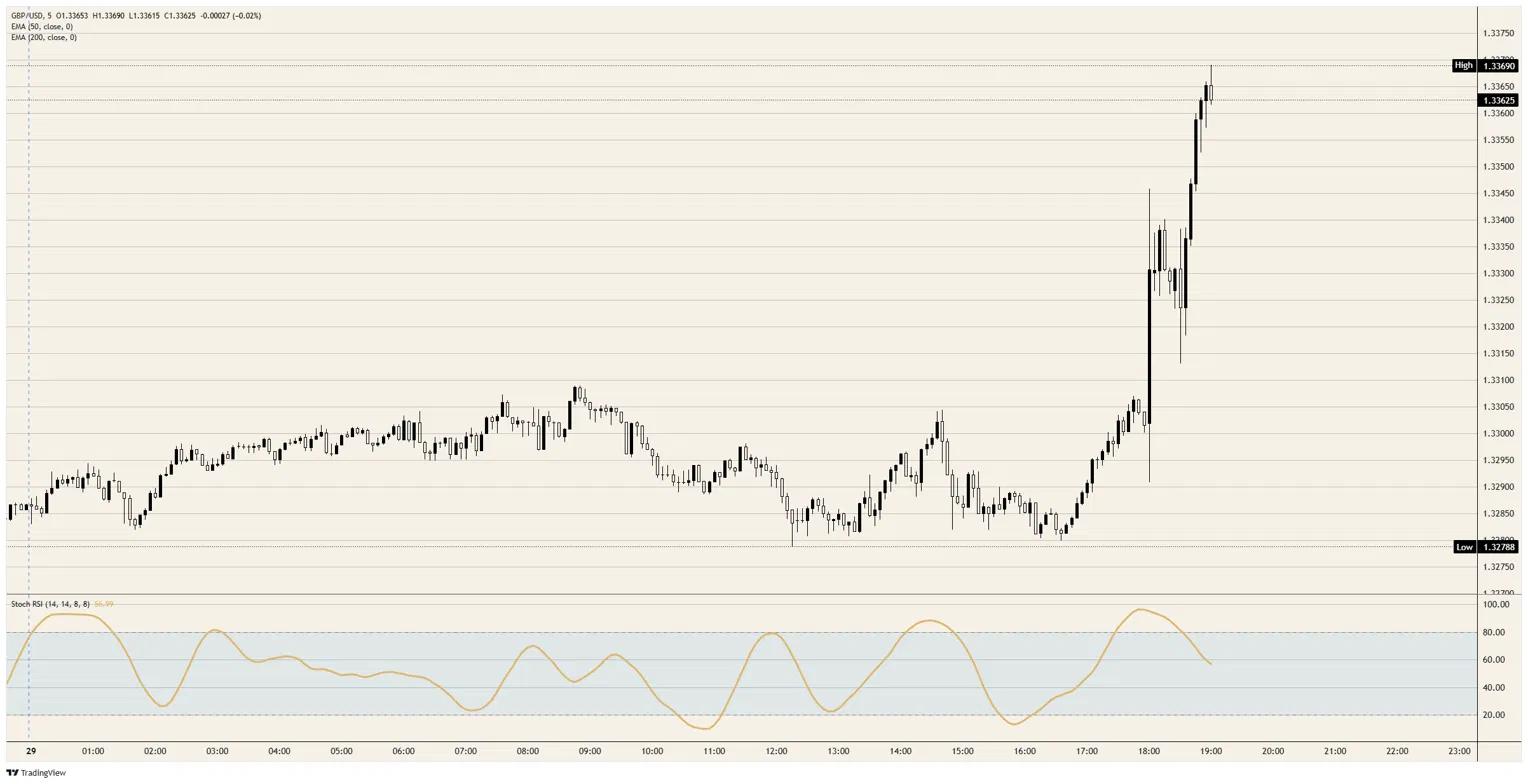
The Federal Reserve (Fed) held its target range at 3.50% to 3.75% at 18:00 GMT on a 9-3 vote, with three voting members preferring an immediate quarter-point increase, and Sterling rallied through the 1.3300 shelf it lost last week to trade just above 1.3350. None of that is a British story. The pair held a 30-pip band around 1.3300 for the whole London session and did all of its work after the American headline.
The rally is entirely Dollar-side
Sterling has not traded its own economy for a fortnight. June Retail Sales beat against an expected decline, the business surveys returned to growth, and household confidence reached a six-month high. None of it moved the currency off a broken shelf. What moved it today was a Fed that produced its most hawkish vote record of the cycle and then refused to say what the vote meant.
The mechanism matters more than the direction. This meeting attached no Summary of Economic Projections, the statement carries no forward guidance by design, and the briefing at 18:30 GMT declined to convert three dissents into anything resembling a path. Futures responded by pricing at least one increase by September 16 near 64%, against roughly 80% on the captures taken before the meeting, with the December two-hike probability down to roughly 42% from 57%.
Two holds, still not symmetric
Both central banks are now holding with hawkish dissent blocs attached. The fed funds rate sits at 3.50% to 3.75% with three members wanting a quarter point more, and the Bank of England is expected to hold at 3.75% with two members wanting the same, unchanged from June on the calendar consensus. Wednesday established what this market does with that configuration when nobody validates the dissent, which is fade it.
The difference tomorrow is the paperwork. London attaches a full Monetary Policy Report, the Minutes and a Governor's briefing at 11:30 GMT, so the guidance Washington withheld is scheduled to arrive in the morning. That cuts both ways for a currency that has just been handed roughly 60 pips it did not earn, and it is the reason this rally sits on borrowed time rather than on a changed British case.
There is a structural asymmetry underneath the timing as well. One of these central banks has abolished forward guidance and the other still publishes a full set of forecasts, so the two currencies no longer respond to the same class of information. Sterling can be repriced by a document on Thursday morning in a way the US Dollar can no longer be repriced by anything the Fed chooses to publish.
The band is the whole question
Price is now inside the moving average band rather than beneath it, which is the first thing that has changed on this chart since the shelf broke. The two averages have converged just under 1.3400 since mid-July and have turned back every attempt at them, so the pair is not testing a level so much as walking into the mechanism that has defined the trend.
A hawkish surprise from the Bank of England, meaning a third vote for a quarter point or a set of forecasts that hardens the September case, is the only route to a Sterling-led break through it. Absent that, a currency riding a Dollar leg into a converged band with a Monetary Policy Report in the way is a fade, not a trend change.
The week's two binaries
The Bank of England decision lands at 11:00 GMT Thursday, with the calendar carrying seven votes to hold, two for a quarter-point increase and none for a cut, all unchanged from the previous meeting. The Report and the minutes publish alongside and the Governor speaks half an hour later, giving the market four separate documents to read in ninety minutes.
The American half follows at 12:30 GMT the same day. The June Personal Consumption Expenditures price index is seen at 0.2% MoM on the core measure and 3.3% YoY, alongside preliminary second-quarter Gross Domestic Product at 2.1% and initial jobless claims at 200K against a 187K prior. A soft PCE print extends the Dollar leg and still does nothing for the Pound's own case.
Levels
Resistance: The exponential moving average band just under 1.3400 has capped every rally since mid-July and price now sits inside it. Through 1.3400 the mid-July peak near 1.3550 is the next reference.
Support: The 1.3300 shelf, reclaimed today, is the first test on any fade. Beneath it 1.3250 and then the summer base just under 1.3150.
Bias: Bearish while the band caps. Sell strength into 1.3400 with objectives at 1.3300 and 1.3250, invalidation on a daily close above 1.3400 reopening 1.3550.
GBP/USD 5-minute chart
Pound Sterling FAQs
The Pound Sterling (GBP) is the oldest currency in the world (886 AD) and the official currency of the United Kingdom. It is the fourth most traded unit for foreign exchange (FX) in the world, accounting for 12% of all transactions, averaging $630 billion a day, according to 2022 data. Its key trading pairs are GBP/USD, also known as ‘Cable’, which accounts for 11% of FX, GBP/JPY, or the ‘Dragon’ as it is known by traders (3%), and EUR/GBP (2%). The Pound Sterling is issued by the Bank of England (BoE).
The single most important factor influencing the value of the Pound Sterling is monetary policy decided by the Bank of England. The BoE bases its decisions on whether it has achieved its primary goal of “price stability” – a steady inflation rate of around 2%. Its primary tool for achieving this is the adjustment of interest rates. When inflation is too high, the BoE will try to rein it in by raising interest rates, making it more expensive for people and businesses to access credit. This is generally positive for GBP, as higher interest rates make the UK a more attractive place for global investors to park their money. When inflation falls too low it is a sign economic growth is slowing. In this scenario, the BoE will consider lowering interest rates to cheapen credit so businesses will borrow more to invest in growth-generating projects.
Data releases gauge the health of the economy and can impact the value of the Pound Sterling. Indicators such as GDP, Manufacturing and Services PMIs, and employment can all influence the direction of the GBP. A strong economy is good for Sterling. Not only does it attract more foreign investment but it may encourage the BoE to put up interest rates, which will directly strengthen GBP. Otherwise, if economic data is weak, the Pound Sterling is likely to fall.
Another significant data release for the Pound Sterling is the Trade Balance. This indicator measures the difference between what a country earns from its exports and what it spends on imports over a given period. If a country produces highly sought-after exports, its currency will benefit purely from the extra demand created from foreign buyers seeking to purchase these goods. Therefore, a positive net Trade Balance strengthens a currency and vice versa for a negative balance.
Author

Joshua Gibson
FXStreet
Joshua joins the FXStreet team as an Economics and Finance double major from Vancouver Island University with twelve years' experience as an independent trader focusing on technical analysis.

















