British Pound slides against Japanese Yen as suspected intervention rattles markets
- GBP/JPY falls nearly 1% as the Japanese Yen strengthens across major currency pairs.
- A sharp Yen rally raises speculation that Japanese authorities may have intervened again.
- Technical indicators favour sellers as the RSI slips below 50 and the MACD turns negative.

GBP/JPY falls nearly 1% on Wednesday as the Japanese Yen (JPY) strengthens across the board. At the time of writing, the cross trades around 214.43 after hitting an intraday low near 213.70, its lowest level since August 10.
The sharp rise in the Yen raises speculation that Japanese authorities may have intervened again after USD/JPY briefly moved above the 160 threshold. Although there is no official confirmation of intervention, the move has spilled over across major Yen pairs.
Hawkish Bank of Japan (BoJ) expectations also support the Yen. BoJ Governor Kazuo Ueda said the central bank will discuss another rate increase at its September 17-18 meeting as policymakers assess growing inflation risks. BoJ board member Hajime Takata added that the central bank needs “a more nimble approach with rate hikes” and should consider “a broad range of options, not just a 0.25% rate hike each time.”
However, broader macroeconomic headwinds could limit additional gains in the Yen. Japan’s expansionary fiscal policy, heavy government debt burden and relatively low interest rates remain key concerns for the currency.
Against this backdrop, additional selling pressure on GBP/JPY could remain limited following the sharp intraday decline. However, UK fiscal concerns and the Bank of England’s (BoE) steady policy outlook keep sentiment toward the Pound Sterling subdued. The BoE is expected to leave interest rates unchanged at 3.75% later this month. Governor Andrew Bailey said last week that the second-round effects of higher energy prices were subdued, suggesting that the central bank does not need to tighten policy immediately.
Sentiment support for Pound seen hinging on UK budget
Strategists at Scotiabank emphasise that “sentiment remains a key source of support for the GBP,” pointing again to the “material improvement since PM Burnham’s arrival in late June.” They add that “fiscal developments will remain a key driver of sentiment into the UK budget scheduled for late October,” suggesting investors are likely to treat the forthcoming fiscal plans as a critical test of this improved backdrop.
Technical Analysis
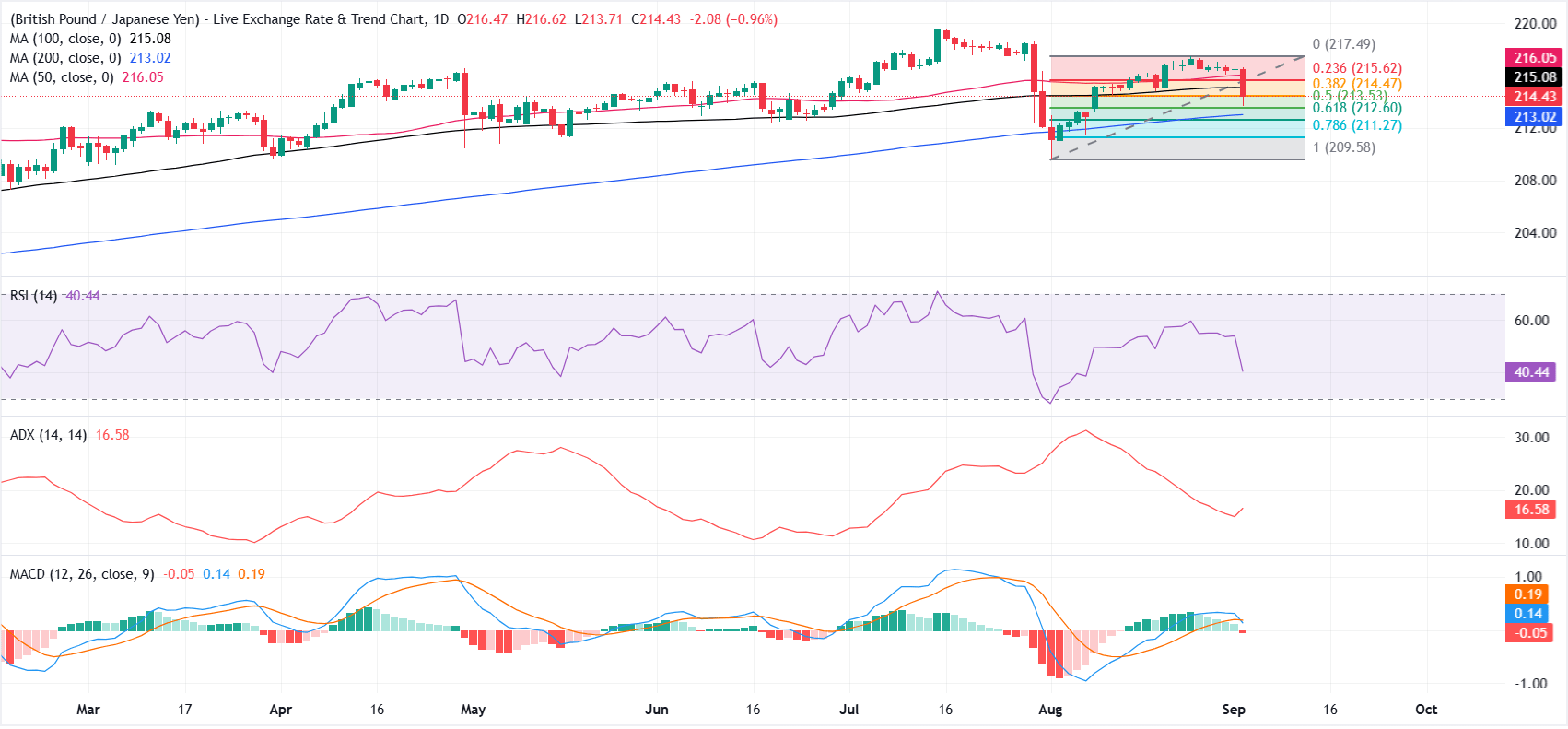
On the daily chart, GBP/JPY keeps a near-term bearish tone as price has slipped below the 100-day and 50-day simple moving averages (SMAs). The pair is also trading just under the 38.2% Fibonacci retracement at 214.47, suggesting that former upside levels are now capping the recovery, with a soft momentum backdrop as the Relative Strength Index (RSI) hovers below the 50 line and the Moving Average Convergence Divergence (MACD) dips fractionally into negative territory, while a subdued Average Directional Index (ADX) near 17 hints at a weak trend.
On the topside, initial resistance is seen at the 38.2% retracement around 214.47, followed by the 100-day SMA near 215 and the 23.6% retracement at 215.62, with the 50-day SMA at 216 reinforcing a broader supply zone above.
On the downside, immediate support is aligned with the 50.0% retracement at 213.53, ahead of the 200-day SMA at 213, while deeper pullbacks would expose the 61.8% retracement at 212.60 and the lower Fibonacci levels at 211.27 and 209.58 if selling pressure extends.
(The technical analysis of this story was written with the help of an AI tool. Know more.)
Japanese Yen Price Today
The table below shows the percentage change of Japanese Yen (JPY) against listed major currencies today. Japanese Yen was the strongest against the New Zealand Dollar.
| USD | EUR | GBP | JPY | CAD | AUD | NZD | CHF | |
|---|---|---|---|---|---|---|---|---|
| USD | -0.02% | 0.06% | -0.92% | -0.33% | -0.37% | 0.77% | 0.12% | |
| EUR | 0.02% | 0.08% | -0.88% | -0.31% | -0.34% | 0.76% | 0.14% | |
| GBP | -0.06% | -0.08% | -0.96% | -0.36% | -0.43% | 0.65% | 0.06% | |
| JPY | 0.92% | 0.88% | 0.96% | 0.58% | 0.55% | 1.66% | 1.04% | |
| CAD | 0.33% | 0.31% | 0.36% | -0.58% | -0.04% | 1.07% | 0.45% | |
| AUD | 0.37% | 0.34% | 0.43% | -0.55% | 0.04% | 1.10% | 0.50% | |
| NZD | -0.77% | -0.76% | -0.65% | -1.66% | -1.07% | -1.10% | -0.60% | |
| CHF | -0.12% | -0.14% | -0.06% | -1.04% | -0.45% | -0.50% | 0.60% |
The heat map shows percentage changes of major currencies against each other. The base currency is picked from the left column, while the quote currency is picked from the top row. For example, if you pick the Japanese Yen from the left column and move along the horizontal line to the US Dollar, the percentage change displayed in the box will represent JPY (base)/USD (quote).
Author

Vishal Chaturvedi
FXStreet
I am a macro-focused research analyst with over four years of experience covering forex and commodities market. I enjoy breaking down complex economic trends and turning them into clear, actionable insights that help traders stay ahead of the curve.
















