British Pound falls as hot PPI, Starmer turmoil lift US Dollar
- US PPI jumps to four-year high, lifting Treasury yields.
- Dollar gains as Oil-driven inflation keeps Fed cuts distant.
- Starmer resignation rumors pressure Sterling before UK GDP data.

The British Pound (GBP) posts a 0.19% loss against the US Dollar (USD) on Wednesday in back-to-back bearish days after a red-hot US inflation report, amid mounting pressure on UK Prime Minister Keir Starmer to resign. The GBP/USD pair trades at 1.3513 after hitting a low of 1.3484 earlier in the day.
Sterling weakens as US inflation shock and UK politics bite
Inflation continues to grab the headlines. High energy prices, due to stalled negotiations between the US and Iran to resolve the conflict, keep Oil prices above $100. Hence, central banks are positioning to hold interest rates higher for longer, prompting traders to buy the Greenback.
Producer inflation in the US hit its highest level in four years, up 6% YoY in April, exceeding March’s 4.3% rise. Excluding volatile items, the so-called Core Producer Price Index (PPI) expanded by 5.2% YoY, up from March’s 4%, crushing estimates of 4.3%.
Consequently, US Treasury yields shoot up, with the 10-year note up 2.5 basis points to 4.488%. The US Dollar Index (DXY), which tracks the buck’s value against a basket of six currencies, is up 0.21% at 98.49.
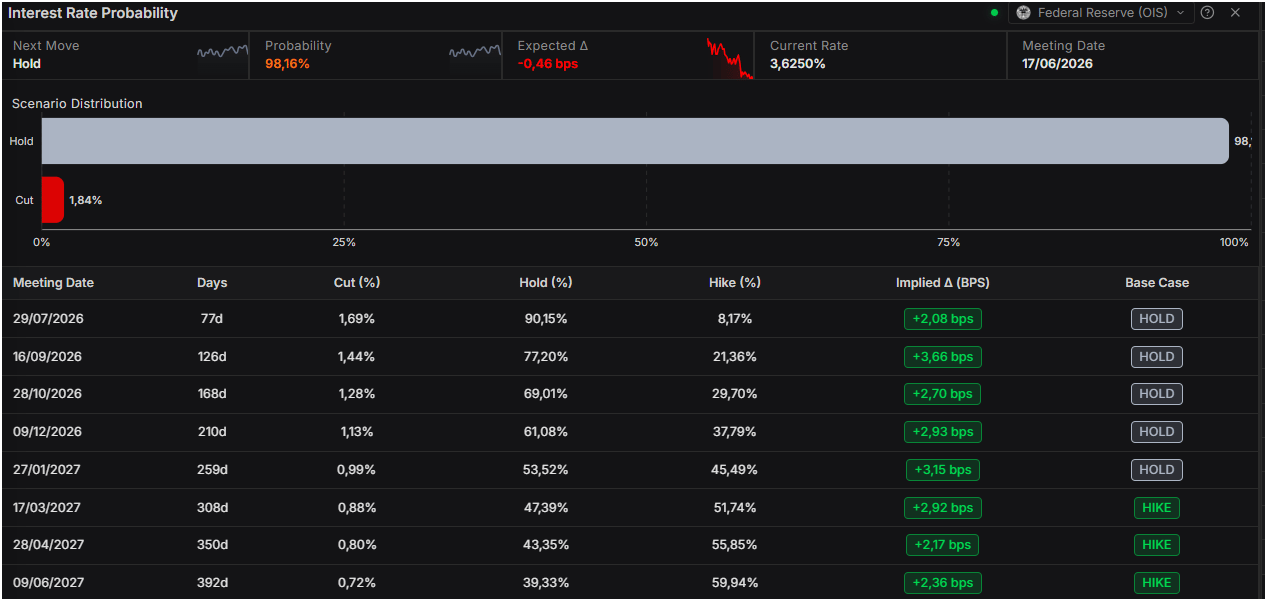
Meanwhile, money markets have priced out Federal Reserve (Fed) interest rate cuts, expecting the central bank to keep rates unchanged. Data from Prime Terminal suggests that the Fed will keep funds rate unchanged at the 3.50%-3.75% range at its first meeting with Kevin Warsh as Chair, if he is confirmed by the Senate.
In the UK, some Labour MPs voted to oust Prime Minister Keir Starmer following the local election, in which his party suffered losses. Rumors that his health minister, Wes Streeting, is resigning to trigger a contest to replace him are exerting pressure on Sterling.
Meanwhile, 111 Labour MPs signed a statement of support for Starmer, saying that “This is no time for a leadership contest.”
Aside from this, GBP/USD traders are awaiting the release of UK GDP data on Thursday. In the US, jobless claims and Retail Sales will provide updates on the economy.
GBP/USD Price Forecast: Technical outlook
In the daily chart, GBP/USD trades at 1.3518, holding a mild bullish bias as it stays above the clustered simple moving averages (SMAs) around 1.3430 while still trading below the descending resistance trend line that is now projected near 1.3620. The latest 14-day Relative Strength Index hovers close to the 50 line, suggesting balanced momentum and hinting that any immediate upside will likely depend on whether buyers can sustain the pair above the reclaimed moving average support.
On the topside, initial resistance is defined by the downward-sloping trend line break level around 1.3620, and a daily close above this barrier would open the way for a more sustained recovery. On the downside, the SMA cluster near 1.3430 acts as the first significant support, with the immediate price area around 1.3518 functioning as a nearby pivot that bulls will want to defend to keep the constructive tone intact.
(The technical analysis of this story was written with the help of an AI tool.)
Pound Sterling Price This week
The table below shows the percentage change of British Pound (GBP) against listed major currencies this week. British Pound was the strongest against the Swiss Franc.
| USD | EUR | GBP | JPY | CAD | AUD | NZD | CHF | |
|---|---|---|---|---|---|---|---|---|
| USD | 0.32% | 0.27% | 0.76% | 0.16% | -0.57% | 0.03% | 0.58% | |
| EUR | -0.32% | -0.06% | 0.50% | -0.17% | -0.89% | -0.33% | 0.26% | |
| GBP | -0.27% | 0.06% | 0.06% | -0.13% | -0.86% | -0.26% | 0.32% | |
| JPY | -0.76% | -0.50% | -0.06% | -0.66% | -1.33% | -0.74% | -0.12% | |
| CAD | -0.16% | 0.17% | 0.13% | 0.66% | -0.64% | -0.08% | 0.42% | |
| AUD | 0.57% | 0.89% | 0.86% | 1.33% | 0.64% | 0.60% | 1.16% | |
| NZD | -0.03% | 0.33% | 0.26% | 0.74% | 0.08% | -0.60% | 0.55% | |
| CHF | -0.58% | -0.26% | -0.32% | 0.12% | -0.42% | -1.16% | -0.55% |
The heat map shows percentage changes of major currencies against each other. The base currency is picked from the left column, while the quote currency is picked from the top row. For example, if you pick the British Pound from the left column and move along the horizontal line to the US Dollar, the percentage change displayed in the box will represent GBP (base)/USD (quote).
Author

Christian Borjon Valencia
FXStreet
Markets analyst, news editor, and trading instructor with over 14 years of experience across FX, commodities, US equity indices, and global macro markets.
















