British Pound erases early gains against US Dollar, US CPI in focus
- The British Pound surrenders gains against the US Dollar and flattens to near 1.3235.
- Investors keenly await the US CPI and the UK monthly GDP data.
- The Fed has signaled concerns regarding elevated inflationary pressures.

The British Pound (GBP) gives back its early gains against the US Dollar (USD), trading flat at around 1.3235 during the European session on Monday. The GBP/USD pair retreats as the US Dollar recovers morning losses and turns positive, with financial markets turning cautious ahead of the United States (US) Consumer Price Index (CPI) data for September on Wednesday.
As of writing, the US Dollar Index (DXY), which gauges the Greenback’s value against six major currencies, trades 0.15% higher to near 102.38.
According to estimates, the US headline inflation accelerated to 3.7% Year-on-Year (YoY) from the August reading of 3.4%. The core CPI – which excludes volatile food and energy items – is expected to come in at 2.5% YoY, higher than the previous reading of 2.4%. On a monthly basis, the headline CPI grew at a faster pace of 0.6% compared to the prior release of 0.4%.
Investors will pay close attention to the US inflation data as recent comments from Federal Reserve (Fed) officials have signaled that they are highly concerned about elevated inflation levels.
On the geopolitical front, a sharp recovery move in oil prices even as global energy supply risks have slightly diminished, following the energy ceasefire between Ukraine and Russia, has also supported the US Dollar. Analysts at ING said in a note that morning losses in crude were being driven by US President Donald Trump’s announcement this weekend that Russia will export “300kt of diesel immediately, followed by 500kt in November and 1mt in December.” ING notes that the agreement will also see “the US temporarily easing sanctions on Russian diesel,” adding to near‑term product availability and helping to explain why prices are softening despite ongoing geopolitical tensions.
On the British Pound front, investors await the United Kingdom (UK) monthly Gross Domestic Product (GDP) data for August, which will be released on Thursday. The UK economy is expected to have contracted 0.1% after growing by 0.4% in July. Investors will also focus on the Manufacturing and Industrial Production data.
GBP/USD Technical Analysis
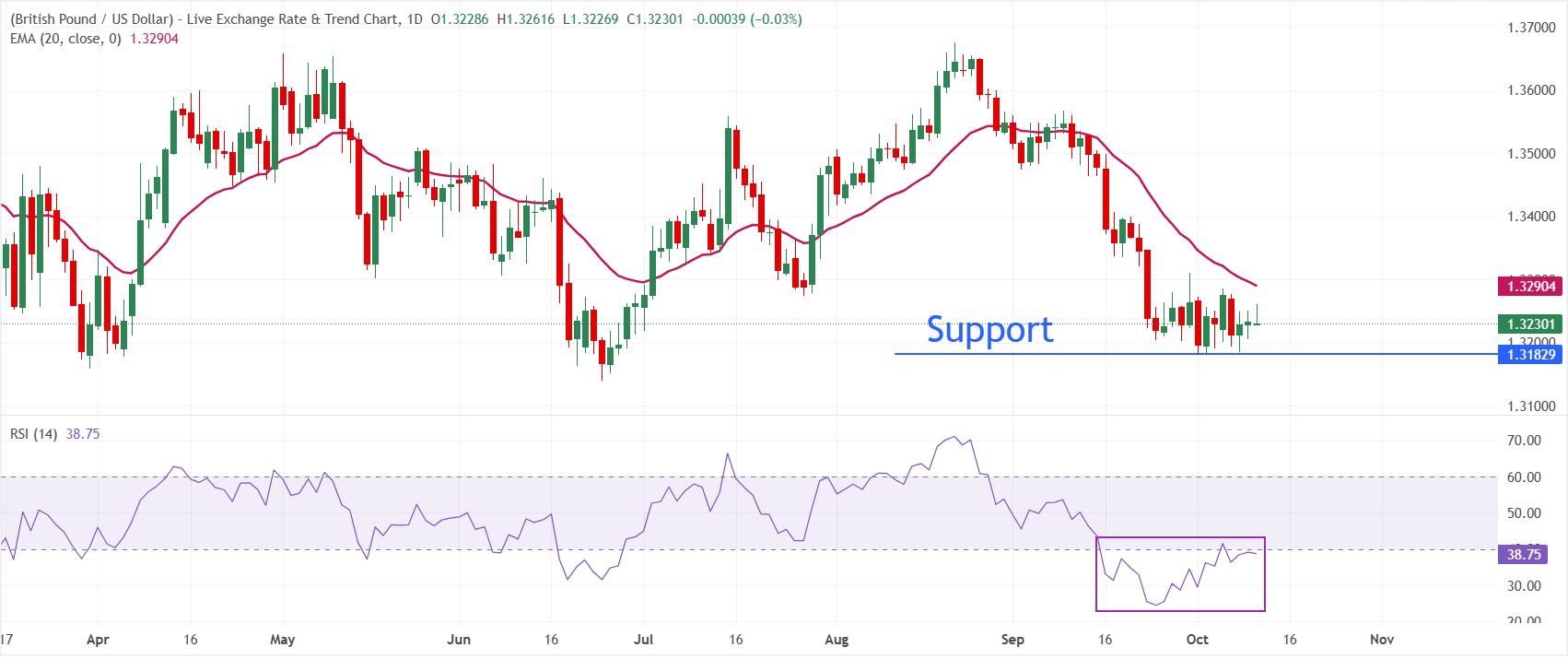
In the daily chart, GBP/USD trades at 1.3230, maintaining a bearish near-term tone as spot holds beneath the 20-period Exponential Moving Average (EMA) at 1.3290. The pair’s inability to reclaim this short-term EMA suggests that rallies remain capped for now, while the Relative Strength Index (RSI) near 39 hints at weak but stabilizing downside momentum rather than outright oversold conditions.
On the topside, initial resistance is located at the 20-period EMA at 1.3290, and a daily close above this level would be needed to ease immediate selling pressure and open the way for a stronger corrective bounce. With no clear nearby support levels derived from moving averages or momentum indicators, the pair remains vulnerable to further slippage while it trades under 1.3290, leaving price action driven by how it reacts to this overhead barrier.
(The technical analysis of this story was written with the help of an AI tool. Know more.)
Economic Indicator
Gross Domestic Product (MoM)
The Gross Domestic Product (GDP), released by the Office for National Statistics on a monthly and quarterly basis, is a measure of the total value of all goods and services produced in the UK during a given period. The GDP is considered as the main measure of UK economic activity. The MoM reading compares economic activity in the reference month to the previous month. Generally, a rise in this indicator is bullish for the Pound Sterling (GBP), while a low reading is seen as bearish.
Read more.Next release: Thu Oct 15, 2026 06:00
Frequency: Monthly
Consensus: -0.1%
Previous: 0.4%
Source: Office for National Statistics
Author

Sagar Dua
FXStreet
Sagar Dua is associated with the financial markets from his college days. Along with pursuing post-graduation in Commerce in 2014, he started his markets training with chart analysis.

















