Bitcoin stalls below 70k as correlation with tech stocks tightens
- Bitcoin stalls below 70k alongside softening tech momentum.
- BTC is increasingly tracking software stocks.
- Liquidity flows are driving both markets.
- U.S. data may set the next move.
- BTC technical analysis.

Bitcoin is struggling below the psychologically important 70k level amid a cautious broader market mood. While BTC rebounded sharply from last week’s 15-month low at 60k, that recovery has stalled as investors wait for the next clear catalyst.
This caution is mirrored across traditional markets. U.S. equity futures point to a slightly weaker open, while the tech-heavy Nasdaq has also seen its recovery from the February low at 24,150 stall near 25,250—a pattern that closely matches Bitcoin’s recent price action. In contrast, the more value- and cyclical-focused Dow Jones continues to outperform, trading above 50,000 and hovering near record highs.
Bitcoin and software stocks move in sync
The divergence highlights a broader rotation away from growth assets. Increasingly, Bitcoin is behaving less like a standalone alternative asset and more like an extension of the high-growth tech trade. A recent Grayscale report reinforces this view, showing that Bitcoin’s recent price movements have tracked the software sector particularly closely. The chart highlights striking similarities between Bitcoin and software stocks over the past 20 months, suggesting the same underlying forces are driving both markets.
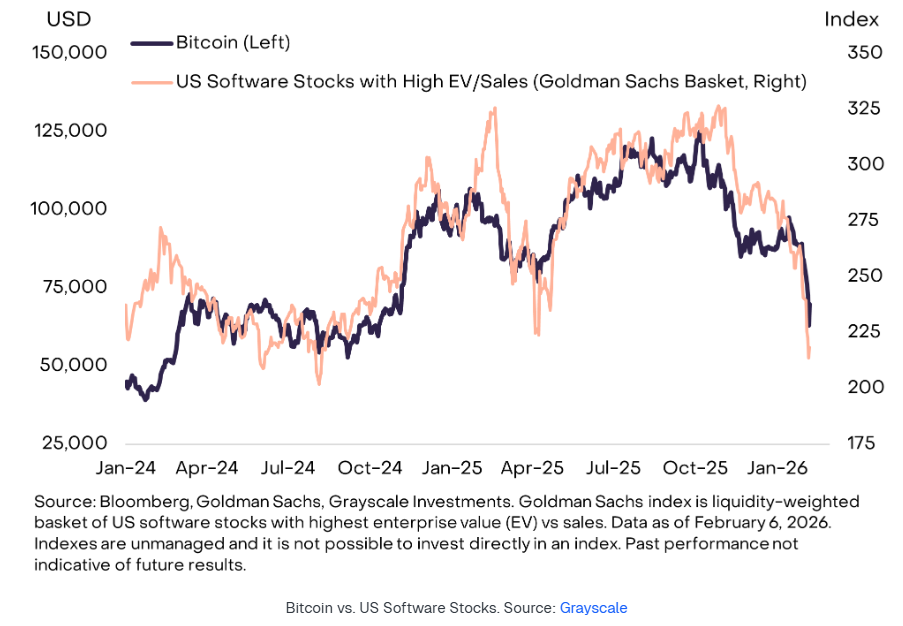
This synchronisation implies that the latest Bitcoin drawdown was driven more by broad de-risking across growth assets—and, more specifically, by concerns about AI’s potential to disrupt software business models—than by crypto-specific issues. As investors reassess valuations in software stocks, Bitcoin has been caught in the same liquidity-driven pullback.
The trend is attributed to private credit and liquidity flows that impact both sectors, causing capital to behave similarly across software stocks and Bitcoin. Bitcoin’s 30-day rolling correlation with the iShares Expanded Tech Software ETF (IGV) currently stands at 0.73, indicating a strong positive short-term relationship and a crypto-related risk that may have been overlooked.
Longer term
Longer term, however, Bitcoin’s narrative remains more nuanced. Reports that China is accelerating its reduction in US Treasury exposure and simultaneously increasing gold purchases could provide underlying support for BTC. The shift comes amid heightened geopolitical risk and political uncertainty under the Trump administration, adding weight to the de-dollarisation theme. While unlikely to act as a near-term catalyst, these developments could strengthen Bitcoin’s appeal as a longer-term hedge.
Near-term
In the near term, attention turns to this week’s US non-farm payrolls report and Friday’s CPI data. These releases will be closely watched for clues on the timing of Federal Reserve rate cuts and the broader liquidity outlook. As long as growth assets remain sensitive to macroeconomic data and Federal Reserve rate expectations, Bitcoin is likely to continue trading in line with U.S. tech stocks rather than decoupling from them.
BTC technical analysis
-1770737012685-1770737012687.png)
BTC/USDT declined 11% last week, reaching a low of 60k on Friday before rebounding to retest the daily resistance at 73k on Sunday. The price continues to consolidate around 70k. The primary trend remains bearish; therefore, any price recovery should be treated with caution.
The price recovery from 60k has brought the RSI out of oversold territory, but at 32 keeps sellers hopeful of further downside. Sellers will look to break out of range below 68k to bring 60k back into play. Below 60k, ahead of 50k the psychological level.
Buyers would need to risk above 72k to bring 75k back into focus. However, a rise above 85k is needed to negate the near-term downtrend.
Start trading with PrimeXBT
Author

PrimeXBT Research Team
PrimeXBT
PrimeXBT is a leading Crypto and CFD broker that offers an all-in-one trading platform to buy, sell and store Cryptocurrencies and trade over 100 popular markets, including Crypto Futures, Copy Trading and CFDs on Crypto, Forex, I