Beginning of the end of the shutdown leads to bounce in stocks, led by tech
- AI stocks back in fashion.
- It’s just another manic Monday.
- Eight Democrats saved Thanksgiving.
- Economic data releases come back to the fore.
- Why the AI sell off may ease, for now.

The effects of the beginning of the end of the US shutdown continue to be felt across financial markets. European stocks are a sea of green, led by the financial, industrial and tech sectors. US stock market futures are also pointing to a strong open, and tech stocks that led last week’s sell-off are expected to have a strong start on Monday.
AI stocks back in fashion
Palantir, who’s high valuation prompted the sell off, is higher by 3.3% in the pre-market today, and Nvidia, which fell 8% last week, is higher by 3.4%. While there is good reason to celebrate the end of the US government shutdown, there could be another reason why stocks are rallying so strongly today: because it’s Monday.
It’s just another manic Monday
The Monday effect has seen stock markets tend to perform well at the start of the week. In 2025, the S&P 500 has posted a gain 69% of the time on the first day of the week, according to Bloomberg. This could be part of the dip-buying that has taken markets by storm this year and helped spur recovery in stocks after the selloff in April, with investors willing to buy any lows after a weekend break.
Eight Democrats saved Thanksgiving
The end of the US government shutdown comes at the right time, just before Thanksgiving. This should allow American families to fly all over the country for the holidays and it should mean that supply chains are fully functioning for the biggest shopping weekend of the year. This is why US airlines like American Airlines are pointing to a gain of more than 1% today, and retailers like Macy’s, the poster child for Thanksgiving, is also higher by nearly 1% in the pre-market.
Economic data releases come back to the fore
However, once the US government shutdown is formally over, it still has some hoops to jump through, then we should get a deluge of delayed economic data including jobs data and CPI. The risk is that this data is less market-friendly and may not support a rate cut from the Fed next month.
There is currently a 65% chance of a rate cut in December. However, a big gain in the November jobs figures, or signs of an accelerating economy, could, ironically, weigh on stocks, as it would erode a pillar of their strength: hopes of another rate cut from the Federal Reserve.
Why the AI sell off may ease, for now
However, the AI trade sell off may be out to bed for this year. TSMC, the Taiwanese chip maker, reported a weaker than expected rise in sales for October. The 16.9% rise in sales was the weakest since February 2024, which caused the share price to fall more than 2.8% earlier, although its secondary listing in the US is pointing to a higher open. However, this is not as bad as it seems, and results from TSMC and Nvidia may put the brakes on recent volatility in the AI trade.
In fairness, 16% sales growth is strong, and is in line with expectations. Added to this, there is no sign that the AI chip sales will slow anytime soon, since the hyperscalers, including Meta, Alphabet, and Amazon, have pledged to spend more than $400bn next year on their AI buildout, a 21% increase on 2025.
The issue for TSMC is not demand, it is supply. The company has announced that capacity remains tight and they are working hard to narrow the gap between supply and demand. Thus, sales growth concerns may be company specific at TSMC, rather than a sign that the AI trade is slowing down. Nvidia’s results next week could also show that demand for AI chips and GPUs remains robust, which could give the AI trade legs into the end of the year.
Overall, risk is back on, and last week’s sell off seems like a distant memory. There are some risks ahead, but unless we see a meaningful decline in Fed rate cut expectations, or a weak earnings report from Nvidia next week, then stocks could be poised to rally into year end.
MSCI world index, bounces ahead of the 50-day sma
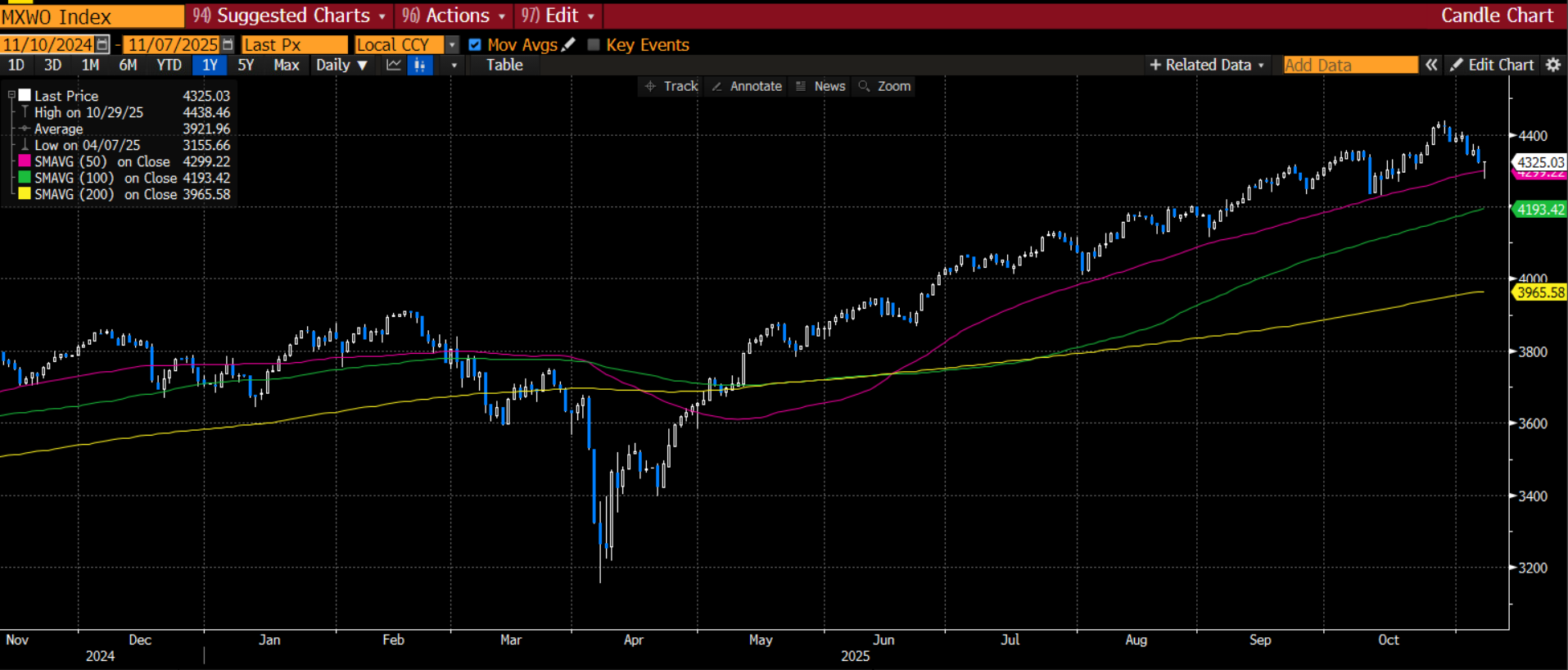
Source: XTB and Bloomberg
Author

Kathleen Brooks
XTB UK
Kathleen has nearly 15 years’ experience working with some of the leading retail trading and investment companies in the City of London.