Bank of Japan stands pat, re-defines YCC cap

The Bank of Japan (BoJ) board members decided to leave their current policy settings unadjusted, following its October monetary policy review meeting.
The Japanese central bank maintained the interest rate and 10-year JGB yield target at -10bps and 0% respectively.
Summary of the BoJ policy statement
Changes language around 1.0% 10-year JGB yield cap.
Decides to keep yield target but make 1% a reference cap.
Will guide market operations nimbly.
Will regard upper bound of 1% for 10-year JGB yield as reference in its market ops.
Will determine offer rate for fixed-rate JGB buying ops each time, taking account market rates and other factors.
Decides to make YCC more flexible.
Wages, prices must strengthen in virtuous cycle.
BoJ will patiently continue monetary easing under YCC to support economic activity, create environment where wages rise more.
Appropriate to make YCC more flexible given very high uncertainty over economy, markets.
USD/JPY reaction to the BoJ policy announcements
USD/JPY’s recovery regained traction on the BoJ’s policy announcements. The pair is currently trading at 149.85, up 0.52% on the day, having tested 150.10 in a knee-jerk reaction to the BoJ decision.
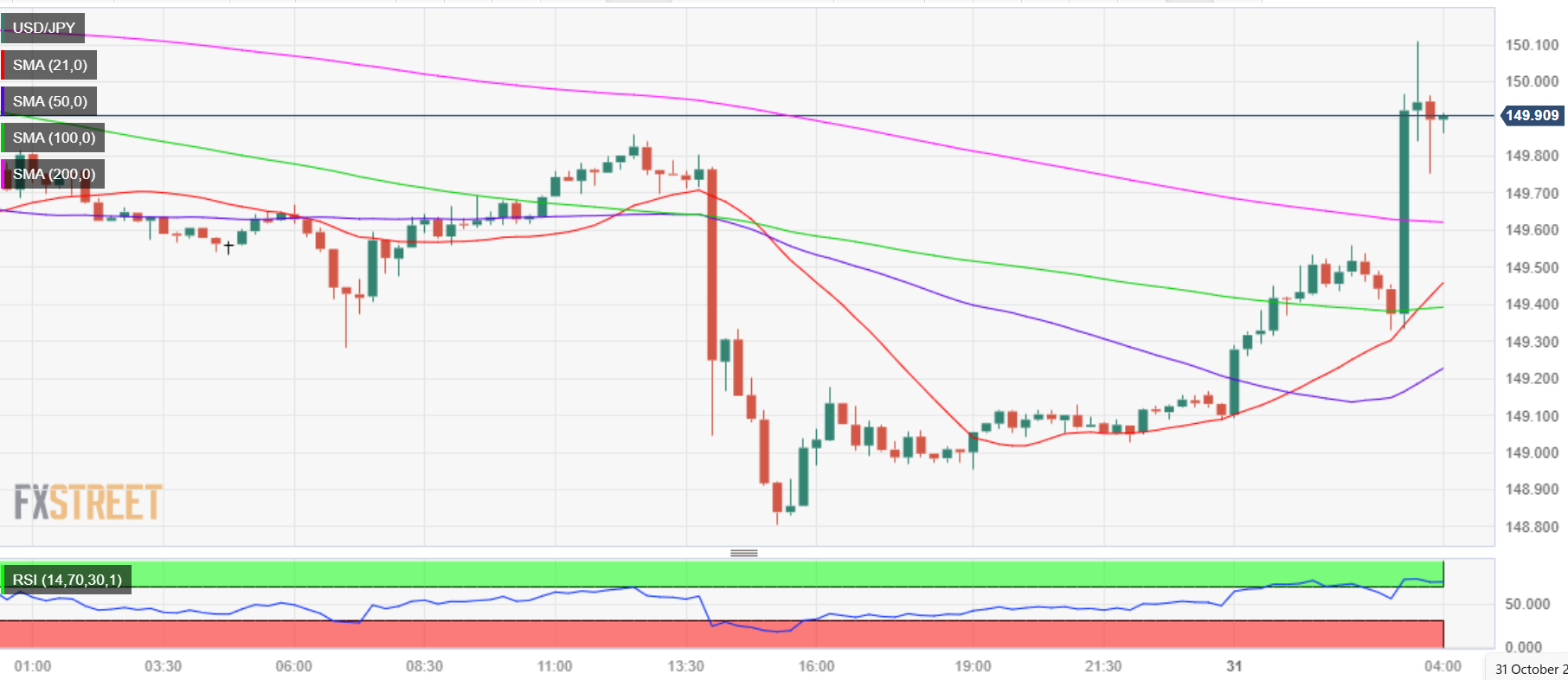
USD/JPY: 15-minutes chart
Japanese Yen price today
The table below shows the percentage change of Japanese Yen (JPY) against listed major currencies today. Japanese Yen was the strongest against the Australian Dollar.
| USD | EUR | GBP | CAD | AUD | JPY | NZD | CHF | |
| USD | 0.17% | 0.18% | 0.12% | 0.34% | 0.57% | 0.20% | 0.07% | |
| EUR | -0.18% | 0.00% | -0.03% | 0.15% | 0.39% | 0.01% | -0.10% | |
| GBP | -0.21% | -0.05% | -0.07% | 0.10% | 0.35% | -0.02% | -0.15% | |
| CAD | -0.14% | 0.07% | 0.04% | 0.20% | 0.45% | 0.06% | -0.06% | |
| AUD | -0.34% | -0.15% | -0.15% | -0.17% | 0.24% | -0.14% | -0.27% | |
| JPY | -0.58% | -0.40% | -0.39% | -0.47% | -0.25% | -0.38% | -0.50% | |
| NZD | -0.19% | -0.01% | 0.01% | -0.03% | 0.14% | 0.38% | -0.12% | |
| CHF | -0.08% | 0.11% | 0.11% | 0.06% | 0.25% | 0.51% | 0.12% |
The heat map shows percentage changes of major currencies against each other. The base currency is picked from the left column, while the quote currency is picked from the top row. For example, if you pick the Euro from the left column and move along the horizontal line to the Japanese Yen, the percentage change displayed in the box will represent EUR (base)/JPY (quote).
This section below was published at 23:00 GMT as a preview of the Bank of Japan (BoJ) policy announcements.
- The Bank of Japan to keep interest rate and YCC policy steady yet again.
- The BoJ is reportedly said to upgrade fiscal 2023 and 2024 inflation forecasts.
- Quarterly outlook to overshadow Japan’s interest rate decision, rocking USD/JPY.
The Bank of Japan (BoJ) is expected to announce its decision on the interest rate, as well as, the Yield Curve Control (YCC) policy on Tuesday.
Heading into the BoJ policy announcements, the Japanese Yen (JPY) has recovered some ground against the US Dollar (USD), having weakened past the key 150.00 level last week, a threshold that once again prompted Japanese policymakers to intervene in the bond market.
Markets are not expecting any surprises from the BoJ even though Japan’s inflation exceeded the 2% price target for the 19th consecutive month and the government bond (JGB) yields held at decade highs.
Bank of Japan policy expectation and its impact on USD/JPY
Following the October monetary policy review meeting on Tuesday, the Bank of Japan is set to leave its current policy settings unadjusted, maintaining interest rate and 10-year JGB yield target at -10bps and 0.00%, respectively.
Heading into the BoJ policy announcements, the central bank has already intervened in the bond market for the sixth time this month to stem the relentless upsurge in JGB yields. Domestic yields have yielded into the bullish pressure, induced by the staggering rally in US Treasury bond yields to a 16-year high. The benchmark 10-year US Treasury bond yield briefly topped the 5.0% key level last Monday.
The benchmark 10-year JGB yield is sitting close to 0.86%, its highest level since July 2013. The persistent rise in JGB yields has put pressure on the BoJ “to discuss the possibility of additional loosening YCC at the October policy meeting,” Reuters reported, citing sources at the central bank. The BoJ unexpectedly raised the cap for the 10-year yield from 0.50% to 1.0% on July 28.
Another concern for the Japanese central bank remains the elevated inflation level, which has been consistently above the Bank’s 2% target for over a year now. Tokyo core Consumer Price Index (CPI), a figure closely watched by the BoJ, rose 2.7% in October from a year earlier, up from a 2.5% increase in September. Meanwhile, The "core-core" index, excluding fresh food and energy, climbed 3.8%.
Amidst stubbornly high inflation, three people familiar with the matter said earlier this month that the “BoJ is set to raise its core consumer inflation forecast for the year ending in March 2024 to near 3.0% from the current 2.5% projected in July in its fresh quarterly growth and inflation forecasts. It is also seen upgrading its forecast for 2024 from the current 1.9%, to at or above 2.0%,” Reuters reported.
Analysts at BBH noted: “The updated macro forecasts will be key. Reports suggest the Bank of Japan will likely revise its core inflation forecasts upward at this meeting. The FY23 forecast will likely be closer to 3.0% vs. 2.5% seen in July, while the FY24 forecast will likely be 2.0% or more vs. 1.9% seen in July. The forecasts for FY24 and FY25 will be very important, as anything much above 2% would suggest the bank will likely start removing accommodation in early 2024.”
A potential upgrade to its inflation estimates would still allow the BoJ to stick to its ultra-loose monetary policy stance. However, it would also imply mounting pressure on the central bank to lift its yield cap beyond the current 1.0%.
That said, the BoJ could hold its horses as policymakers continue evaluating various factors to be under consideration when exiting ultra-loose policy while patiently waiting for a sustainable achievement of the target. According to a summary of opinions at the BoJ’s September meeting, one board member said the second half of the current fiscal year, ending in March 2024, will be an "important period" in determining whether the BoJ's price target will be achieved.
Economists surveyed by Reuters showed that nearly 80% of them expect the BoJ to abandon the 10-year yield control framework by the end of 2024. A majority of them predicted the central bank to end its negative interest rate policy (NIRP) next year.
USD/JPY levels to consider on BoJ policy announcements
If the Bank of Japan lifts the yield target or upgrades the inflation projections, it could signal that the central bank is preparing to shift the gear to a hawkish policy earlier than expected. In such a case, the Japanese Yen is likely to see a sharp buying wave, triggering a notable USD/JPY sell-off. Conversely, inaction by the BoJ on the policy and the outlook front will drive USD/JPY back toward last year’s FX intervention level of 151.96.
Dhwani Mehta, Asian Session Lead Analyst at FXStreet, offers a brief technical outlook for the major and explains: “The USD/JPY pair is clinging to the critical 21-day Simple Moving Average (SMA) at 149.52 in the lead-up to the BoJ decision. The 14-day Relative Strength Index (RSI) is holding comfortably above the 50 level, keeping the upside risks intact for the major.”
On the upside, the immediate resistance is seen at 150.42, Friday’s high, above which the previous week’s intervention level of 150.78 will be put to the test again. Alternatively, a sustained break of the 21-day SMA could trigger a fresh downswing toward the ascending 50-day SMA at 148.25. The last line of defense for buyers will be the 148.00 round figure,” Dhwani added.
Bank of Japan FAQs
What is the Bank of Japan?
The Bank of Japan (BoJ) is the Japanese central bank, which sets monetary policy in the country. Its mandate is to issue banknotes and carry out currency and monetary control to ensure price stability, which means an inflation target of around 2%.
What has been the Bank of Japan’s policy?
The Bank of Japan has embarked in an ultra-loose monetary policy since 2013 in order to stimulate the economy and fuel inflation amid a low-inflationary environment. The bank’s policy is based on Quantitative and Qualitative Easing (QQE), or printing notes to buy assets such as government or corporate bonds to provide liquidity. In 2016, the bank doubled down on its strategy and further loosened policy by first introducing negative interest rates and then directly controlling the yield of its 10-year government bonds.
How do Bank of Japan’s decisions influence the Japanese Yen?
The Bank’s massive stimulus has caused the Yen to depreciate against its main currency peers. This process has exacerbated more recently due to an increasing policy divergence between the Bank of Japan and other main central banks, which have opted to increase interest rates sharply to fight decades-high levels of inflation. The BoJ’s policy of holding down rates has led to a widening differential with other currencies, dragging down the value of the Yen.
Is the Bank of Japan’s ultra-loose policy likely to change soon?
A weaker Yen and the spike in global energy prices have led to an increase in Japanese inflation, which has exceeded the BoJ’s 2% target. Still, the Bank judges that the sustainable and stable achievement of the 2% target has not yet come in sight, so any sudden change in the current policy looks unlikely.
Author

FXStreet Team
FXStreet
Composed of a group of economic journalists and FX experts, the FXStreet content team produces and oversees all content published on FXStreet. It provides a purely journalistic approach to the Forex market.
















