Australian Dollar extends decline on firm Fed interest rate hike bets
- The Australian Dollar weakens against the US Dollar due to firm Fed interest rate hike prospects.
- Investors keenly await the US ADP Employment Change data for August.
- Australian Q2 GDP growth remained stronger at 2.1% YoY than 1.8% estimates.

The Australian Dollar (AUD) falls further against the US Dollar (USD) on Wednesday, trading 0.1% lower at around 0.7135 during the European trading session. The Aussie pair is under pressure as the US Dollar outperforms due to firm expectations that the Federal Reserve (Fed) will hike interest rates at its policy meeting this month.
At press time, the US Dollar Index (DXY), which gauges the Greenback’s value against six major currencies, trades 0.1% higher to near 99.75, the highest level seen in over two weeks.
Fed pricing edges higher as officials stress data dependence
Analysts at MUFG note that “there are now 17bps of Fed hikes priced in for [the] 16th September FOMC meeting,” reflecting a market that is increasingly wary of further tightening as energy costs climb. They argue that “it will be harder for the Fed to leave rates on hold if energy prices continue to rise ahead of the meeting,” with higher input costs complicating the inflation outlook.
Meanwhile, Fed Governor Michael Barr also said on Tuesday that interest rate hikes would be needed if inflation stays higher.
In Wednesday’s session, investors will focus on the US ADP Employment Change data for August, which will be published at 12:15 GMT. The US private sector is expected to have created 48K fresh jobs, slightly higher than 44K in July.
On the Aussie front, strong Australian Q2 Gross Domestic Product (GDP) data has increased Reserve Bank of Australia (RBA) interest rate hike expectations.
According to TD Securities, the stronger details in the latest Q2 GDP release “add to the case for the Bank to hike,” prompting the bank to revise its policy call. TD now expects the RBA to “deliver a 25bps hike at its meeting at the end of the month, taking the target cash rate to 4.60%,” and notes that this would also “take terminal to 4.60%.” While the house acknowledges that “a follow-up hike this year is a possibility,” it stresses that this is “not our central view.”
The Australian Bureau of Statistics reported that the economy expanded 0.4% Year-on-Year (YoY), stronger than estimates and the prior release of 0.3%. On an annualized basis, GDP growth was 2.1%, stronger than 1.8% estimates, but slower than the previous reading of 2.5%.
AUD/USD Technical Analysis
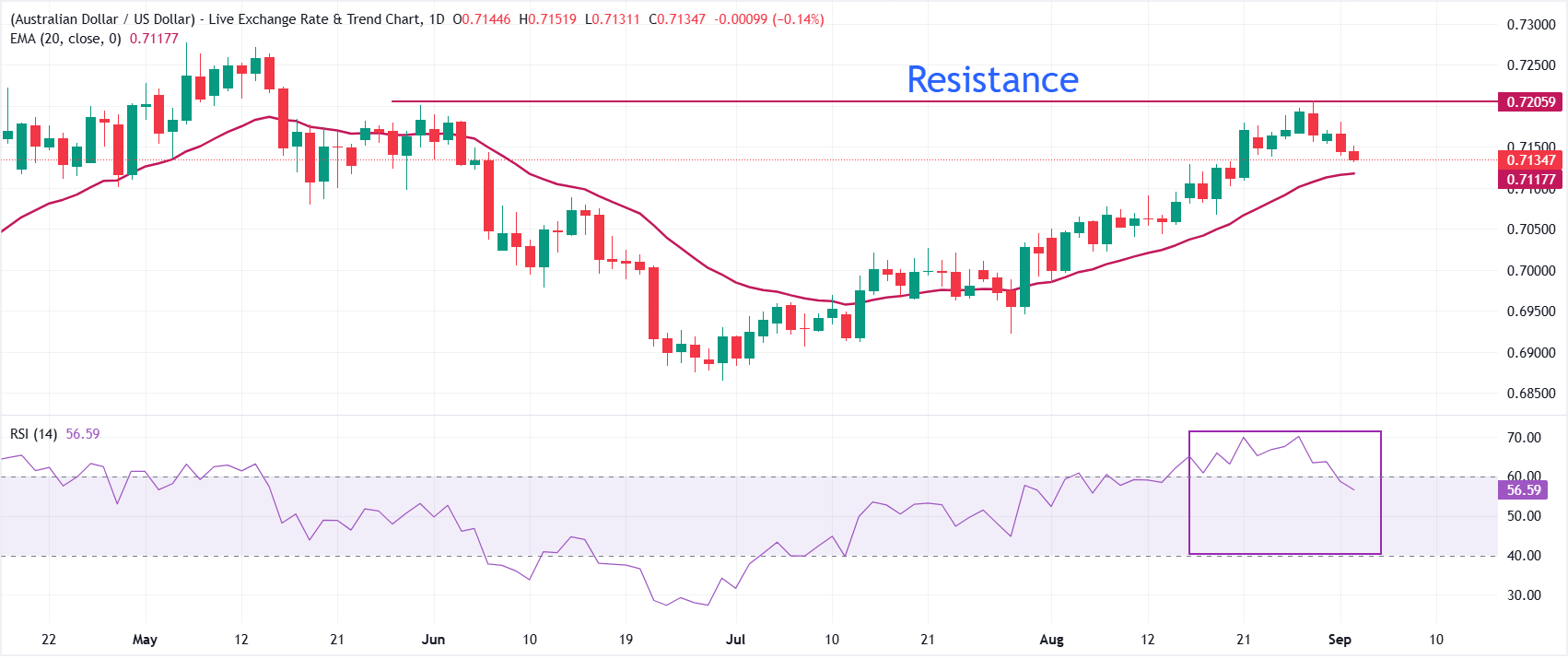
In the daily chart, AUD/USD trades at 0.7135, holding a modest bullish bias as price remains above the 20-day exponential moving average (EMA) at 0.7118. The pair is consolidating just off recent highs, while the Relative Strength Index (RSI) around 56 suggests positive but not overstretched momentum, hinting that buyers still retain the near-term advantage.
On the downside, initial support emerges at the day’s open near 0.7135, with the 20-day EMA at 0.7118 reinforcing a nearby demand zone that would need to give way to ease the current constructive tone. With no clear overhead technical caps immediately in play from this dataset, further gains could see the pair extending its advance so long as it continues to defend this support band.
(The technical analysis of this story was written with the help of an AI tool. Know more.)
Fed’s Barr warns on sticky inflation, keeps rate hike option alive
Fed’s Barr delivered a modestly more hawkish tone, with the FXS Speechtracker score at 7/10, slightly above the 6.8/10 historical average, underscoring concern that inflation “remains too high” even as the labor market stays stable and the economy grows “solidly” on Artificial Intelligence investment. The key remark that steady rates are favored only if there is confidence inflation is moderating, coupled with a clear warning that a lack of progress would warrant an interest rate hike, keeps upside risks to the Dollar intact and reinforces a conditional tightening bias. The emphasis on persistent inflation risks, despite low unemployment, suggests limited near-term scope for policy easing and supports a higher-for-longer rate narrative.
The FXS Fed Sentiment Index slipped by 0.42 points to 128.86, signaling a slight pullback in perceived hawkishness even as the gauge remains firmly above the neutral 100 mark. This configuration indicates that, while the immediate tone is marginally less hawkish than prior readings, the overall stance remains clearly restrictive, and the combination of a high index level and a solid FXS Speechtracker score continues to favor the Dollar over lower-yielding currencies.
Author

Sagar Dua
FXStreet
Sagar Dua is associated with the financial markets from his college days. Along with pursuing post-graduation in Commerce in 2014, he started his markets training with chart analysis.