Australian Dollar cools off against the New Zealand Dollar before jobs data
- AUD/NZD cools off below 1.2450 before jobs data, off a 13-year high.
- RBA cash rate at 4.35% against the RBNZ's 2.75%.
- RBA decides on September 29, the RBNZ on October 28.

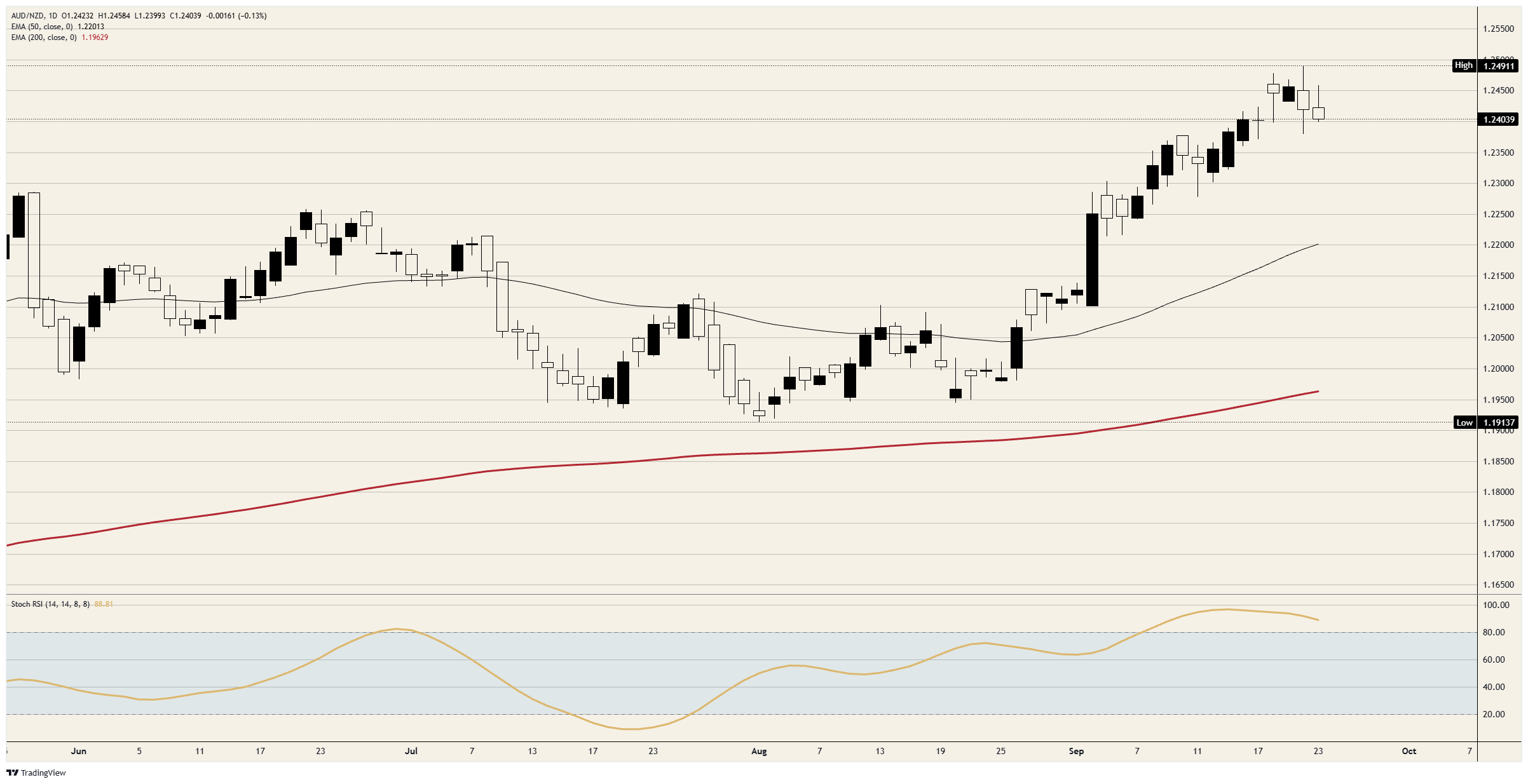
Tuesday's peak just under 1.2500 was the highest for AUD/NZD since early 2013. The cross is trading just above 1.2400, on track for a second straight down day.
The climb has come from the gap between the two countries' interest rates. The Reserve Bank of Australia (RBA) has its cash rate at 4.35% and is widely expected to raise it to 4.60% on September 29. The Reserve Bank of New Zealand (RBNZ) is at 2.75%, and its own forecast points to no change on October 28. The RBNZ raised its rate on September 2 and the Kiwi still fell against the Aussie that day, because the forecast published with the hike pointed to that pause.
A good Australian jobs number has little left to add
Australia's employment report comes out at 01:30 GMT on Thursday, with a 20K gain in jobs and a steady 4.5% jobless rate forecast. A result like that keeps the RBA on course for September 29, and a soft one raises doubts about the hike. New Zealand has no data of its own before the weekend.
A strong report would mostly confirm a gap that is already wide. In early 2013, the two cash rates were half a point apart, and an RBA hike would take the gap to 1.85 percentage points.
Levels and bias
Resistance: 1.2450 capped Wednesday's bounce. Above it, Tuesday's high just under 1.2500 is the cap, and 1.2500 itself hasn't traded since early 2013.
Support: The 1.2400 area has held Wednesday's dip so far, with Tuesday's low just under it. Below that, 1.2350, then 1.2300, the old ceiling that capped the cross in early September before it broke higher on September 8.
Bias: A cautious short below 1.2450, looking for a pullback to 1.2350 and then 1.2300 rather than a turn in the trend. The daily Stochastic Relative Strength Index (Stoch RSI) turned down from the top of its range and reads near 89. A daily close above 1.2500 calls off the short.
AUD/NZD daily chart
Australian Dollar FAQs
One of the most significant factors for the Australian Dollar (AUD) is the level of interest rates set by the Reserve Bank of Australia (RBA). Because Australia is a resource-rich country another key driver is the price of its biggest export, Iron Ore. The health of the Chinese economy, its largest trading partner, is a factor, as well as inflation in Australia, its growth rate and Trade Balance. Market sentiment – whether investors are taking on more risky assets (risk-on) or seeking safe-havens (risk-off) – is also a factor, with risk-on positive for AUD.
The Reserve Bank of Australia (RBA) influences the Australian Dollar (AUD) by setting the level of interest rates that Australian banks can lend to each other. This influences the level of interest rates in the economy as a whole. The main goal of the RBA is to maintain a stable inflation rate of 2-3% by adjusting interest rates up or down. Relatively high interest rates compared to other major central banks support the AUD, and the opposite for relatively low. The RBA can also use quantitative easing and tightening to influence credit conditions, with the former AUD-negative and the latter AUD-positive.
China is Australia’s largest trading partner so the health of the Chinese economy is a major influence on the value of the Australian Dollar (AUD). When the Chinese economy is doing well it purchases more raw materials, goods and services from Australia, lifting demand for the AUD, and pushing up its value. The opposite is the case when the Chinese economy is not growing as fast as expected. Positive or negative surprises in Chinese growth data, therefore, often have a direct impact on the Australian Dollar and its pairs.
Iron Ore is Australia’s largest export, accounting for $118 billion a year according to data from 2021, with China as its primary destination. The price of Iron Ore, therefore, can be a driver of the Australian Dollar. Generally, if the price of Iron Ore rises, AUD also goes up, as aggregate demand for the currency increases. The opposite is the case if the price of Iron Ore falls. Higher Iron Ore prices also tend to result in a greater likelihood of a positive Trade Balance for Australia, which is also positive of the AUD.
The Trade Balance, which is the difference between what a country earns from its exports versus what it pays for its imports, is another factor that can influence the value of the Australian Dollar. If Australia produces highly sought after exports, then its currency will gain in value purely from the surplus demand created from foreign buyers seeking to purchase its exports versus what it spends to purchase imports. Therefore, a positive net Trade Balance strengthens the AUD, with the opposite effect if the Trade Balance is negative.
Author

Joshua Gibson
FXStreet
Joshua joins the FXStreet team as an Economics and Finance double major from Vancouver Island University with twelve years' experience as an independent trader focusing on technical analysis.