AUD/USD Price Forecast: Struggles to extend rally above 0.7100
- AUD/USD falls further to near 0.7050 as the Australian Dollar faces selling pressure.
- Financial markets seem unconvinced by the RBA’s hawkish remarks.
- The US Dollar gains even as traders have trimmed hawkish Fed bets.

The Australian Dollar (AUD) trades 0.17% lower at around 0.7050 against the US Dollar (USD) during the early European trading session on Thursday. The Aussie pair extends Wednesday’s correction, which started after revisiting the two-month high near 0.7090, as financial markets remain unconvinced by the Reserve Bank of Australia’s (RBA) hawkish tone.
On Tuesday, the RBA left its Official Cash Rate (OCR) unchanged at 4.35%, as expected, and explicitly said that the central bank won’t hesitate to raise interest rates further, citing upside inflation risks.
Contrary to the RBA’s hawkish remarks, financial markets believe that the RBA’s appetite to tighten monetary conditions appears very weak.
Analysts at Standard Chartered note that, at the press conference, Governor Bullock “talked up the uncertainty around the RBA’s central forecasts and did not rule out the need for more policy tightening in the immediate future if upside inflation risks materialise.”
Despite this hawkish nuance, Standard Chartered emphasises that “our base case remains no more RBA rate hikes in the foreseeable future.” The bank cautions, however, that “the risk to our view is skewed towards a hike in Q4 if demand does not slow sufficiently or if energy prices revisit recent highs, exacerbating both capacity and price pressures.”
Ultimately, “easing labour-market conditions, if sustained, should help contain underlying wage and price pressures in the economy,” supporting their view that further tightening is not the central scenario even as the RBA keeps its options open," Standard Chartered added.
Meanwhile, an upbeat US Dollar, despite traders paring back hawkish Federal Reserve (Fed) bets for the September meeting, is also hurting the Aussie pair.
AUD/USD Technical Analysis
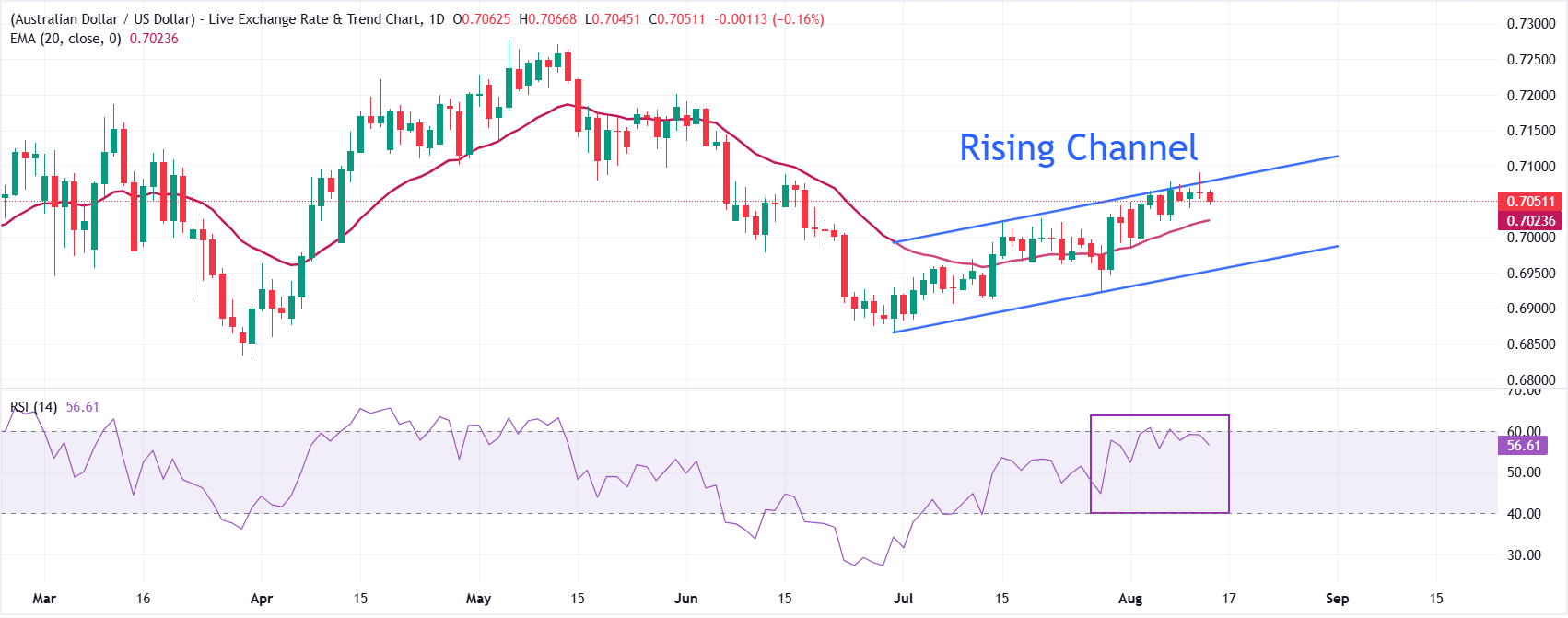
AUD/USD trades lower at around 0.7050, but is holding a constructive bullish bias as it remains within an upward parallel channel. The pair is trading above the 20-day exponential moving average (EMA) at 0.7024, which suggests underlying demand, while the channel top near 0.7077 caps the immediate topside.
The Relative Strength Index (RSI) at 56.69 stays in positive territory, hinting that bullish momentum is intact though not overstretched.
On the downside, initial support is located at the 20-day EMA at 0.7024, ahead of the lower boundary of the rising channel around 0.6951, with a deeper structural floor toward 0.6866. On the topside, a sustained break above the channel resistance at 0.7077 would open the way for further gains within the broader ascending structure. Above 0.7077, major hurdles are the round-level resistance at 0.7100, followed by the June 5 high at 0.7144.
(The technical analysis of this story was written with the help of an AI tool. Know more.)
Economic Indicator
RBA Interest Rate Decision
The Reserve Bank of Australia (RBA) announces its interest rate decision at the end of its eight scheduled meetings per year. If the RBA is hawkish about the inflationary outlook of the economy and raises interest rates it is usually bullish for the Australian Dollar (AUD). Likewise, if the RBA has a dovish view on the Australian economy and keeps interest rates unchanged, or cuts them, it is seen as bearish for AUD.
Read more.Last release: Tue Aug 11, 2026 04:30
Frequency: Irregular
Actual: 4.35%
Consensus: 4.35%
Previous: 4.35%
Source: Reserve Bank of Australia
Author

Sagar Dua
FXStreet
Sagar Dua is associated with the financial markets from his college days. Along with pursuing post-graduation in Commerce in 2014, he started his markets training with chart analysis.