AUD/USD Price Forecast: Picks up above 0.7120 after finding support in the 0.7100 area
- AUD/USD holds above 0.7100 after falling from 0.7174 highs on Wednesday.
- An unexpected rise in Australian unemployment adds to the case for an RBA rate pause.
- The pair is trading in a triangle pattern, with a bearish outcome favoured.

The Australian Dollar (AUD) gives away gains against the US Dollar (USD) on Thursday, as soft Australian employment data cemented hopes that the Reserve Bank of Australia (RBA) will take a pause in the coming months after three consecutive rate hikes. The pair trades at 0.7126 at the time of writing, after bouncing from lows near 0.7100, but remains well below Wednesday's highs, at 0.7174..
Australian unemployment rate rose to 4.5% in April, according to the Australian Bureau of Statistics, reaching its highest level since 2021, against expectations of a steady 4.3% rate. The jump in the jobless rate was due to an unexpected decline in net employment, which fell by 18.6K against the 17.5K increase expected.
Aussie's weakness, however, is being tamed by a mild improvement in market sentiment as US President Donald Trump affirmed that Washington and Tehran would be in the final stages of a peace deal.
Technical Analysis: The pair is forming a small triangle pattern
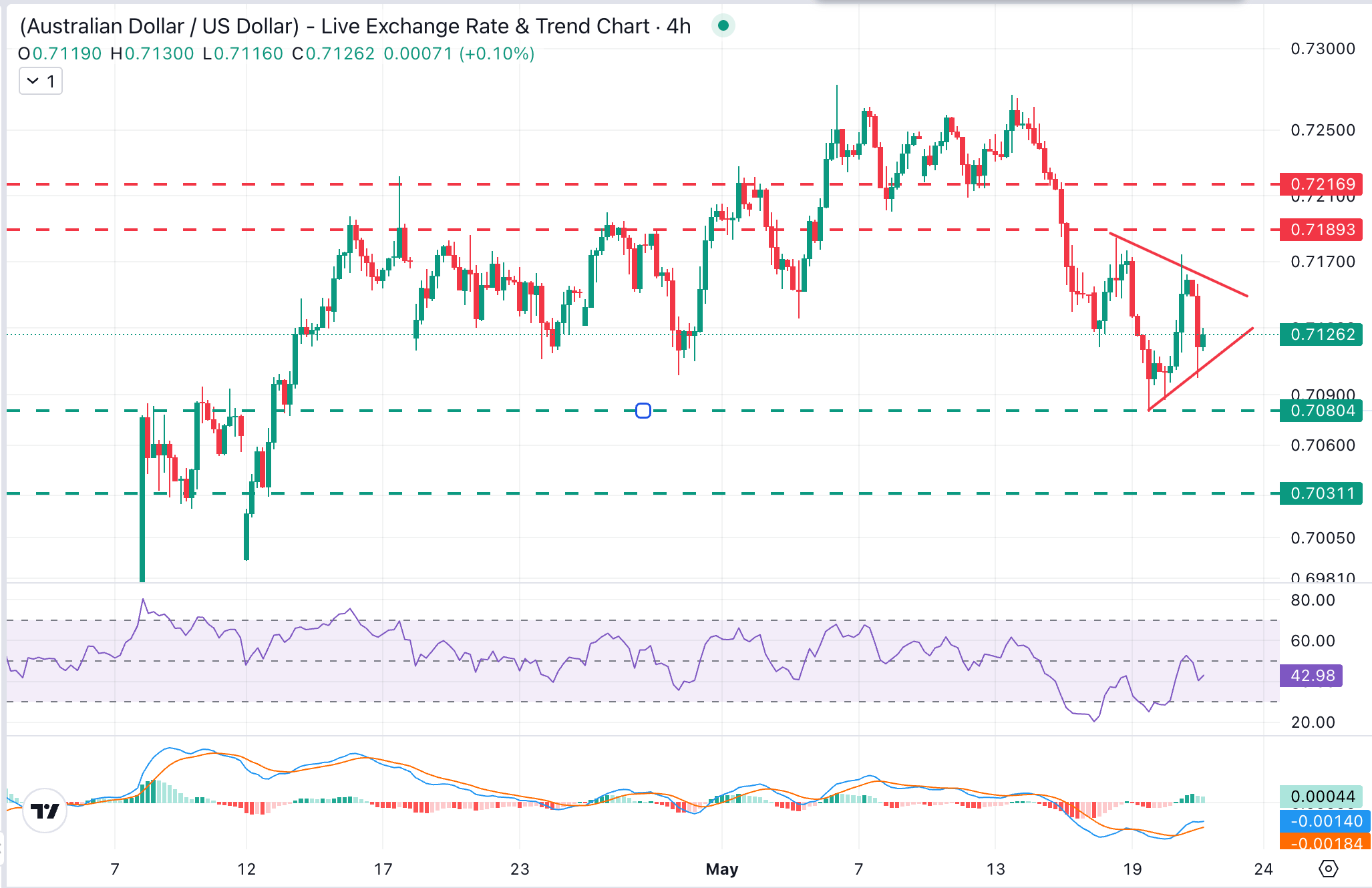
AUD/USD trades at the lower band of the monthly trading range, with price action forming ang a small triangle pattern. Triangles are considered continuation patterns, and, in this case, would anticipate a bearish outcome.
Momentum indicators, in the 4-hour chart, are mixed. The Relative Strength Index (RSI) remains capped below the 50 line, highlighting a mild bearish pressure, while the Moving Average Convergence Divergence (MACD) has turned marginally positive, hinting that bullish momentum is attempting to rebuild above recent lows.
Initial support is seen at the uptrend line around 0.7108, with additional protection emerging at the 0.7080 area (April 14, May 10 lows). A break below this band would expose an intraday support area at 0.7030.
Rallies, on the contrary, are likely to be tested in the area between the triangle top, near 0.7160, and Wednesday's high, at the mentioned 0.7174 level. Further up, Monday's high, at 0.7185, will also challenge bulls ahead of a previous support area, near 0.7215.
(The technical analysis of this story was written with the help of an AI tool.)
Australian Dollar Price Today
The table below shows the percentage change of Australian Dollar (AUD) against listed major currencies today. Australian Dollar was the strongest against the New Zealand Dollar.
| USD | EUR | GBP | JPY | CAD | AUD | NZD | CHF | |
|---|---|---|---|---|---|---|---|---|
| USD | -0.01% | -0.00% | 0.06% | 0.11% | 0.38% | 0.19% | -0.02% | |
| EUR | 0.00% | -0.00% | 0.09% | 0.10% | 0.38% | 0.15% | -0.02% | |
| GBP | 0.00% | 0.00% | 0.09% | 0.11% | 0.40% | 0.17% | -0.02% | |
| JPY | -0.06% | -0.09% | -0.09% | 0.02% | 0.33% | 0.04% | -0.09% | |
| CAD | -0.11% | -0.10% | -0.11% | -0.02% | 0.31% | 0.07% | -0.14% | |
| AUD | -0.38% | -0.38% | -0.40% | -0.33% | -0.31% | -0.23% | -0.44% | |
| NZD | -0.19% | -0.15% | -0.17% | -0.04% | -0.07% | 0.23% | -0.20% | |
| CHF | 0.02% | 0.02% | 0.02% | 0.09% | 0.14% | 0.44% | 0.20% |
The heat map shows percentage changes of major currencies against each other. The base currency is picked from the left column, while the quote currency is picked from the top row. For example, if you pick the Australian Dollar from the left column and move along the horizontal line to the US Dollar, the percentage change displayed in the box will represent AUD (base)/USD (quote).
Author
Guillermo Alcala
FXStreet
Graduated in Communication Sciences at the Universidad del Pais Vasco and Universiteit van Amsterdam, Guillermo has been working as financial news editor and copywriter in diverse Forex-related firms, like FXStreet and Kantox.