AUD/USD Price Forecast: Continues to hold key support level of around 0.6900
- AUD/USD declines to near 0.6975 as the Australian Dollar underperforms across the board.
- Australian CPI growth cools down to 3.7% YoY in February.
- Iran’s denial of its involvement in de-escalation talks with the US continues to support the US Dollar.

The AUD/USD pair trades 0.3% lower to near 0.6975 during the late Asian trading session on Wednesday. The Aussie pair faces selling pressure as the Australian Dollar (AUD) underperforms its peers, even as market sentiment has improved, following reports that the United States (US) is pursuing a month-long ceasefire plan with Iran.
S&P 500 futures are up 0.8% around 6,610 in the Asian trade, reflecting the increased risk appetite of investors.
On the domestic front, the Consumer Price Index (CPI) data for February has arrived lower at 3.7% Year-on-Year (YoY) compared to estimates and the previous reading of 3.8%. On a monthly basis, the CPI remained flat, as expected, against 0.4% growth seen in January.
A slight slowdown in the Australian inflation growth is unlikely to impact market expectations towards the Reserve Bank of Australia’s (RBA) monetary policy outlook, as they don’t reflect the impact of the recent surge in energy prices amid Middle East conflicts.
Meanwhile, the US Dollar (USD) trades higher as Iran continues to deny involvement in negotiations with the US regarding the de-escalation in the war.
AUD/USD technical analysis
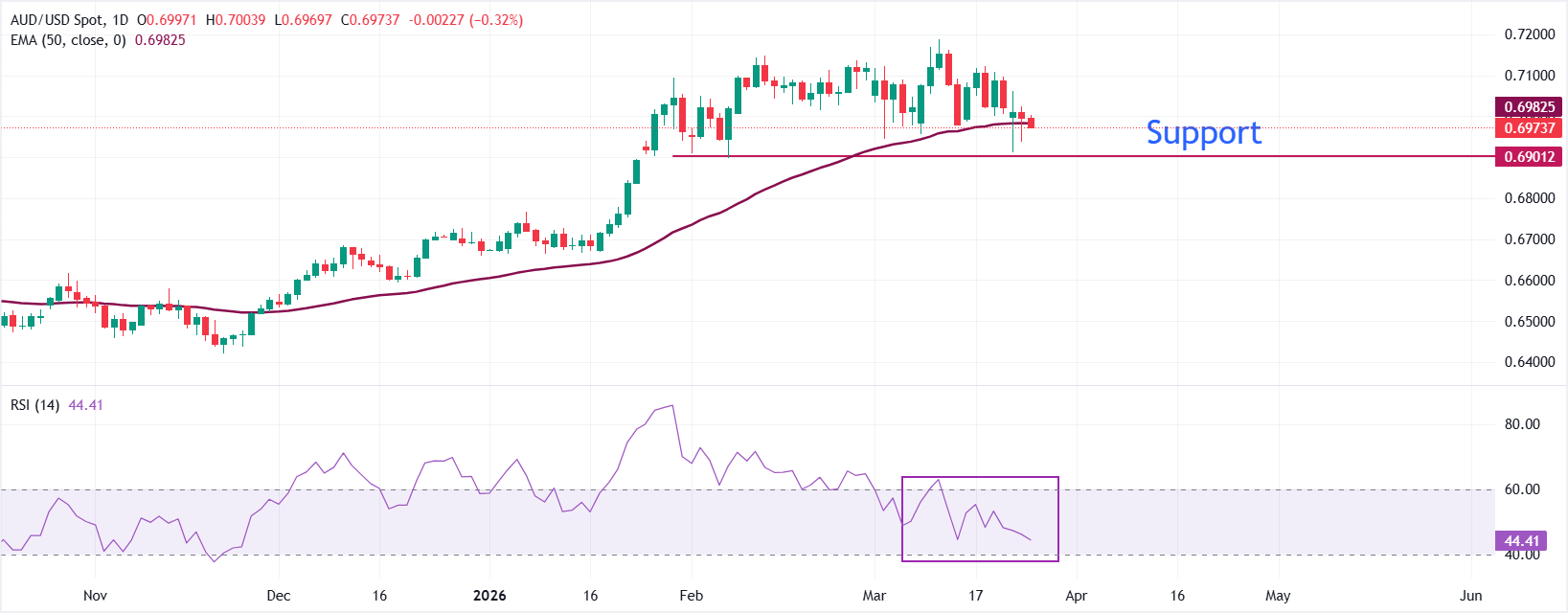
AUD/USD weakens to near 0.6975 in the Asian trade on Wednesday. The near-term bias leans neutral-to-bearish as spot trades broadly confined to near the 50-day Exponential Moving Average (EMA), which has flattened just below 0.70 after previously guiding the advance.
Price has lost topside momentum after failing to sustain gains above 0.71 on several attempts this month, reinforcing the impression of a capped upswing rather than a trending market.
The 14-day Relative Strength Index (RSI) has retreated toward the mid-40s from overbought territory seen earlier in the sequence, signaling fading bullish momentum and leaving sellers with a slight tactical edge while the pair holds below recent highs.
Immediate resistance emerges at 0.7020, where recent intraday rebounds stalled, followed by the 0.7080 area that coincides with this month’s congestion band and guards the 0.7120 peak. A daily close above 0.7120 would be needed to reassert a bullish structure and open the way toward the mid-0.71s.
On the downside, initial support sits near 0.6950 around the 50-day EMA, with a break lower exposing 0.6920 and then 0.6880 as deeper retracement levels within the broader medium-term recovery. A clear move below 0.6880 would shift the focus toward a more decisive bearish phase rather than consolidation.
(The technical analysis of this story was written with the help of an AI tool.)
Economic Indicator
Consumer Price Index (YoY)
The Consumer Price Index (CPI), released by the Australian Bureau of Statistics on a monthly basis, measures the changes in the price of a comprehensive basket of goods and services acquired by household consumers. The indicator is the primary measure of headline inflation after a new methodology was applied to transition from quarterly to monthly readings, applying to data from April 2024 onwards. The YoY reading compares prices in the reference month to the same month a year earlier. A high reading is seen as bullish for the Australian Dollar (AUD), while a low reading is seen as bearish.
Read more.Last release: Wed Mar 25, 2026 00:30
Frequency: Monthly
Actual: 3.7%
Consensus: 3.8%
Previous: 3.8%
Source: Australian Bureau of Statistics
Author

Sagar Dua
FXStreet
Sagar Dua is associated with the financial markets from his college days. Along with pursuing post-graduation in Commerce in 2014, he started his markets training with chart analysis.

















