AUD/USD Price Forecast: Bulls test 0.6950 resistance after rebound from 100-day SMA
- AUD/USD firms as the US Dollar softens ahead of Trump’s Iran deadline.
- Technically, AUD/USD is currently testing the 0.6950 level, a former support that now acts as immediate resistance.
- Momentum indicators improve as RSI recovers toward 50, and MACD signals fading bearish pressure.

The Australian Dollar (AUD) strengthens against the US Dollar (USD) on Tuesday as the Greenback softens amid fragile market sentiment ahead of a deadline set by US President Donald Trump for Iran to reach a deal or reopen the Strait of Hormuz by 8:00 p.m. Eastern Time (00:00 GMT on Wednesday).
At the time of writing, the pair is trading around 0.6955, up nearly 0.54% on the day. Meanwhile, the US Dollar Index (DXY), which tracks the Greenback's value against a basket of six major currencies, is trading around 99.80 after failing to sustain gains above the 100 mark.
Beyond USD weakness, the Australian Dollar is also supported by strength in the Chinese Yuan (CNY), after the People's Bank of China set the daily reference rate at 6.8854, its strongest level in nearly three years. The AUD is widely seen as a proxy for China’s economy, given Australia’s close trade ties with the country.
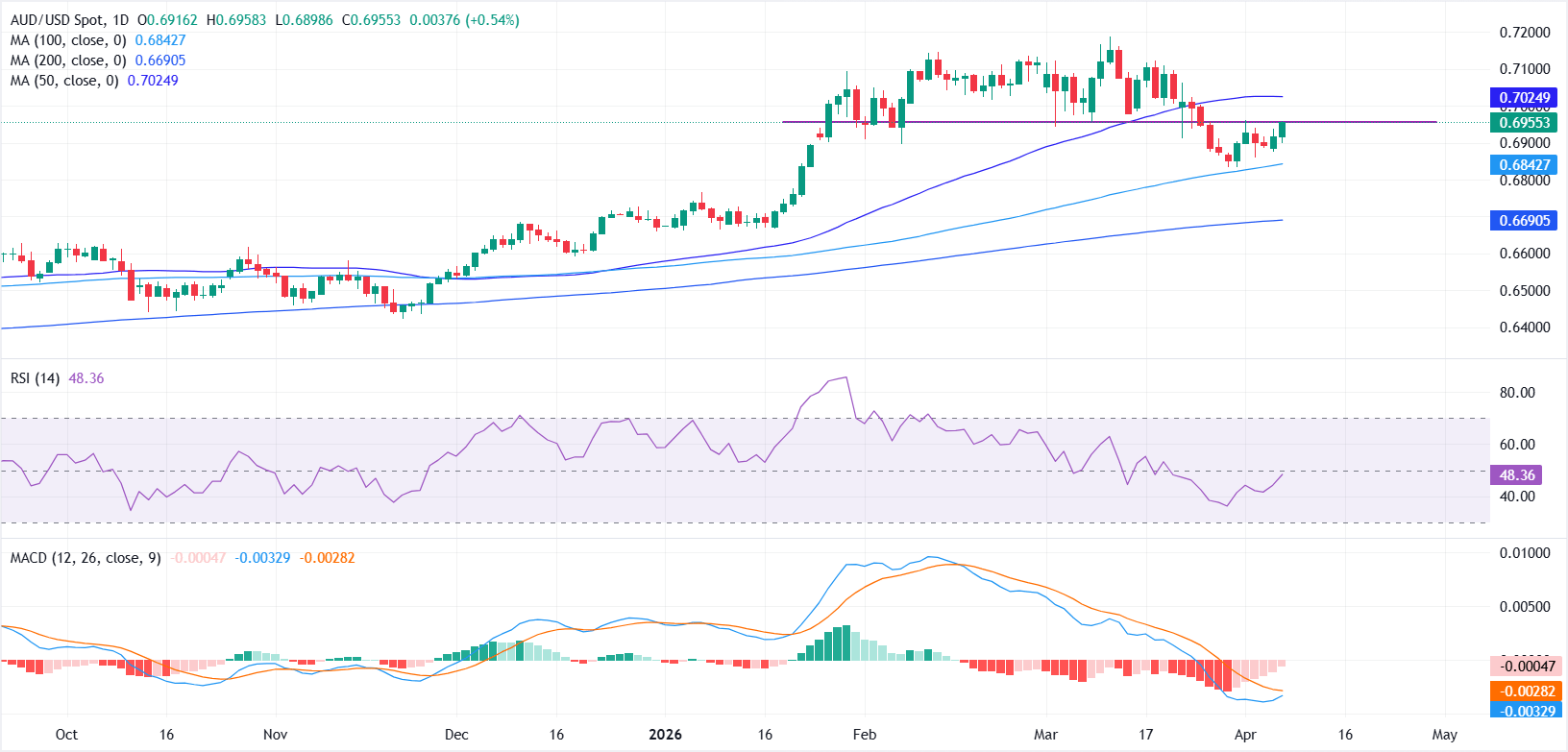
From a technical perspective, the daily chart shows AUD/USD attempting a modest recovery after finding support above the 100-day Simple Moving Average (SMA) at 0.6842. The pair is currently testing the 0.6950 level, which previously served as a key support and is now acting as immediate resistance.
A break above this area could open the door toward the 0.7000 psychological level, which closely aligns with the 50-day Simple Moving Average (SMA) at 0.7024.
On the downside, immediate support lies near the 100-day SMA. A break below this level on a daily closing basis could open the door toward the 0.6700 psychological level, which marks a previous breakout zone.
The Relative Strength Index (RSI) has recovered toward the 50 level, indicating stabilizing momentum after a prior loss of upside pressure. Meanwhile, the Moving Average Convergence Divergence (MACD) line remains slightly below the signal line but is edging higher toward the zero line, suggesting bearish momentum is fading. The MACD histogram is also narrowing, reinforcing the view that downside pressure is easing.
Australian Dollar FAQs
One of the most significant factors for the Australian Dollar (AUD) is the level of interest rates set by the Reserve Bank of Australia (RBA). Because Australia is a resource-rich country another key driver is the price of its biggest export, Iron Ore. The health of the Chinese economy, its largest trading partner, is a factor, as well as inflation in Australia, its growth rate and Trade Balance. Market sentiment – whether investors are taking on more risky assets (risk-on) or seeking safe-havens (risk-off) – is also a factor, with risk-on positive for AUD.
The Reserve Bank of Australia (RBA) influences the Australian Dollar (AUD) by setting the level of interest rates that Australian banks can lend to each other. This influences the level of interest rates in the economy as a whole. The main goal of the RBA is to maintain a stable inflation rate of 2-3% by adjusting interest rates up or down. Relatively high interest rates compared to other major central banks support the AUD, and the opposite for relatively low. The RBA can also use quantitative easing and tightening to influence credit conditions, with the former AUD-negative and the latter AUD-positive.
China is Australia’s largest trading partner so the health of the Chinese economy is a major influence on the value of the Australian Dollar (AUD). When the Chinese economy is doing well it purchases more raw materials, goods and services from Australia, lifting demand for the AUD, and pushing up its value. The opposite is the case when the Chinese economy is not growing as fast as expected. Positive or negative surprises in Chinese growth data, therefore, often have a direct impact on the Australian Dollar and its pairs.
Iron Ore is Australia’s largest export, accounting for $118 billion a year according to data from 2021, with China as its primary destination. The price of Iron Ore, therefore, can be a driver of the Australian Dollar. Generally, if the price of Iron Ore rises, AUD also goes up, as aggregate demand for the currency increases. The opposite is the case if the price of Iron Ore falls. Higher Iron Ore prices also tend to result in a greater likelihood of a positive Trade Balance for Australia, which is also positive of the AUD.
The Trade Balance, which is the difference between what a country earns from its exports versus what it pays for its imports, is another factor that can influence the value of the Australian Dollar. If Australia produces highly sought after exports, then its currency will gain in value purely from the surplus demand created from foreign buyers seeking to purchase its exports versus what it spends to purchase imports. Therefore, a positive net Trade Balance strengthens the AUD, with the opposite effect if the Trade Balance is negative.
Author

Vishal Chaturvedi
FXStreet
I am a macro-focused research analyst with over four years of experience covering forex and commodities market. I enjoy breaking down complex economic trends and turning them into clear, actionable insights that help traders stay ahead of the curve.