AUD/USD Price Forecast: Bulls struggle below the 50-day SMA
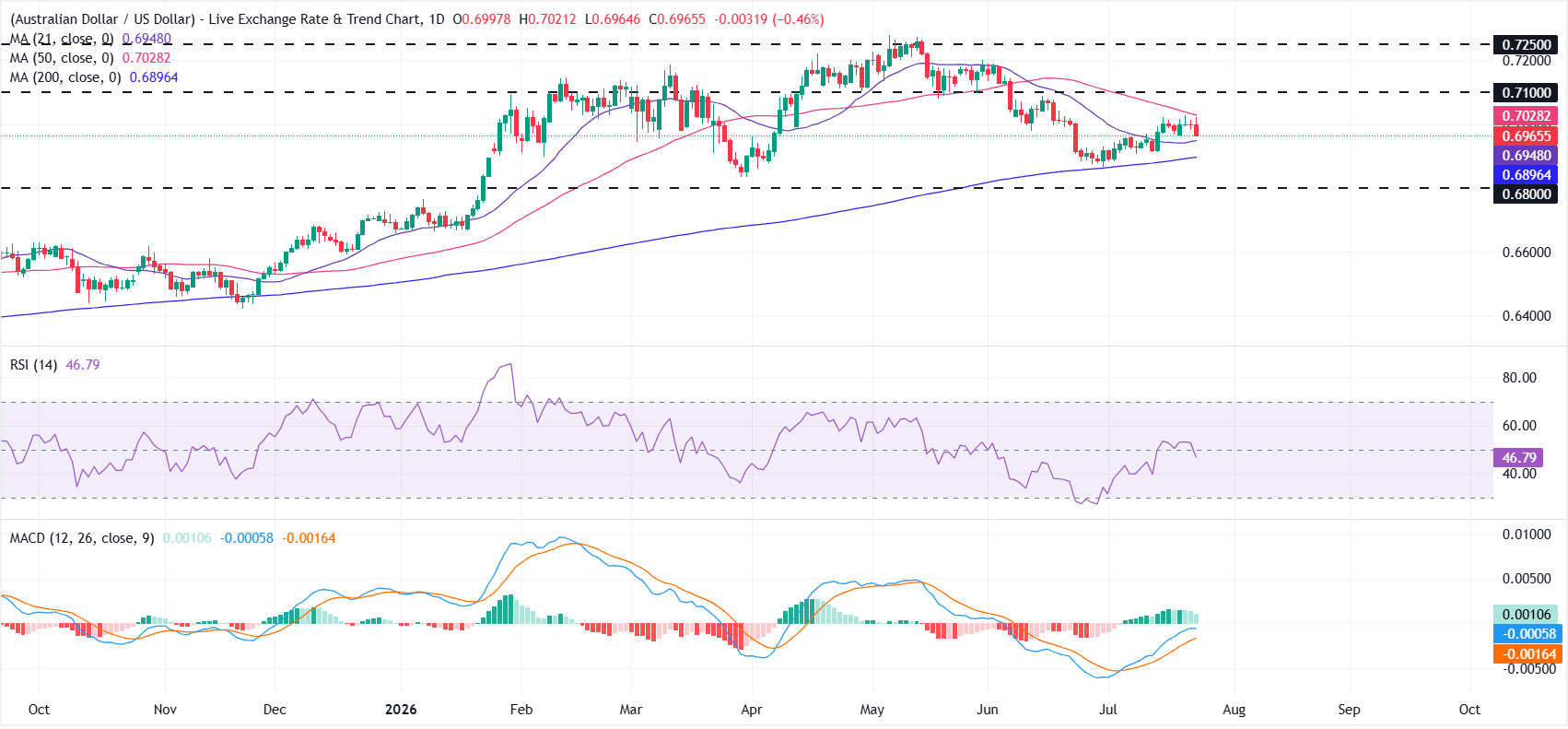
- AUD/USD holds above the 21-day and 200-day SMAs, keeping the near-term outlook mildly positive.
- The 50-day SMA at 0.7028 caps the upside, while momentum indicators show fading buying pressure.
- A break below the 200-day SMA would expose the 0.6800 support level.

AUD/USD edges lower on Thursday as a stronger US Dollar (USD) outweighs support from stronger-than-expected Australian employment data. At the time of writing, the pair trades around 0.6966, down 0.45% on the day.
The US Dollar gains as the Middle East war lifts safe-haven demand, while the resulting surge in Oil prices adds to inflation worries and strengthens expectations that the Federal Reserve (Fed) may need to raise interest rates.
According to the CME FedWatch Tool, markets now see an 83% chance of a rate hike in September. The US Dollar Index (DXY), which tracks the Greenback’s value against a basket of six major currencies, trades around 101.45, its highest level in three weeks.
From a technical standpoint, AUD/USD holds above the 21-day and 200-day Simple Moving Averages (SMAs) at 0.6948 and 0.6896, respectively, keeping the near-term outlook mildly constructive. However, the pair remains capped by the 50-day SMA at 0.7028.
The Relative Strength Index (RSI) near 47 sits just below the neutral 50 level, pointing to subdued momentum. The Moving Average Convergence Divergence (MACD) indicator remains marginally positive, but the fading green histogram suggests that bullish momentum is weakening.
On the upside, initial resistance is seen at the 50-day SMA at 0.7028, followed by the horizontal barrier at 0.7100 and then 0.7250. On the downside, immediate support is located at the 21-day SMA at 0.6948, followed by the 200-day SMA at 0.6896. A sustained break below these levels would expose the 0.6800 mark.
Author

Vishal Chaturvedi
FXStreet
I am a macro-focused research analyst with over four years of experience covering forex and commodities market. I enjoy breaking down complex economic trends and turning them into clear, actionable insights that help traders stay ahead of the curve.

















