AUD/USD Price Forecast: Breaks below 61.8% Fibo retracement at 0.7010
- AUD/USD tumbles below 0.7000 as the Australian Dollar underperforms after the RBA’s policy announcement.
- The RBA hikes its OCR by 25 bps to 4.6% and leaves the door open for further monetary tightening.
- Firm US Treasury Yields have strengthened the US Dollar.

The Australian Dollar (AUD) underperforms its major currency peers during the European trading session on Tuesday. The antipodean is down almost 0.4% below 0.7000 against the US Dollar (USD).
Australian Dollar Price Today
The table below shows the percentage change of Australian Dollar (AUD) against listed major currencies today. Australian Dollar was the weakest against the US Dollar.
| USD | EUR | GBP | JPY | CAD | AUD | NZD | CHF | |
|---|---|---|---|---|---|---|---|---|
| USD | 0.31% | 0.23% | 0.17% | 0.19% | 0.46% | 0.39% | 0.35% | |
| EUR | -0.31% | -0.08% | -0.14% | -0.14% | 0.16% | 0.09% | 0.03% | |
| GBP | -0.23% | 0.08% | -0.04% | -0.05% | 0.22% | 0.16% | 0.11% | |
| JPY | -0.17% | 0.14% | 0.04% | 0.01% | 0.28% | 0.21% | 0.16% | |
| CAD | -0.19% | 0.14% | 0.05% | -0.01% | 0.26% | 0.20% | 0.15% | |
| AUD | -0.46% | -0.16% | -0.22% | -0.28% | -0.26% | -0.06% | -0.12% | |
| NZD | -0.39% | -0.09% | -0.16% | -0.21% | -0.20% | 0.06% | -0.05% | |
| CHF | -0.35% | -0.03% | -0.11% | -0.16% | -0.15% | 0.12% | 0.05% |
The heat map shows percentage changes of major currencies against each other. The base currency is picked from the left column, while the quote currency is picked from the top row. For example, if you pick the Australian Dollar from the left column and move along the horizontal line to the US Dollar, the percentage change displayed in the box will represent AUD (base)/USD (quote).
The Australian currency is under pressure even as Reserve Bank of Australia (RBA) Governor Michele Bullock has delivered hawkish remarks after the central bank decided to raise its Official Cash Rate (OCR) one more time this year.
Analysts at MUFG note that the Australian Dollar “has softened overnight falling back below the 0.7000-level against the US Dollar,” even as the currency’s yield appeal remains intact. They highlight that the Aussie’s position “as one of the highest yielding G10 currencies was supported overnight by the RBA’s decision to hike rates for the fourth time this year lifting the policy rate up to 4.60%.”
MUFG points out that the RBA reiterated it will “continue to do what it considers necessary to bring inflation sustainably back to target, including increasing the cash rate target further if needed,” underlining its willingness to tighten further if required. However, they add that Governor Bullock struck a more cautious note in the press conference, saying she hopes that “four hikes are restrictive enough to slow inflation, but she doesn’t know,” a remark that has tempered expectations for additional near-term tightening and contributed to the softer tone in AUD.
Meanwhile, the US Dollar outperforms due to firm United States (US) Treasury Yields. In the European trade, the US Dollar Index (DXY), which gauges the Greenback’s value against six major currencies, revisits the two-month high at 101.50. 10-year US Treasury Yields trade close to its 19-year high of 5.27% posted on Monday.
AUD/USD Technical Analysis
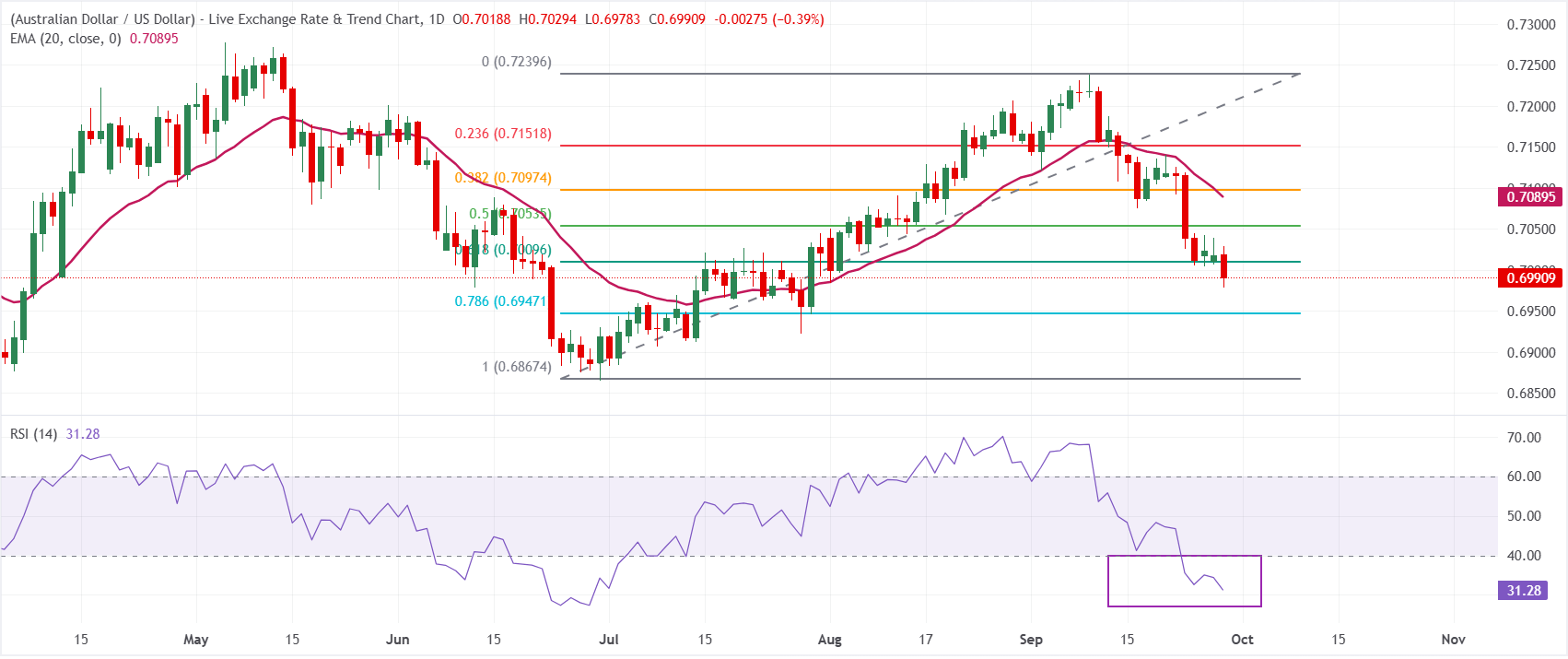
In the daily chart, AUD/USD trades around 0.6991, keeping a bearish near-term bias as spot holds below the 20-period exponential moving average (EMA) at 0.7090 and a dense cluster of Fibonacci retracements overhead. The pair has slipped under the key 61.8% retracement at 0.7010, leaving recent rebounds capped and reinforcing a downside tone, while the Relative Strength Index (14) near 31 hints at emerging oversold conditions that could slow, but not yet reverse, the current decline.
On the topside, initial resistance appears at the 61.8% Fibonacci retracement at 0.7010, followed by the 50.0% level at 0.7054, with the 20-period EMA at 0.7090 and the 38.2% retracement at 0.7097 forming a broader supply zone before the 23.6% level at 0.7152 and the 0.7240 cycle high. On the downside, support is seen first at the 78.6% retracement at 0.6947, ahead of the structural floor around 0.6867, where a deeper pullback could attempt to stabilize.
(The technical analysis of this story was written with the help of an AI tool. Know more.)
Economic Indicator
RBA Interest Rate Decision
The Reserve Bank of Australia (RBA) announces its interest rate decision at the end of its eight scheduled meetings per year. If the RBA is hawkish about the inflationary outlook of the economy and raises interest rates it is usually bullish for the Australian Dollar (AUD). Likewise, if the RBA has a dovish view on the Australian economy and keeps interest rates unchanged, or cuts them, it is seen as bearish for AUD.
Read more.Last release: Tue Sep 29, 2026 04:30
Frequency: Irregular
Actual: 4.6%
Consensus: 4.6%
Previous: 4.35%
Source: Reserve Bank of Australia
Author

Sagar Dua
FXStreet
Sagar Dua is associated with the financial markets from his college days. Along with pursuing post-graduation in Commerce in 2014, he started his markets training with chart analysis.