|

AUD/USD dips on risk-off mood, RBNZ's dovish pivot

  • AUD/USD falls 0.73% as RBNZ's cautious rate decision overshadows Australia's inflation report.
  • US economic data reveals growth, with GDP at 3.2% YoY, influencing global market sentiment.
  • Upcoming Australian Retail Sales expected to show recovery, with market forecasting a 1.5% rise MoM.

The Australian Dollar (AUD) dropped 0.73%, against the US Dollar (USD) on Wednesday/s session, courtesy of a dovish hold by the Reserve Bank of New Zealand (RBNZ), which followed a solid inflation report from Australia. As the Asian session begins, the AUD/USD trades at 0.6496, virtually unchanged.

AUD/USD retreats as investors weigh RBNZ's rate hold and anticipate Australian retail sales data

Wall Street finished with losses, as depicted by the S&P 500, down 0.30%. Economic data from the United States (US) showed the US economy is growing above the trend needed to drive inflation toward the US Federal Reserve's 2% target. the Gross Domestic Product (GDP) for the last quarter of 2023 grew by 3.2% YoY, below estimates of 3.3% and Q3 4.9%.

Besides that, Fed speakers stuck to their cautious stance, with Boston Fed President Susan Collins and New York Fed President John Williams supporting rate cuts later in the year. Collins noted that the road to achieving the inflation target would be “bumpy,” Williams said, “We still have a ways to go on the journey to sustained 2% inflation.”

Aside from this, Australian inflation data adopted a back seat as the RBNZ grabbed the attention with its decision to hold rates at 5.50% while removing hawkish comments from the monetary policy statement. AUD/USD and NZD/USD traders gathered more signals from RBNZ Governor Adrian Orr's Q&A session. He said there were discussions about a rate hike. Still, the strong consensus aimed to keep the current level of tightening, adding that some variables revealed that monetary policy is working.

What to watch?

Ahead of the Asian session, the Aussie’s economic docket will feature Retail Sales data, with the consensus expecting a jump from -2.7% to 1.5% MoM in January.

AUD/USD Price Analysis: Technical outlook

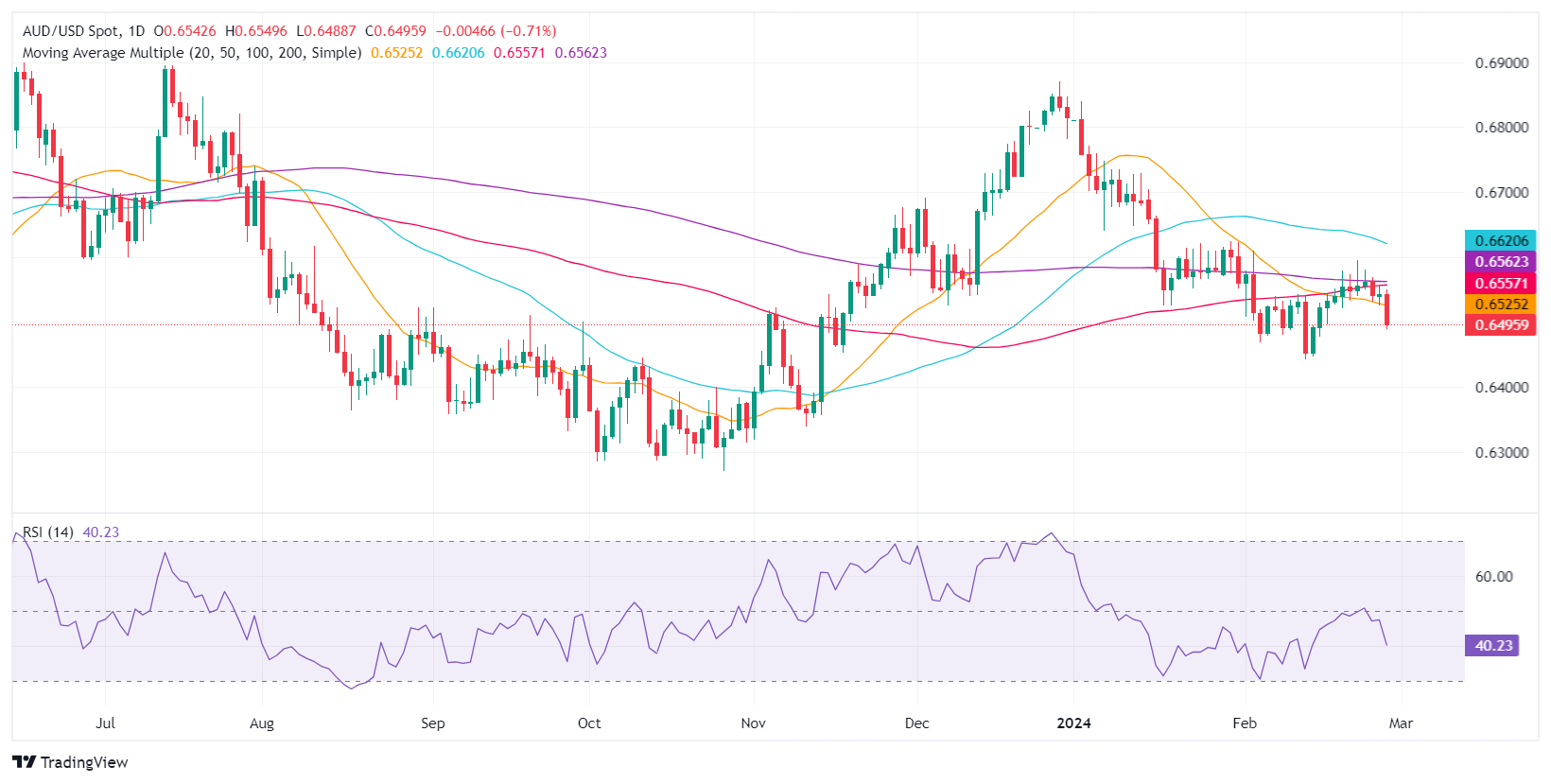
The AUD/USD pair shifted bearish bias after hovering around a narrow range of 0.6520-0.6580 and failing to crack the 200-day Moving Average (DMA) at 0.6559. that, along with fundamental reasons, pushed the spot price below the 0.6500 figure and extended its losses to a 9-day low. A fall below that area would expose the February 13 low of 0.6442, which, once cleared, could pave the way to test 0.6400. Conversely, if buyers reclaim 0.6500, they must regain the 100-DMA at 0.6533.
AUD/USD

Overview
Today last price0.6496
Today Daily Change-0.0046
Today Daily Change %-0.70
Today daily open0.6542
 
Trends
Daily SMA200.6528
Daily SMA500.6625
Daily SMA1000.6556
Daily SMA2000.6563
 
Levels
Previous Daily High0.6558
Previous Daily Low0.6525
Previous Weekly High0.6595
Previous Weekly Low0.6522
Previous Monthly High0.6839
Previous Monthly Low0.6525
Daily Fibonacci 38.2%0.6545
Daily Fibonacci 61.8%0.6538
Daily Pivot Point S10.6526
Daily Pivot Point S20.6509
Daily Pivot Point S30.6493
Daily Pivot Point R10.6559
Daily Pivot Point R20.6575
Daily Pivot Point R30.6592

Author

Christian Borjon Valencia

Markets analyst, news editor, and trading instructor with over 14 years of experience across FX, commodities, US equity indices, and global macro markets.


More from Christian Borjon Valencia
Share:

Editor's Picks

AUD/USD bulls regain control above 0.6950 amid USD retreat

AUD/USD regains traction and extends the previous day's bounce from the weekly low, aiming for 0.7000 in Asia on Friday. The overnight pullback in US bond yields keeps the US Dollar below an 18-month high, which in turn offers some support to the pair. Meanwhile, hawkish RBA expectations also keep the major underpinned.

USD/JPY holds gains near 158.00 after Japan's weak Household Spending data

USD/JPY clings to gains around 158.00 after data showed on Friday that Japan's Household Spending fell for the ninth straight month, undermining the Japanese Yen. Meanwhile, the US Dollar remains depressed as the overnight fall in US bond yields counters a hawkish Fed and geopolitical uncertainties, could cap any downside in the pair.

Gold remains range-bound below $4,200

Gold has given up some ground after an initial bullish attempt to reach weekly highs, returning to below the $4,200 mark per troy ounce on Friday. The US Dollar’s strong upside momentum, combined with rising US Treasury yields across the curve, seems to keep further gains in the yellow metal under scrutiny.

Has Bitcoin really escaped the macro forces it was built to fight?
Over 17 years ago, Satoshi Nakamoto designed Bitcoin (BTC) on the back of a global financial crisis as an alternative to the global monetary system outside the control of central banks, governments and traditional intermediaries. This raises a key question: has Bitcoin really become independent of the macroeconomic forces it was built to challenge?
The Euro is not the sick man of Europe. France's bond market is
EUR/USD remains under pressure, near the 17-month low of 1.1161 reached on Monday. The pair has lost more than 7% since its yearly peak, as concerns over France's public finances increasingly weigh on the single currency. But behind the weakness of the Euro (EUR), the problem does not necessarily lie with the European economy as a whole.
Has Bitcoin really escaped the macro forces it was built to fight?
Over 17 years ago, Satoshi Nakamoto designed Bitcoin (BTC) on the back of a global financial crisis as an alternative to the global monetary system outside the control of central banks, governments and traditional intermediaries. This raises a key question: has Bitcoin really become independent of the macroeconomic forces it was built to challenge?














