|

AUD/JPY Price Analysis: Sees minor losses, capped by Ichimoku Cloud

  • AUD/JPY drops 0.20%, hovering near Ichimoku Cloud top, as improved market sentiment doesn't dent JPY's appeal.
  • Technical setup shows a range-bound trend with immediate resistance at 97.00 and 97.39 swing high.
  • Potential downside risks include breach of 96.71 (Tenkan-Sen), targeting Kijun-Sen at 95.82 and 96.00 level.

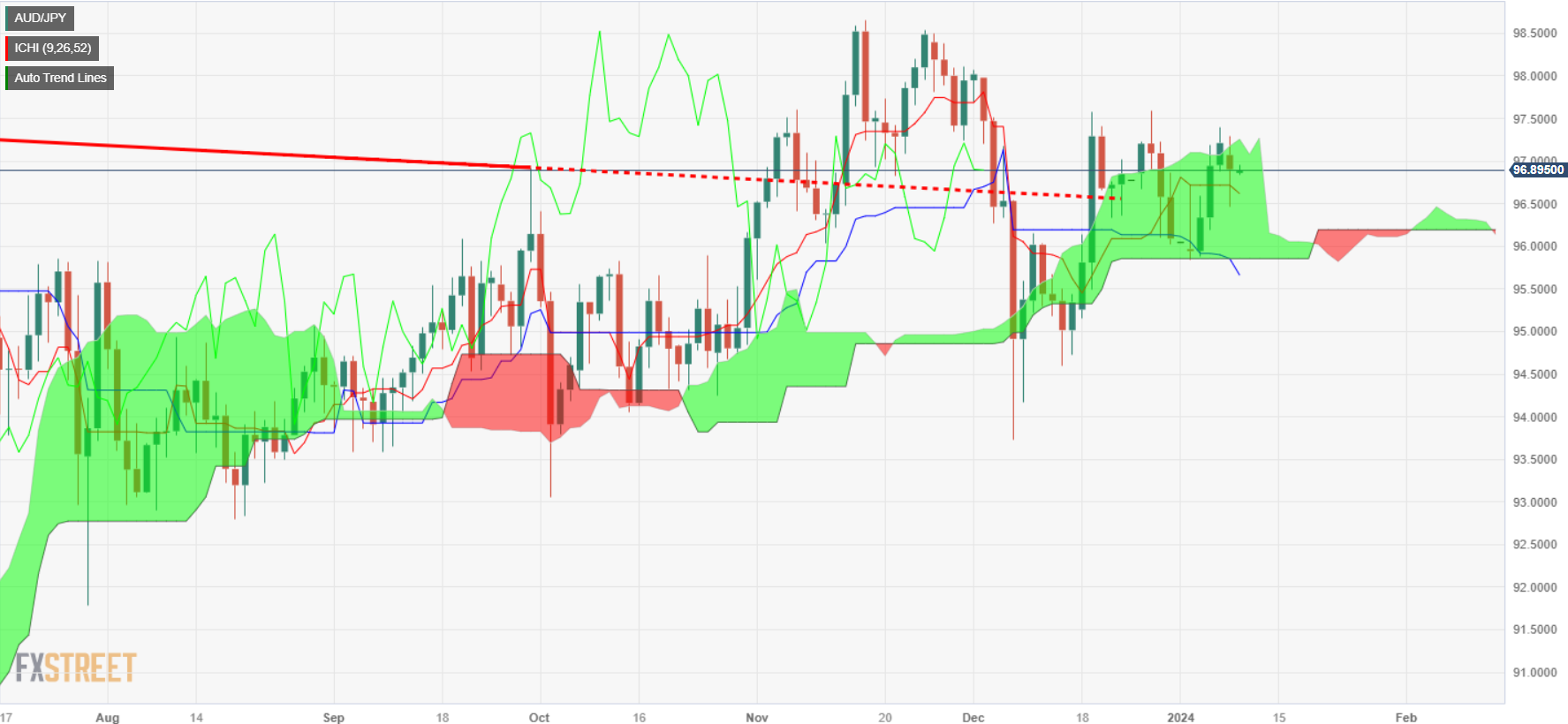
The AUD/JPY registered modest losses of around 0.20% on Monday despite market sentiment shifting positively, usually a headwind for the safe-haven status of the Japanese Yen (JPY). Consequently, the cross-pair is trading at 96.80, after hitting a daily high of 97.27.

From a technical perspective, the AUD/JPY is range-bound though slightly tilted to the upside, with the pair hovering near the top of the Ichimoku Cloud (Kumo), and above the Tenkan-Sen and the Kijun-Sen. Nevertheless, a breach of the former at around 96.71, could pave the way for challenging the latter just below the 96.00 figure, at 95.82.

Given the backdrop, the AUD/JPY first resistance level is the 97.00 figure. Followed by the January 5 swing high at around 97.39. if buyers step in and push the prices above that level, up next would be the December 27 high at 97.59, followed by the 98.00 mark.

AUD/JPY Price Action – Daily Chart
AUD/JPY Technical Levels

AUD/JPY

Overview
Today last price96.9
Today Daily Change-0.31
Today Daily Change %-0.32
Today daily open97.21
 
Trends
Daily SMA2096.34
Daily SMA5096.79
Daily SMA10095.78
Daily SMA20094.29
 
Levels
Previous Daily High97.4
Previous Daily Low96.88
Previous Weekly High97.4
Previous Weekly Low95.84
Previous Monthly High98.07
Previous Monthly Low93.73
Daily Fibonacci 38.2%97.2
Daily Fibonacci 61.8%97.08
Daily Pivot Point S196.93
Daily Pivot Point S296.65
Daily Pivot Point S396.41
Daily Pivot Point R197.45
Daily Pivot Point R297.68
Daily Pivot Point R397.96

Author

Christian Borjon Valencia

Markets analyst, news editor, and trading instructor with over 14 years of experience across FX, commodities, US equity indices, and global macro markets.


More from Christian Borjon Valencia
Share:

Editor's Picks

AUD/USD holds firm near 0.7000 after Chinese inflation data

AUD/USD stays firm near 0.7000 in Wednesday’s Asian session, little moved by China's mixed inflation data. CPI rose less than expected in September, while PPI inflation picked up. The pair remains underpinned by a broadly subdued US Dollar, despite the Middle East escalation, as focus will be on the US consumer inflation figures for fresh tradiing impetus.

USD/JPY consolidates near 158.50; looks to US CPI for fresh impetus

USD/JPY stays range-bound near 158.50 in the Asian session on Wednesday, with looming intervention risks supporting the Japanese Yen and capping upside amid a softer US Dollar. However, geopolitical uncertainties act as a tailwind for the safe-haven USD and the pair. Traders also seem hesitant ahead of the release of the latest US inflation figures.

Gold stays defensive near $4,150, awaits US CPI report

Gold is oscillating in a narrow band near $4,150 in the Asian session on Wednesday, awaiting US Consumer Price Index (CPI) inflation data for more cues about the Fed's policy path. Meanwhile, escalating hostilities between Saudi Arabia and Yemen's Iran-backed Houthis lift Oil prices, weighing on Gold. However, a softer US Dollar helps limit Gold's downside.

Strategy bitcoin buying model faces scrutiny as STRC costs climb
Strategy’s (MSTR) STRC financing strategy increased its Bitcoin (BTC) holdings in H1, but made its capital structure more expensive, prompting an examination of its effectiveness, according to a Tuesday report by K33. STRC recovered close to its $100 par value, closing at $99.90 after an extended period of heavy buybacks.
What happens after a US Treasury market crash
The global bond market is under severe pressure as US Treasury yields reach multi-decade highs, driven by persistent inflation risk, heavy government and corporate debt issuance, and expanding term premiums. Higher yields raise borrowing costs and tighten financial conditions, but a severe bond selloff can ultimately shift investor focus from inflation to growth and financial stability.
Has Bitcoin really escaped the macro forces it was built to fight?
Over 17 years ago, Satoshi Nakamoto designed Bitcoin (BTC) on the back of a global financial crisis as an alternative to the global monetary system outside the control of central banks, governments and traditional intermediaries. This raises a key question: has Bitcoin really become independent of the macroeconomic forces it was built to challenge?















