ASML just showed its hand – What that means for TSMC’s earnings tomorrow
Can TSMC keep pace with the AI investment cycle when it reports Q2 2026 results on July 16, 2026? Markets rarely get an advance look at a company’s earnings before the report lands. But when ASML — the Dutch equipment maker that sits at the very top of the semiconductor supply chain — posts a blowout quarter and raises guidance for the second time this year, it might be previewing what its biggest customer is about to say. Taiwan Semiconductor Manufacturing Company (TSMC), the world’s largest contract chipmaker, is expected to report its own Q2 2026 results tomorrow on July 16, 2026, with consensus estimates pointing to EPS of $3.89 and revenue of $39.31 billion.
Why ASML’s results matter for TSMC investors
ASML is the sole global supplier of extreme ultraviolet (EUV) lithography systems, the machines required to manufacture the most advanced chips on the planet. TSMC is, by a wide margin, ASML’s largest customer for these tools: every new node created by TSMC, from today’s leading-edge processes down to the upcoming 2-nanometre generation, depends on ASML’s EUV and High-NA EUV equipment being installed, calibrated and running at scale.
That relationship makes ASML’s order book and capacity plans a leading indicator for TSMC’s own expansion. When ASML confirms it’s raising EUV production capacity by roughly 30% by 2027 — with another comparable increase targeted for 2028 — it is effectively telling the market that its largest customers (TSMC chief among them) have already placed the orders to justify that build-out. Capacity expansion of that scale doesn’t happen speculatively; it happens because foundries have booked it.
There’s a second, less obvious signal buried in ASML’s numbers: guided revenue growth of around 75% in its memory-chip-related segment. That’s relevant to TSMC not because TSMC makes memory itself, but because it points to the same underlying driver: AI infrastructure buildouts that need both logic chips (TSMC’s core business) and high-bandwidth memory in tandem. When one leg of that stool grows this fast, it’s rarely happening in isolation.
ASML Q2 2026 recap: The upstream signal
ASML’s second-quarter print, released earlier today, gave the market plenty to digest. Revenue came in at €9.33 billion, up from €7.69 billion a year earlier, with gross margin expanding to 54% and net income rising to €2.92 billion. Management raised full-year revenue guidance to a range of €43–45 billion, up from €36–40 billion previously, and lifted the gross margin target to 54–56%.
The takeaway for TSMC watchers isn’t the headline beat itself: it’s what management said drove it — sustained, broad-based demand from foundry customers investing in AI-related capacity, with order visibility now extending into 2028. That’s about as direct a read-through to TSMC’s own capex plans as the market is likely to get before TSMC publishes its financial results.
TSMC heading into its own report
TSMC arrives at this earnings date on the back of an exceptional run. In Q1 2026, revenue rose 35% year-over-year to NT$1.134 trillion, while net income jumped 58% to a record NT$572.48 billion. That momentum didn’t fade into the second quarter: June monthly revenue was up 68% year-over-year, and first-half revenue growth came in at 35.6%.
For Q2 itself, management guided revenue toward $39–40.2 billion, and reaffirmed full-year guidance of more than 30% revenue growth in U.S. dollar terms. AI processor demand remains the central growth engine, with TSMC positioned as the exclusive manufacturing partner for many of the industry’s leading chip designers, including Nvidia, Apple and AMD.
What traders should watch about TSMC’s earnings
Second-half outlook and capex plans. This is arguably the single most important data point, and it’s the one most directly comparable to what ASML just disclosed. If TSMC’s own capex guidance and order commentary echo the scale of ASML’s capacity build-out, it would corroborate that AI-driven demand for advanced manufacturing capacity is not just holding: it’s still accelerating. Any hesitation on capex, by contrast, would stand out precisely because it clashes with what the equipment supplier just said.
2-nanometre ramp and advanced packaging. TSMC’s progress on next-generation 2nm production is the direct downstream beneficiary of ASML’s High-NA EUV rollout, commercial deployment of which is intensifying through 2026. Traders will want specifics on yield, timeline and customer commitments.
Gross margin trajectory. ASML surprised to the upside on margins this quarter, evidence of strong pricing power even as it ramps investment. TSMC investors will be watching whether the foundry can show similar resilience — offsetting the cost of scaling advanced nodes and packaging capacity without margin erosion.
Two main shared risk factors across the chain
The two companies don’t just share a customer relationship, they also share a risk profile (even if the specific exposures differ).
Geopolitics. ASML continues to face U.S. export restrictions limiting sales of its most advanced tools to China, a market it still expects to represent roughly 20% of 2026 revenue. TSMC’s geopolitical exposure runs through a different channel: recent tensions in the Middle East and broader supply-chain diversification concerns. However, management has said it doesn’t expect material production disruption, citing diversified sourcing and strategic inventories. Different geography, same underlying theme: both companies operate in an industry where politics can move faster than fundamentals.
Valuation. Both stocks have had exceptional runs into these earnings dates, and both now carry the same risk: high expectations leave little room for anything less than a clean beat-and-raise. ASML’s own share price gave back some of today’s opening gains despite beating estimates: a reminder that when good news is already priced in, even strong results can fail to push shares higher. This pattern was on clear display last week when Samsung Electronics shares slid despite posting record preliminary second-quarter profits, dragged down by lingering anxieties over future capital expenditure and demand.
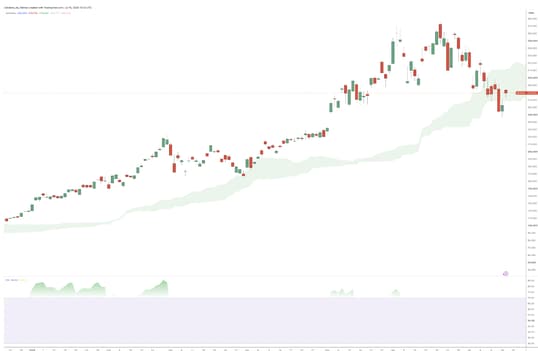
Samsung Daily Chart - Source: TradingView
TSMC shares outlook: Bull case vs bear case
From a technical perspective, TSMC’s daily chart still points to a broadly positive trend. The stock continues to trade above the Ichimoku cloud, confirming that the primary uptrend remains intact. However, recent price action has weakened, with the shares slipping below the Tenkan-sen (conversion line) and testing the Kijun-sen (base line). Meanwhile, the RSI has fallen below the neutral 50 level, suggesting that bullish momentum is fading in the short term. This leaves TSMC at a technical crossroads ahead of its earnings release.
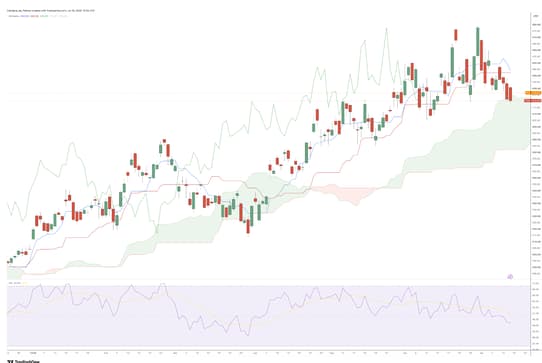
TSMC Daily Chart - Source: TradingView
Bull case: The AI investment cycle continues to strengthen across the semiconductor supply chain. ASML’s latest results reinforced that view, with stronger guidance, record order visibility stretching into 2028, and continued capacity expansion plans. If TSMC delivers similarly optimistic guidance for the second half of the year—particularly on AI demand, 2nm production and capital expenditure—it would further validate the structural nature of the AI boom. Such an outcome could reignite bullish sentiment not only for TSMC, but also for chip designers, cloud hyperscalers and semiconductor equipment manufacturers that depend on sustained AI infrastructure spending.
Bear case: Expectations remain exceptionally high after the sector’s strong rally, leaving little room for disappointment. Any indication that AI-related investment is beginning to normalize—whether through slower data centre spending by hyperscalers, delays in the 2nm manufacturing ramp, or renewed geopolitical and export restrictions—could prompt a sharp repricing. Technically, a decisive break below the top of the Ichimoku cloud would reinforce the loss of momentum and increase the risk of a deeper pullback.
Stay up to date with what's moving and shaking on the world's markets and never miss another important headline again! Check ActivTrades daily news and analyses here.
Author

Carolane de Palmas
ActivTrades
Carolane graduated with a Masters in Corporate Finance & Financial Markets and got the AMF Certification (Financial Markets Regulator in France). Afterward, she became an independent trader, investing mostly in European and American stocks/indices.