AMD vs. Intel: AI development meets the factory bill


The two firms both benefit from the same AI trend, yet the demand impacts their profits in distinct ways. AMD can grow its chip lineup by leaning on manufacturing partners. Intel has to move competitive processors at scale while also turning its factories into money-makers. That makes AMD vs INTC a sharper dividing line than a simple benchmark battle. AMD runs the faster-growing data-center business. Intel has a recovering server group and a manufacturing arm whose losses still eat into that recovery.
The core view: AMD right now offers the cleaner line from AI demand to operating profit. Intel's extra upside depends on narrowing the gap between what its products earn and what its fabs cost.
AMD vs Intel data center revenue: Two speeds of growth
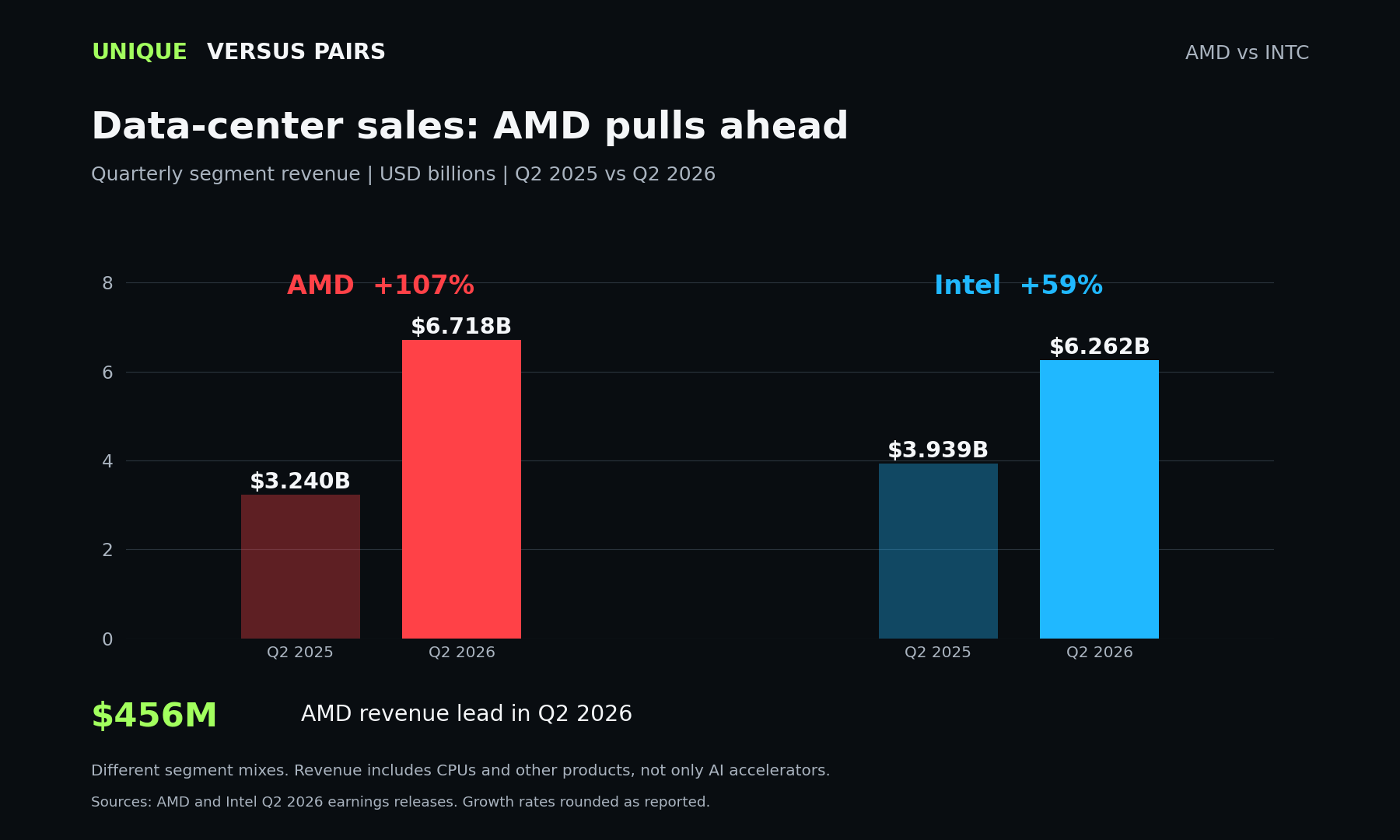
AMD posted second-quater data-center revenue of $6.718 billion in its second-quarter results, a 107% jump from a year earlier. EPYC CPUs and Instinct accelerators both pulled weight, so the rising AMD data center revenue line tells you more than a GPU-only story.
Intel's second-quarter report showed Data Center and AI revenue of $6.262 billion, up 59%. AMD ended the period about $456 million ahead, although the two segments package different product mixes and do not give a clean apples-to-apples read on accelerator sales.
The server rebound also muddies AMD vs Intel AI chips as a clean winner-take-all matchup. AI infrastructure needs CPUs and accelerators working side by side. Customer budgets can feed both companies even when their GPU positions sit far apart.
AMD vs Intel Foundry strategy: Who carries the cost
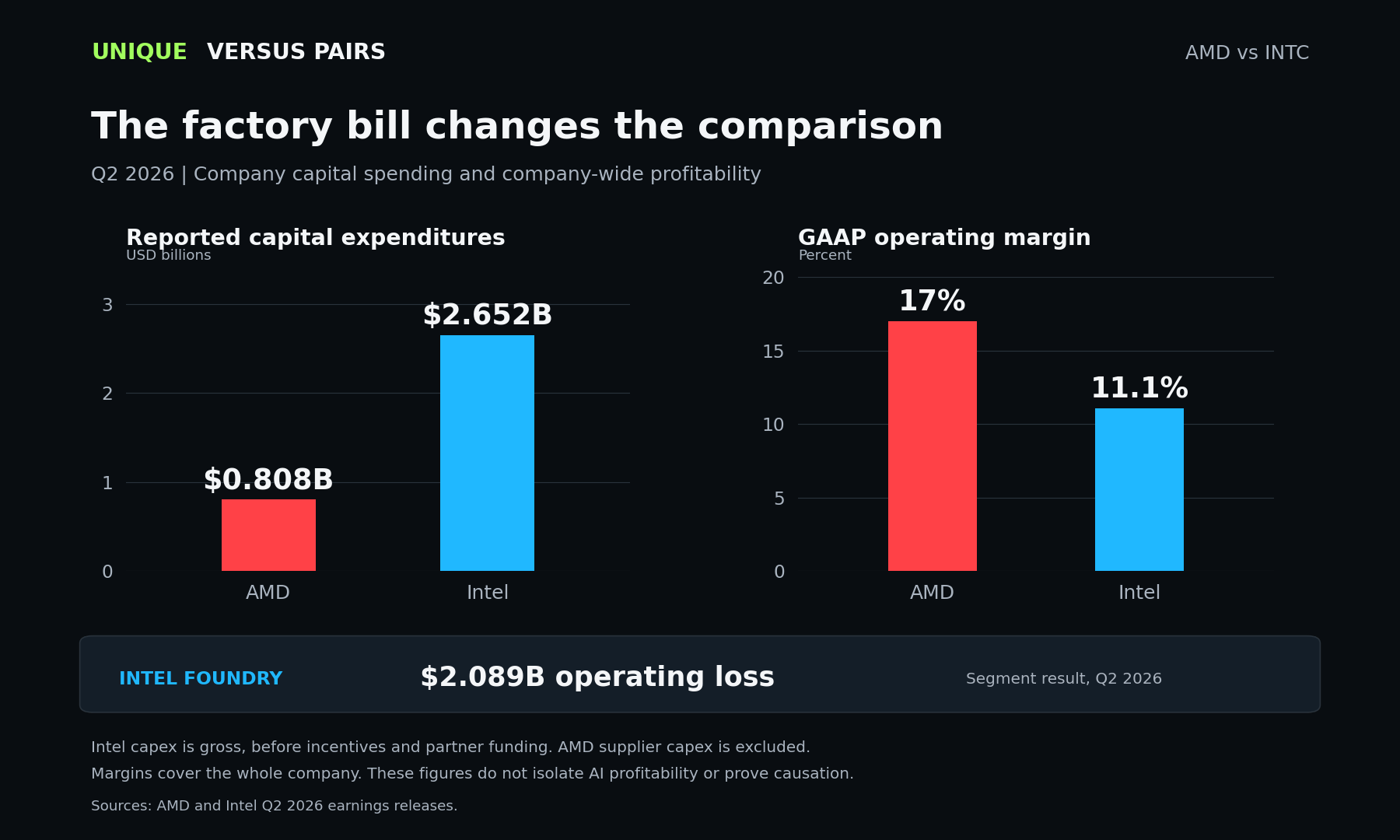
AMD put $808 million into property and equipment last quarter. Intel reported $2.652 billion in gross capital expenditures. These are company-reported capital expenditures. They exclude investment by AMD's manufacturing suppliers. Intel's gross figure also precedes adjustments. These adjustments are for government incentives and partner funding.
The Intel Foundry business booked $5.765 billion in segment revenue and swallowed a $2.089 billion operating loss. Much of that revenue comes from internal transfers inside Intel, so you can't stack it on top of product sales as if outside customers paid for it.
Intel unveiled Xeon 6+ on its 18A node and shifted 18A-P into the risk production. Progress on the manufacturing side matters, but commercial success needs enough volume and better unit economics. Owning the fabs gives Intel control while leaving it with the bill for expensive capacity.
AMD's reliance on external production creates a different kind of constraint. A winning chip design still needs fab and packaging capacity on terms that work financially.
Open systems still need paying customers
AMD's July AI platform update ties together ROCm software, Instinct MI455X accelerators, and Helios racks. In July, AMD said that OpenAI would probably make Helios available in the last three months of 2026, with more deployment expected in 2027. However, the schedule alone does not reveal how much revenue AMD has accrued.
Intel also teams up with partners on mixed AI systems. Open systems are not exclusive to AMD. The commercial test comes down to how easily software compatibility and system integration let large deployments repeat without squeezing margins.
AMD/INTC comparison: Earnings must carry the narrative
AMD's company-wide GAAP operating margin hit 17% last quarter, compared with Intel's 11.1%. Neither number proves AI profit will stick around, but the current spread leans toward AMD's operating model.
Setting an AMD stock chart next to an Intel stock chart won't tell you which business is cheaper. AMD's stock valuation hinges on how much future deployment growth the market has already priced in. Intel's stock valuation depends on the path of manufacturing losses and if Intel can shrink them without another heavy investment bill.
The AMD stock forecast rests on execution and how well deployments turn into profit. The Intel stock forecast needs signs that stronger product sales can offset the factory burden.
For the Versus Trade AMD INTC setup, AMD keeps the stronger operating case. Intel could surprise if manufacturing economics improve faster than expected. A fresh wave of AI spending alone would not settle that race.
Ready to trade AMD vs Intel on the earnings gap behind the AI headlines?
Author