AI’s second chapter: Can Apple catch Microsoft’s enterprise lead


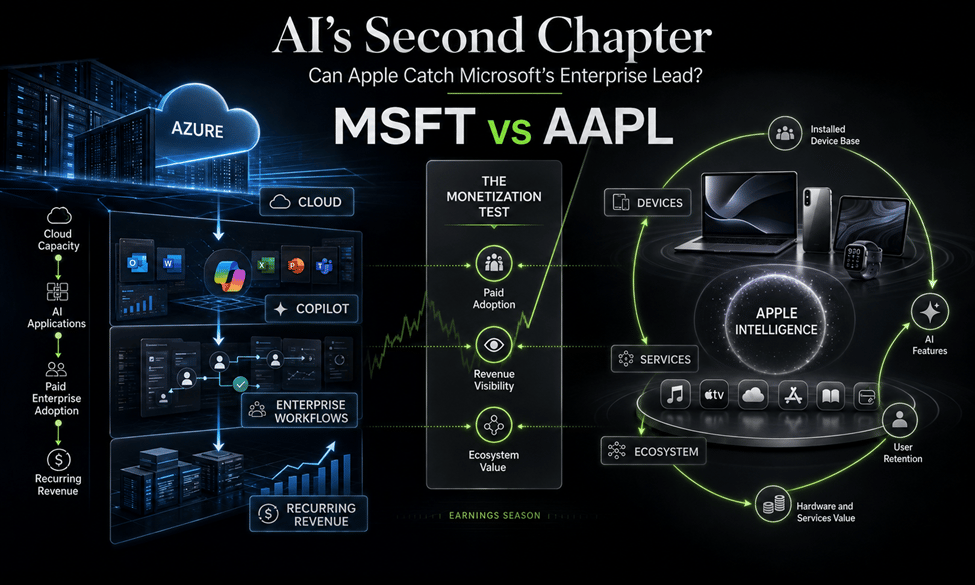
AI announcements no longer buy Big Tech much patience. Capital spending, paid adoption, margins, and forward guidance now carry more weight than another polished product demo. That shift makes Microsoft stock vs. Apple stock an unusually clean test: one company sells AI capacity and software to businesses today, while the other expects intelligence to make an enormous device base more useful, sticky, and valuable.
Microsoft already has the receipts
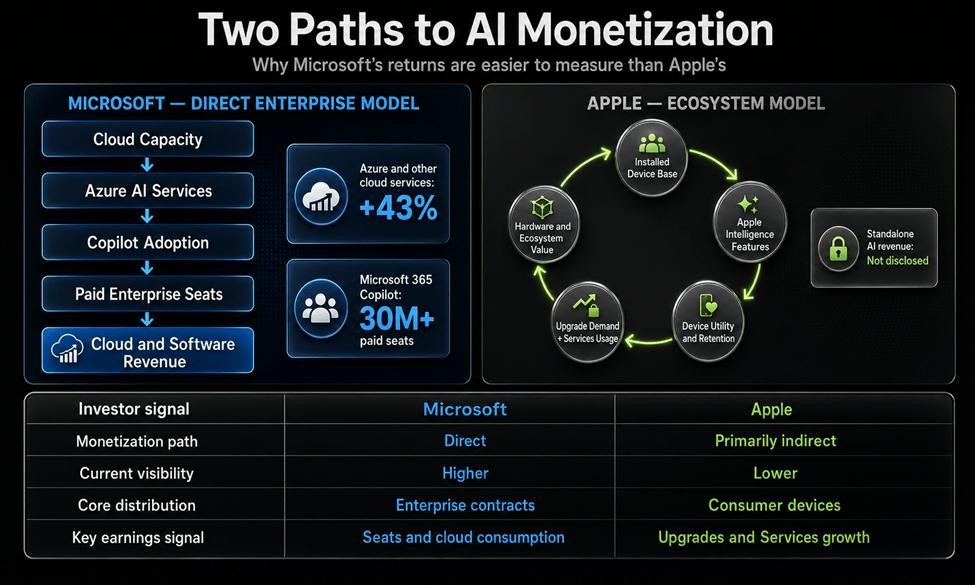
Microsoft entered this reporting season with a lead that could be measured. In its fiscal fourth quarter, revenue reached $90.0 billion, Microsoft Cloud generated $59.3 billion, and Azure and other cloud services revenue grew 43%. For the full year, Azure revenue crossed $100 billion, while Microsoft 365 Copilot passed 30 million paid seats, according to the company’s July 29 results.
That is some of the clearest current evidence of Microsoft’s AI monetization, although the company still does not disclose standalone AI revenue. The important part of Azure AI revenue is its route into existing budgets. Companies already pay Microsoft for cloud infrastructure, security, databases, Office, and developer tools. AI arrives through contracts and workflows that procurement departments understand.
This is why the Microsoft enterprise AI lead looks harder to dislodge than a product-feature advantage. The Microsoft enterprise AI machine connects compute, models, applications, and distribution. In big tech AI monetization, that commercial plumbing matters almost as much as model quality.
Apple is monetizing AI sideways
Apple’s June-quarter numbers were hardly weak. Revenue rose 16% to $109.4 billion, with diluted EPS up 29%, while iPhone revenue reached $54.3 billion. Yet Apple’s earnings release did not isolate AI-generated sales. The Apple AI ecosystem still earns indirectly, through hardware demand, upgrades, services, and retention.
That makes Apple intelligence monetization both plausible and difficult to prove. Apple has introduced wider system-level intelligence and a more capable Siri, with some server-intensive features offering increased access through iCloud+ plans, as its WWDC update explains. Even so, investors cannot yet separate an AI-led iPhone purchase from an ordinary replacement cycle.
The contrast in enterprise AI vs. consumer AI is therefore economic, not cosmetic. Microsoft can point to seats, usage, and cloud consumption. Apple can point to device sales and growth in its installed base, but the causal link remains softer. A Microsoft Copilot vs. Apple Intelligence comparison that ignores those different sales channels misses the real contest.
Earnings have changed the scoreboard
The latest Microsoft vs. Apple earnings sharpened the split. Microsoft showed accelerating cloud growth alongside huge infrastructure spending, although those investments continued to pressure cloud margins. Apple delivered strong current demand but a softer September-quarter outlook, with component constraints clouding the near-term picture. That is the AI impact on tech earnings in its second chapter: execution is being priced company by company.
For Microsoft vs. Apple AI monetization, Microsoft leads on visibility. For Microsoft vs. Apple AI strategy, Apple retains a powerful option on distribution. More than two billion active devices can turn useful intelligence into higher switching costs without creating a separate AI invoice.
So, can Apple catch Microsoft in AI? In enterprise revenue, not soon. In consumer-scale economics, the answer remains open. The broader Microsoft vs. Apple AI race may never produce one universal winner because each company is compounding a different asset.
That nuance matters when reading Microsoft vs. Apple through quarterly results. The next decisive signals are Copilot seat growth, Azure capacity and margins, iPhone upgrade behavior, services growth, and any clearer paid tier for Apple Intelligence. Traders following Versus pairs MSFT vs AAPL are comparing two revenue architectures, not two chatbots. The same distinction should frame any decision to Versus trade MSFT vs. AAPL around the next earnings cycle.
Author