A Fed hold, a Warsh non-answer, and one day of cover for the Japanese Yen
- USD/JPY trades near 163.50 after surrendering roughly 60 pips between the 18:00 GMT decision and a session low printed during the press conference.
- A nine-to-three vote with three dissents for a hike pulled the July tail out of the front end without taking the hike off the calendar, and the long end moved the other way entirely.
- Japan's currency authorities have said nothing since a record spring intervention and the Bank of Japan reports Friday, so one session of Dollar softness is the whole reprieve.

The Federal Reserve (Fed) held its target range at 3.50% to 3.75% for a fifth consecutive meeting at 18:00 GMT, and the pair did what a market short the Yen against a 1.00% policy rate does when a hike it partly paid for fails to arrive. Price slipped from a session high just short of 164.00 to the 163.50 area, then to just above 163.00 while the chair took questions. It trades near 163.50 late, down 0.24% on the day.
The hold dated the hike rather than cancelling it
The decision came on a nine-to-three vote, three voting members dissenting in favour of a quarter point, the closest call in years. Futures carried a hike tail near 36% into the meeting, up from roughly 11% in mid-July, and that premium came out of the front end on the announcement. The two-year Treasury yield fell about four basis points while the thirty-year rose more than nine.
That divergence between the curve's two ends is the whole story for a carry pair, because a hold with three hawkish dissents dates a hike rather than cancelling it. September already carried odds near 80% before the vote, so the Yen's reward is one session of relief while the Dollar collects a steeper curve.
A reaction function nobody will describe
The press conference was the more consequential half of the afternoon and produced nothing a trader could price. Fed Chair Warsh refused the word pause for what the committee had just done, declined to say what would trigger a September move, and told the room that participants are learning to react to data rather than the central bank. One reporter was reduced to asking what the news actually was.
The reticence is deliberate policy rather than an accident of temperament, given a June statement cut to roughly 130 words, guidance struck, the chair's own dot withheld, and a July statement barely departed from it. A Fed that will not describe its reaction function is worse for a currency defence than a hawkish one, because it hands every release before 16 September the weight guidance used to absorb.
Tokyo buys a day at a record price
The gap the Yen has to survive runs roughly 275 basis points, a 1.00% Bank of Japan policy rate against a Fed at 3.50% to 3.75%, and with underlying inflation near 2.8% the Japanese real policy rate is negative on every measure. Japan's Ministry of Finance spent about 11.7 trillion Yen buying its own currency between late April and late May, and the pair sits a full figure above where that campaign left it.
Positioning explains why the defence keeps failing, with speculative Yen shorts above 150K contracts at the end of June, the most bearish stance in years. The 162.00 level desks treated as the defence line was breached without response, and currency research now describes that line as having disappeared. Silence is the doctrine, the top currency official quiet since the spring operation while the finance minister's promises of decisive action produce no durable bid.
The Yen stopped trading the differential
The pair recovered half its post-decision drop inside two hours because the transmission channel has moved. The International Monetary Fund flagged in April that the exchange rate had decoupled from the narrowing US-Japan spread, and what fills the gap is Japan's own fiscal premium, with thirty-year and forty-year Japanese government bond yields above 4% against public debt beyond 230% of Gross Domestic Product. A rising US long end is therefore actively Yen-negative, which is what the afternoon delivered.
Japanese Prime Minister Takaichi's fiscal stimulus advocacy and her criticism of higher rates have widened the premium markets charge to hold Japanese paper, and her approval rating has slumped to its lowest since she took office. Officials concede that bond-market anxiety has blunted efforts to talk down Yen bears. A currency cannot be defended against its own sovereign spread.
Crude Oil compounds it, with the barrel up more than 20% this month on renewed Hormuz disruption and Japan importing all of it, so the war premium arrives once in Dollars and again in the exchange rate. Yen-denominated import prices ran 25.5% higher YoY in May, and a funding currency that cannot rally while the Dow trades 1,100 points lower is saying more than any intervention warning.
What Thursday and Friday settle
Thursday at 12:30 GMT brings the June Personal Consumption Expenditures price index, the release September hangs on, with core consensus at 0.2% MoM and 3.3% YoY from 3.4%, headline 3.7% YoY from 4.1%, preliminary Q2 GDP at 2.1% annualized, and jobless claims at 200K against 187K.
Tokyo Consumer Price Index figures land at 23:30 GMT the same evening, expected at 1.7% YoY excluding fresh food against 1.6% prior, which is the entire licence available before Friday's Bank of Japan decision. Consensus has that as a hold at 1.00%, with the quarterly Outlook Report at 03:00 GMT and the governor's press conference at 06:30 GMT, leaving his language on an October or December move as Tokyo's only instrument.
Levels and bias
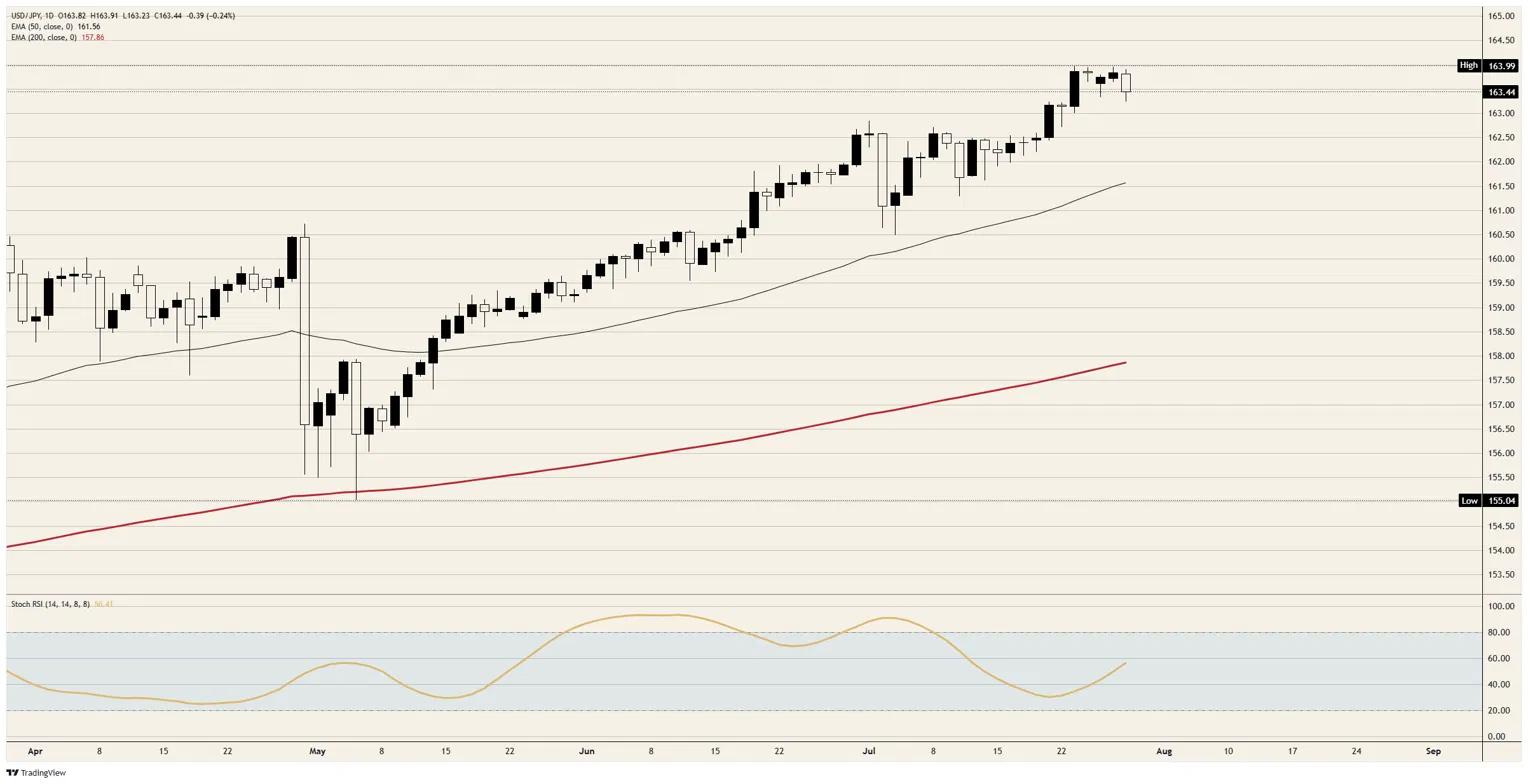
Resistance: The session high stopped just short of 164.00, where the July peak also sits, a shade under the handle and the strongest the pair has traded since December 1986. Above it, 165.00 is where intervention chatter concentrates, which makes it a target and a hazard at the same time.
Support: 163.00 is the pivot, broken on 21 July for the first time in nearly four decades, and it contained the post-decision flush with the session low printing just above it. Beneath that, 162.00 is the June breach level, with the 50-day Exponential Moving Average near 161.50 the first structural line and the 200-day near 158.00 far below.
Bias: Bullish while 163.00 holds. The hold delayed a hike rather than removing it, the long-end differential is widening, Tokyo has no tool that survives contact with a September Fed, and the daily Stochastic Relative Strength Index near 56 leaves room in both directions, so the path of least resistance runs at 164.00 and then toward 165.00. A daily close beneath 163.00 invalidates and turns the focus to 162.00.
USD/JPY daily chart
Japanese Yen FAQs
The Japanese Yen (JPY) is one of the world’s most traded currencies. Its value is broadly determined by the performance of the Japanese economy, but more specifically by the Bank of Japan’s policy, the differential between Japanese and US bond yields, or risk sentiment among traders, among other factors.
One of the Bank of Japan’s mandates is currency control, so its moves are key for the Yen. The BoJ has directly intervened in currency markets sometimes, generally to lower the value of the Yen, although it refrains from doing it often due to political concerns of its main trading partners. The BoJ ultra-loose monetary policy between 2013 and 2024 caused the Yen to depreciate against its main currency peers due to an increasing policy divergence between the Bank of Japan and other main central banks. More recently, the gradually unwinding of this ultra-loose policy has given some support to the Yen.
Over the last decade, the BoJ’s stance of sticking to ultra-loose monetary policy has led to a widening policy divergence with other central banks, particularly with the US Federal Reserve. This supported a widening of the differential between the 10-year US and Japanese bonds, which favored the US Dollar against the Japanese Yen. The BoJ decision in 2024 to gradually abandon the ultra-loose policy, coupled with interest-rate cuts in other major central banks, is narrowing this differential.
The Japanese Yen is often seen as a safe-haven investment. This means that in times of market stress, investors are more likely to put their money in the Japanese currency due to its supposed reliability and stability. Turbulent times are likely to strengthen the Yen’s value against other currencies seen as more risky to invest in.
Author

Joshua Gibson
FXStreet
Joshua joins the FXStreet team as an Economics and Finance double major from Vancouver Island University with twelve years' experience as an independent trader focusing on technical analysis.

















