163.00: Why the Japanese Yen is trading at historic lows despite BoJ hike speculation

The Japanese Yen (JPY) continues to trade at historic lows, with USD/JPY pressing past year-to-date highs above the 163.00 handle, as a renewed surge in global Oil and Natural Gas prices has dealt a severe blow to the net-energy-importing Japanese economy.
While Japanese policymakers face an increasingly tough backdrop as global yields rise, speculation is mounting that the Bank of Japan (BoJ) could deliver an early rate hike to stem currency weakness. Institutional strategists remain divided on whether a single rate increase can reverse the Yen's slide or if a broader shift in Federal Reserve policy will be necessary to drive a lasting turnaround.
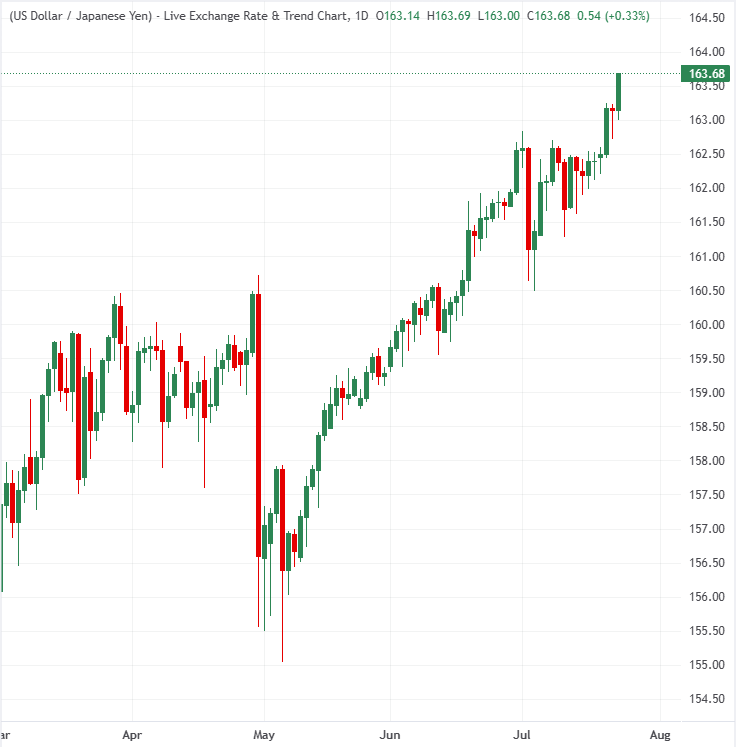
Energy shocks and rising yields create a challenging backdrop for Japan
According to MUFG, rising crude Oil and Natural Gas prices continue to exert heavy downward pressure on low-yielding currencies like the Yen. Verbal interventions from Finance Minister Satsuki Katayama have yielded minimal impact as markets gauge the likelihood of immediate currency intervention.
While reports suggest BoJ officials are open to hiking rates faster than consensus, MUFG warns that domestic rate increases may not be enough on their own.
The Bloomberg report supports our forecast for the BoJ to hike rates as soon as in September. While rising yields in Japan would offer more support for the yen, we are not convinced another BoJ hike on its own will reverse the weakening trend.
Fundamentals and expected Fed moves point to a Yen recovery
Taking a longer-term approach, Commerzbank acknowledges that near-term headwinds have prolonged the Yen's weakness, prompting a slight upward revision to the bank's near-term USD/JPY trajectory.
However, Commerzbank remains firm in its assessment that economic fundamentals will eventually prevail and drive a Yen recovery. The bank expects that Federal Reserve rate cuts next year will remove a major source of US Dollar strength, setting off a clear rally for the Yen.
We are therefore adjusting our forecast slightly upward (weaker yen), but we still expect the yen to appreciate by the end of next year (...) Next year, our economists also continue to anticipate interest rate cuts by the Fed. Such a development would certainly weigh on the US Dollar over the coming months.
Banks project near-term vulnerability followed by more favorable long-term trajectory
The banks project an environment of immediate vulnerability for the Japanese Yen followed by potential relief further out. MUFG cautions that as long as global energy prices remain elevated and yields outside Japan stay high, USD/JPY will remain pinned near YTD highs, with a September BoJ hike serving as a supportive measure rather than a total trend reversal. Meanwhile, Commerzbank maintains a constructive multi-quarter outlook, predicting that a turnaround in sentiment and eventual US monetary easing will drive USD/JPY down toward 145.00 over the medium term.
(This article was created with the help of an Artificial Intelligence tool and reviewed by an editor. Know more.)
Author

FXStreet Insights Team
FXStreet
The FXStreet Insights Team is a group of journalists that handpicks selected market observations published by renowned experts. The content includes notes by commercial as well as additional insights by internal and external analysts.