155.00: Why the Japanese Yen just broke through the level that could define a new range

USD/JPY has suffered a sharp technical breakdown below the key 155.00 psychological threshold, extending losses toward 153.00 amid thin holiday liquidity, unwinding carry trade positions, and renewed political focus on Japan's monetary framework. The drop through prior intervention-driven support levels has caught markets off guard, shifting near-term focus to deeper technical support targets near 152.00 and 150.00. While analysts acknowledge the move is driven primarily by idiosyncratic Japanese Yen (JPY) dynamics rather than a fundamental collapse in broad US Dollar (USD) sentiment, the breach of 155.00 risks establishing a new lower trading corridor for the pair.
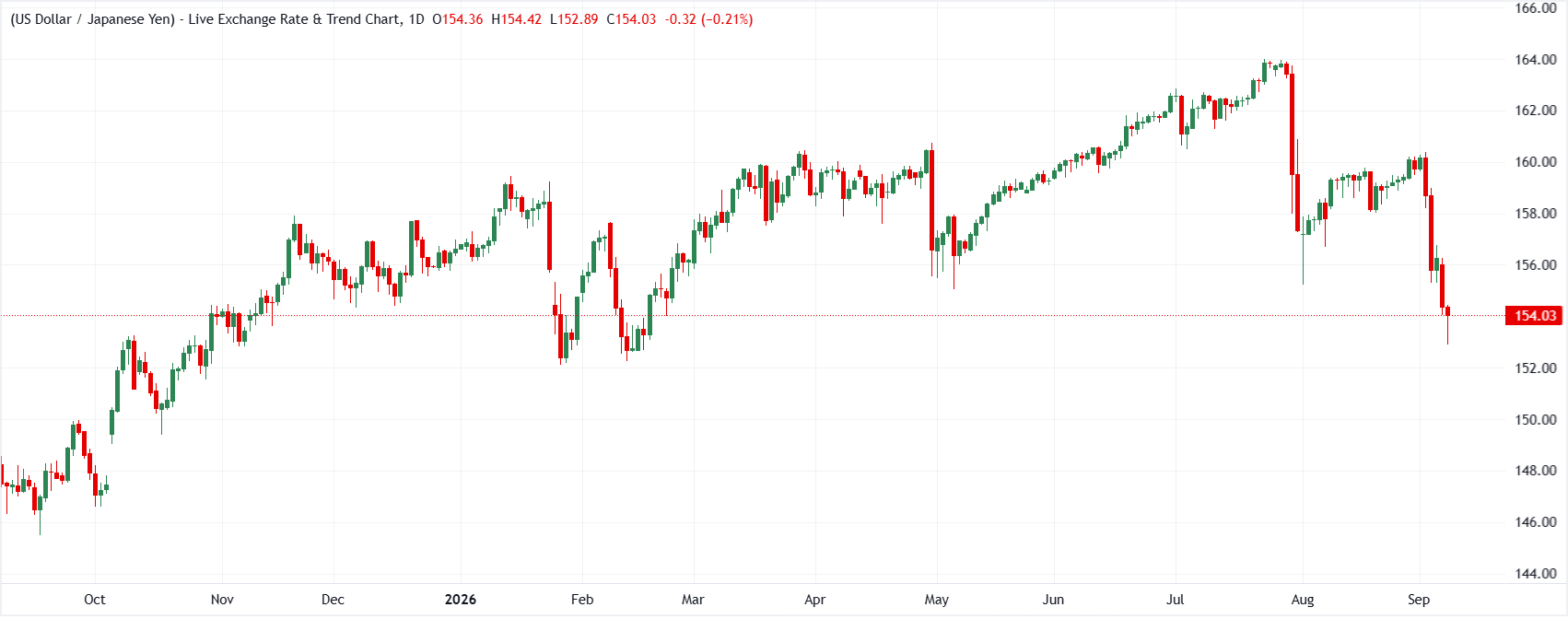
Shift below 155.00 psychological level threatens new lower range
Teppei Ino at MUFG stresses that the pair's fall below 155.00 — which previously marked key support following multiple intervention episodes — represents a major technical turning point. Remarks from US Treasury Secretary Scott Bessent urging Japan to move away from reflationary policy settings have further accelerated position unwinding, putting deeper retracement levels firmly in sight.
"The USD/JPY broke below the psychologically important 155 level on 7 September... From a technical perspective, the pair also briefly fell below the 38.2% retracement of its rise... at above 154.50. This brings the January low of below 152.50 and the 50% retracement level of above 151.50 into view. At a minimum, unless the USD/JPY quickly recovers above 155, the market could shift into a new range in which 155 is viewed as the upper end."
Carry trade unwinding and holiday liquidity push Yen rally toward 150.00
Taking a tactical view, Francesco Pesole, Frantisek Taborsky, and Chris Turner at ING emphasize that while thin liquidity amplified the sell-off down to 153.00, standing in the way of this momentum is dangerous. The potential for further carry trade unwinding could swiftly push the pair toward major support at 152.0 and eventually 150.0, even though solid US payrolls and high energy prices continue to offer underlying support for the greenback.
"Despite short-term fundamentals suggesting the move is overdone, it remains risky to stand in its way, particularly given the scope for further carry trade unwinding. The next meaningful support only comes in at 152.0... A break below that could quickly open the way towards 150.0... We continue to think the bullish case for the dollar will prove stronger in the near term, although Friday’s US CPI release remains a clear risk event."
Based on the combined analysis of both institutions, USD/JPY faces severe near-term technical pressure as position unwinding drives the pair well beneath its 155.00 floor. MUFG cautions that a failure to swiftly reclaim 155.00 will solidify that level as a firm resistance ceiling for a lower trading range toward 152.50 and 151.50. Meanwhile, ING maintains that while broad US economic fundamentals — including $100 Oil and firm labor figures — should eventually reassert US Dollar strength, the immediate momentum of the Japanese Yen rally leaves the door open for further downside testing toward 152.00 and 150.00.
(This article was created with the help of an Artificial Intelligence tool and reviewed by an editor. Know more.)
Author

FXStreet Insights Team
FXStreet
The FXStreet Insights Team is a group of journalists that handpicks selected market observations published by renowned experts. The content includes notes by commercial as well as additional insights by internal and external analysts.

















