WTI corrects to near $100 as focus shifts to key policy decisions
- The Oil price corrects to near $100.00 from its five-month high of $103.28.
- The Fed, the ECB and the BoJ are expected to leave interest rates unchanged this week.
- Oil prices to remain firm as escalation risk ahead of Israeli elections and US midterm elections remains elevated.

West Texas Intermediate (WTI), futures on NYMEX, retreats from its five-month high of $103.28 to near $100 on Monday. The oil price comes under pressure as investors turn cautious ahead of key monetary policy announcements from a number of global central banks.
Central bank trio in focus as markets eye unchanged rates before later hikes
Analysts at Danske Bank highlight that, for the remainder of the week, market attention will be firmly on upcoming policy meetings, with “focus turns to interest rate decisions from the Fed on Wednesday, the ECB on Thursday and the Bank of Japan on Friday.” The bank notes that it “expect all three to keep interest rates unchanged before resuming rate hikes later this year,” underscoring a near-term pause in policy tightening even as the broader narrative remains one of further increases ahead.
Last week, oil prices gained significantly amid fears of fresh escalation in tensions between the United States (US) and Iran. Financial markets turned cautious after the US State Department called for a wider withdrawal of US diplomatic personnel from the Gulf.
What to expect from oil prices going forward?
According to TD Securities, crude prices remain biased higher in the near term, with analysts warning that “we expect crude oil will remain skewed to the upside in the near term as escalation risk ahead of Israeli elections and US midterm elections remains elevated.” They note that “recent Houthi strikes have seen risk premium pricing in the market increase, while persistent tanker attacks by Iran appear to have been successful in reducing some Hormuz flows,” reinforcing the geopolitical premium embedded in current pricing.
WTI Technical Analysis
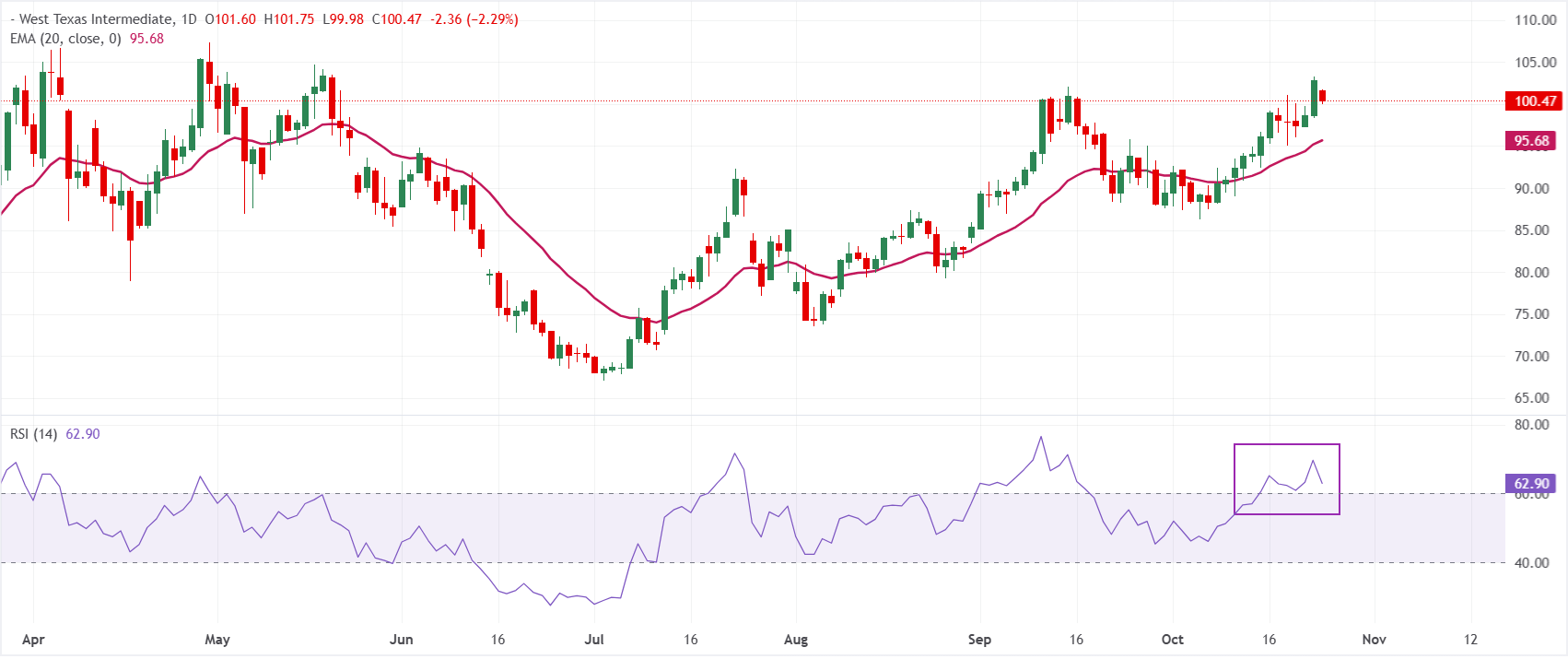
In the daily chart, WTI US Oil trades at $100.51. The contract maintains a bullish near-term bias as price holds well above the 20-day Exponential Moving Average (EMA), currently at $95.68, suggesting the uptrend remains supported despite recent consolidation. The Relative Strength Index (RSI) at 62.99 stays in bullish territory but below overbought levels, hinting that upside momentum is positive yet not extreme.
On the downside, initial support is seen at the $100.51 area as an immediate pivot, with stronger underlying demand emerging near the 20-day EMA at $95.68 should a deeper pullback unfold. With no nearby technical resistance levels flagged by the current dataset, traders may continue to focus on how price behaves above these supports to gauge whether the bullish structure can extend or whether a corrective phase develops.
(The technical analysis of this story was written with the help of an AI tool. Know more.)
WTI Oil FAQs
WTI Oil is a type of Crude Oil sold on international markets. The WTI stands for West Texas Intermediate, one of three major types including Brent and Dubai Crude. WTI is also referred to as “light” and “sweet” because of its relatively low gravity and sulfur content respectively. It is considered a high quality Oil that is easily refined. It is sourced in the United States and distributed via the Cushing hub, which is considered “The Pipeline Crossroads of the World”. It is a benchmark for the Oil market and WTI price is frequently quoted in the media.
Like all assets, supply and demand are the key drivers of WTI Oil price. As such, global growth can be a driver of increased demand and vice versa for weak global growth. Political instability, wars, and sanctions can disrupt supply and impact prices. The decisions of OPEC, a group of major Oil-producing countries, is another key driver of price. The value of the US Dollar influences the price of WTI Crude Oil, since Oil is predominantly traded in US Dollars, thus a weaker US Dollar can make Oil more affordable and vice versa.
The weekly Oil inventory reports published by the American Petroleum Institute (API) and the Energy Information Agency (EIA) impact the price of WTI Oil. Changes in inventories reflect fluctuating supply and demand. If the data shows a drop in inventories it can indicate increased demand, pushing up Oil price. Higher inventories can reflect increased supply, pushing down prices. API’s report is published every Tuesday and EIA’s the day after. Their results are usually similar, falling within 1% of each other 75% of the time. The EIA data is considered more reliable, since it is a government agency.
OPEC (Organization of the Petroleum Exporting Countries) is a group of 12 Oil-producing nations who collectively decide production quotas for member countries at twice-yearly meetings. Their decisions often impact WTI Oil prices. When OPEC decides to lower quotas, it can tighten supply, pushing up Oil prices. When OPEC increases production, it has the opposite effect. OPEC+ refers to an expanded group that includes ten extra non-OPEC members, the most notable of which is Russia.
Author

Sagar Dua
FXStreet
Sagar Dua is associated with the financial markets from his college days. Along with pursuing post-graduation in Commerce in 2014, he started his markets training with chart analysis.