Breaking: RBNZ leaves interest rate unchanged at 2.75%, surprising markets

The Reserve Bank of New Zealand (RBNZ) kept the Official Cash Rate (OCR) unchanged at 2.75% after concluding the October monetary policy meeting on Wednesday.
The decision surprised markets, which had expected the central bank to raise the OCR by 25 basis points (bps).
Summary of the RBNZ Monetary Policy Review (MPR)
All committee members concur on overall inflation outlook.
Global factors contributing to inflation pressures.
Committee agreed stronger monetary policy likely needed.
Committee agrees tighter monetary policy probably needed, depends on economic outlook.
Members varied in emphasis on risks and timing of monetary policy response.
Members agreed on inflation forecast, differed on risk weightings.
New Zealand’s recovery may be stronger than expected but could lose momentum if global environment weakens.
Committee focused on bringing inflation back to 2 percent target midpoint over medium term.
Minutes of the RBNZ interest rate meeting
More OCR hikes probable, but dependent on economic outlook.
Four members Anna Breman, Carl Hansen, Prasanna Gal, Rebecca Williams vote to hold OCR, three members Paul Conway, Hayley Gourley, Karen Silk back increase.
Ongoing higher refined fuel prices and currency depreciation could risk greater indirect inflation effects.
Risk inflation entrenches before conventional expectations adjust despite previous two OCR hikes.
Certain domestic financial conditions ease amid lower exchange rate and decline in some term lending rates.
Committee focuses on medium-term inflation outlook.
NZD/USD reaction to the RBNZ interest rate decision
The New Zealand Dollar (NZD) has come under intense selling pressure in an immediate reaction to the RBNZ interest rate decision. The NZD/USD pair currently trades at 0.5600, down 1.46% on the day.
New Zealand Dollar Price This week
The table below shows the percentage change of New Zealand Dollar (NZD) against listed major currencies this week. New Zealand Dollar was the weakest against the US Dollar.
| USD | EUR | GBP | JPY | CAD | AUD | NZD | CHF | |
|---|---|---|---|---|---|---|---|---|
| USD | 0.84% | 0.53% | 0.55% | 0.08% | 0.03% | 1.79% | 0.66% | |
| EUR | -0.84% | -0.33% | -0.32% | -0.81% | -0.87% | 0.88% | -0.24% | |
| GBP | -0.53% | 0.33% | -0.06% | -0.48% | -0.54% | 1.25% | 0.06% | |
| JPY | -0.55% | 0.32% | 0.06% | -0.41% | -0.57% | 1.26% | 0.03% | |
| CAD | -0.08% | 0.81% | 0.48% | 0.41% | -0.12% | 1.61% | 0.55% | |
| AUD | -0.03% | 0.87% | 0.54% | 0.57% | 0.12% | 1.75% | 0.44% | |
| NZD | -1.79% | -0.88% | -1.25% | -1.26% | -1.61% | -1.75% | -1.12% | |
| CHF | -0.66% | 0.24% | -0.06% | -0.03% | -0.55% | -0.44% | 1.12% |
The heat map shows percentage changes of major currencies against each other. The base currency is picked from the left column, while the quote currency is picked from the top row. For example, if you pick the New Zealand Dollar from the left column and move along the horizontal line to the US Dollar, the percentage change displayed in the box will represent NZD (base)/USD (quote).
This section below was published on October 27 at 20:58 GMT as a preview of the Reserve Bank of New Zealand (RBNZ) interest rate decision.
- RBNZ expected to raise OCR to 3%, with markets fully pricing hike.
- New Zealand inflation remains elevated at 3.7%, supporting further tightening.
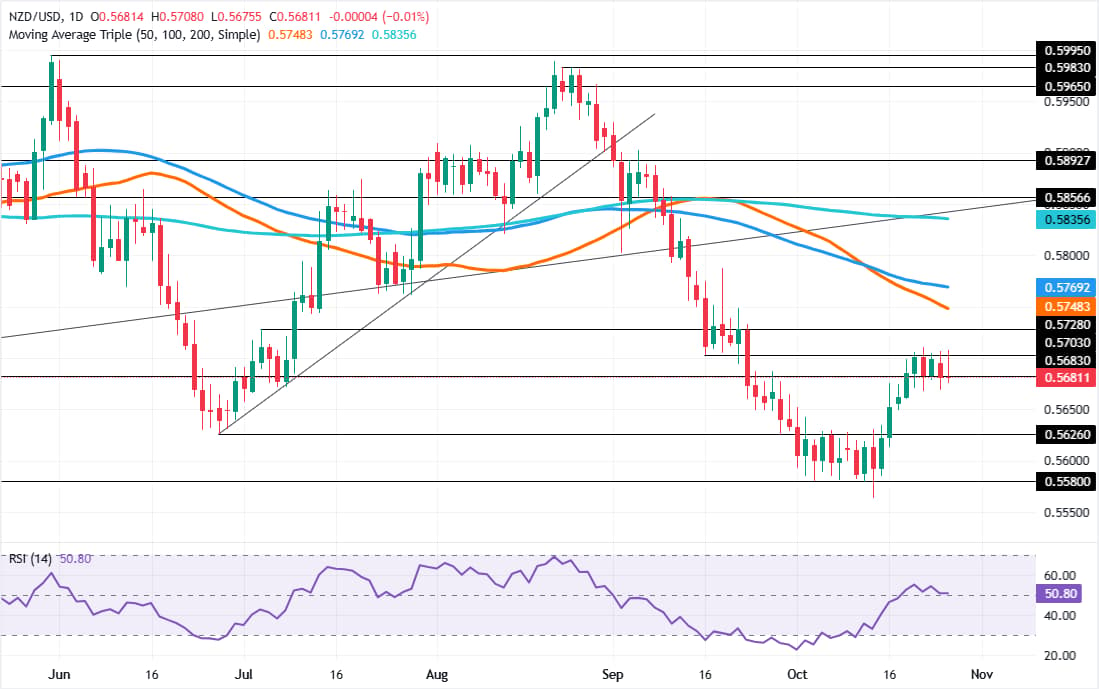
- NZD/USD faces resistance at 0.5748–0.5769, with 0.5600 as key support.
On Wednesday, October 28 at 01:00 GMT, the Reserve Bank of New Zealand (RBNZ), led by Governor Anna Breman, is expected to raise the Overnight Cash Rate (OCR) by 25 basis points, from 2.75% to 3%, as money markets price in a 100% chance.
RBNZ guidance in focus after a 100% chance of a rate hike
This would be the third-rate hike by the RBNZ, while the odds for another hike in December are nearly 50%.
In the September meeting, the Committee reached a consensus to increase the OCR, agreeing unanimously to remove monetary stimulus to drive inflation toward the 2% goal while supporting growth and the labour market. This decision was made to reduce the risk of more aggressive rate adjustments while maintaining an open mind regarding future OCR adjustments.
Of note, a rate hike would bring the OCR closer to the RBNZ's neutral range, with Governor Breman saying at a press conference following the decision that the committee is moving rates towards neutral while remaining accommodative.
Furthermore, Breman added that there will likely be a further increase in OCR, and they will assess the impact of the hikes already implemented.
Overall, this suggests the central bank is leaning towards further rate increases, though the timing remains uncertain.
Recent data suggest there is scope for further rate increases, as New Zealand GDP in Q2 exceeded forecasts at 2.6% YoY against estimates of 2.3%. Meanwhile, CPI for Q3 slowed and printed softer than expected at 3.7% YoY, beneath forecasts of 3.8%, but still was above the RBNZ’s 2% inflation objective.
What are the implications for the NZD/USD?
Currently, the NZD/USD sits comfortably at the bottom of the day’s trading range of 0.5675-0.5708, with traders waiting for a one-two punch reaction, as they are also eyeing the Federal Reserve’s decision.
If the RBNZ leans hawkish, a move to the confluence of the 50-day and 100-day Simple Moving Averages (SMAs), each at 0.5748 and 0.5769, respectively, is on the cards. If the Kiwi clears that area, a potential move towards 0.5800 is likely.
On the other hand, a dovish signal from the RBNZ could pave the way to test 0.5650 and the psychologically important 0.5600 level, guarded by traders, after trading above and below it for at least 14 days. On further weakness, the year-to-date (YTD) low of 0.5564 will be in play.
New Zealand Dollar FAQs
The New Zealand Dollar (NZD), also known as the Kiwi, is a well-known traded currency among investors. Its value is broadly determined by the health of the New Zealand economy and the country’s central bank policy. Still, there are some unique particularities that also can make NZD move. The performance of the Chinese economy tends to move the Kiwi because China is New Zealand’s biggest trading partner. Bad news for the Chinese economy likely means less New Zealand exports to the country, hitting the economy and thus its currency. Another factor moving NZD is dairy prices as the dairy industry is New Zealand’s main export. High dairy prices boost export income, contributing positively to the economy and thus to the NZD.
The Reserve Bank of New Zealand (RBNZ) aims to achieve and maintain an inflation rate between 1% and 3% over the medium term, with a focus to keep it near the 2% mid-point. To this end, the bank sets an appropriate level of interest rates. When inflation is too high, the RBNZ will increase interest rates to cool the economy, but the move will also make bond yields higher, increasing investors’ appeal to invest in the country and thus boosting NZD. On the contrary, lower interest rates tend to weaken NZD. The so-called rate differential, or how rates in New Zealand are or are expected to be compared to the ones set by the US Federal Reserve, can also play a key role in moving the NZD/USD pair.
Macroeconomic data releases in New Zealand are key to assess the state of the economy and can impact the New Zealand Dollar’s (NZD) valuation. A strong economy, based on high economic growth, low unemployment and high confidence is good for NZD. High economic growth attracts foreign investment and may encourage the Reserve Bank of New Zealand to increase interest rates, if this economic strength comes together with elevated inflation. Conversely, if economic data is weak, NZD is likely to depreciate.
The New Zealand Dollar (NZD) tends to strengthen during risk-on periods, or when investors perceive that broader market risks are low and are optimistic about growth. This tends to lead to a more favorable outlook for commodities and so-called ‘commodity currencies’ such as the Kiwi. Conversely, NZD tends to weaken at times of market turbulence or economic uncertainty as investors tend to sell higher-risk assets and flee to the more-stable safe havens.
Economic Indicator
RBNZ Interest Rate Decision
The Reserve Bank of New Zealand (RBNZ) announces its interest rate decision after each of its seven scheduled annual policy meetings. If the RBNZ is hawkish and sees inflationary pressures rising, it raises the Official Cash Rate (OCR) to bring inflation down. This is positive for the New Zealand Dollar (NZD) since higher interest rates attract more capital inflows. Likewise, if it reaches the view that inflation is too low it lowers the OCR, which tends to weaken NZD.
Read more.Next release: Wed Oct 28, 2026 01:00
Frequency: Irregular
Consensus: 3%
Previous: 2.75%
Source: Reserve Bank of New Zealand
The Reserve Bank of New Zealand (RBNZ) holds monetary policy meetings seven times a year, announcing their decision on interest rates and the economic assessments that influenced their decision. The central bank offers clues on the economic outlook and future policy path, which are of high relevance for the NZD valuation. Positive economic developments and upbeat outlook could lead the RBNZ to tighten the policy by hiking interest rates, which tends to be NZD bullish. The policy announcements are usually followed by interim Governor Christian Hawkesby's press conference.
Author

Christian Borjon Valencia
FXStreet
Markets analyst, news editor, and trading instructor with over 14 years of experience across FX, commodities, US equity indices, and global macro markets.