USD/JPY Price Forecast: Japanese Yen underperforms despite multiple tailwinds
- Japanese Yen faces selling pressure despite various supporting triggers.
- The BoJ reiterates hawkish monetary stance after leaving rates steady at 1.25%.
- Japan FM Katayama warns of possible joint intervention with the US.

The Japanese Yen (JPY) is down against its major currency peers, except antipodeans, at the start of the week. In the early European trade, the US Dollar (USD) is up 0.17% at around 157.77 against the Japanese currency.
Japanese Yen Price Today
The table below shows the percentage change of Japanese Yen (JPY) against listed major currencies today. Japanese Yen was the weakest against the Swiss Franc.
| USD | EUR | GBP | JPY | CAD | AUD | NZD | CHF | |
|---|---|---|---|---|---|---|---|---|
| USD | -0.23% | -0.07% | 0.17% | 0.05% | 0.14% | 0.27% | -0.23% | |
| EUR | 0.23% | 0.16% | 0.37% | 0.27% | 0.37% | 0.50% | 0.03% | |
| GBP | 0.07% | -0.16% | 0.23% | 0.12% | 0.21% | 0.34% | -0.13% | |
| JPY | -0.17% | -0.37% | -0.23% | -0.08% | -0.01% | 0.12% | -0.37% | |
| CAD | -0.05% | -0.27% | -0.12% | 0.08% | 0.10% | 0.21% | -0.25% | |
| AUD | -0.14% | -0.37% | -0.21% | 0.00% | -0.10% | 0.13% | -0.35% | |
| NZD | -0.27% | -0.50% | -0.34% | -0.12% | -0.21% | -0.13% | -0.46% | |
| CHF | 0.23% | -0.03% | 0.13% | 0.37% | 0.25% | 0.35% | 0.46% |
The heat map shows percentage changes of major currencies against each other. The base currency is picked from the left column, while the quote currency is picked from the top row. For example, if you pick the Japanese Yen from the left column and move along the horizontal line to the US Dollar, the percentage change displayed in the box will represent JPY (base)/USD (quote).
The Asia-Pacific currency faces selling pressure despite multiple tailwinds, including a sharp correction in oil prices, Bank of Japan (BoJ) reiterating hawkish monetary policy stance in the policy announcement on Friday, and Tokyo warning joint intervention with the United States (US).
As of writing, the WTI Oil price is 2.6% lower to near $99.50. A decline in oil prices bodes well for currencies from economies, such as Japan, given their significant reliance on energy imports.
On Friday, BoJ Governor Kazuo Ueda signaled that the central bank will remain on the monetary tightening path after leaving interest rates steady at 1.25%. “BoJ will continue to raise policy rate and adjust degree of monetary easing in response to economic activity, prices and financial condition developments,” Ueda said in the press conference.
Earlier in the day, Japanese Finance Minister (FM) Satsuki Katayama said that the Joint FX statement with the US persists and the government will act against disorderly moves.
Meanwhile, the US Dollar trades lower as investors turn cautious ahead of US midterm elections on Tuesday.
USD/JPY Technical Analysis
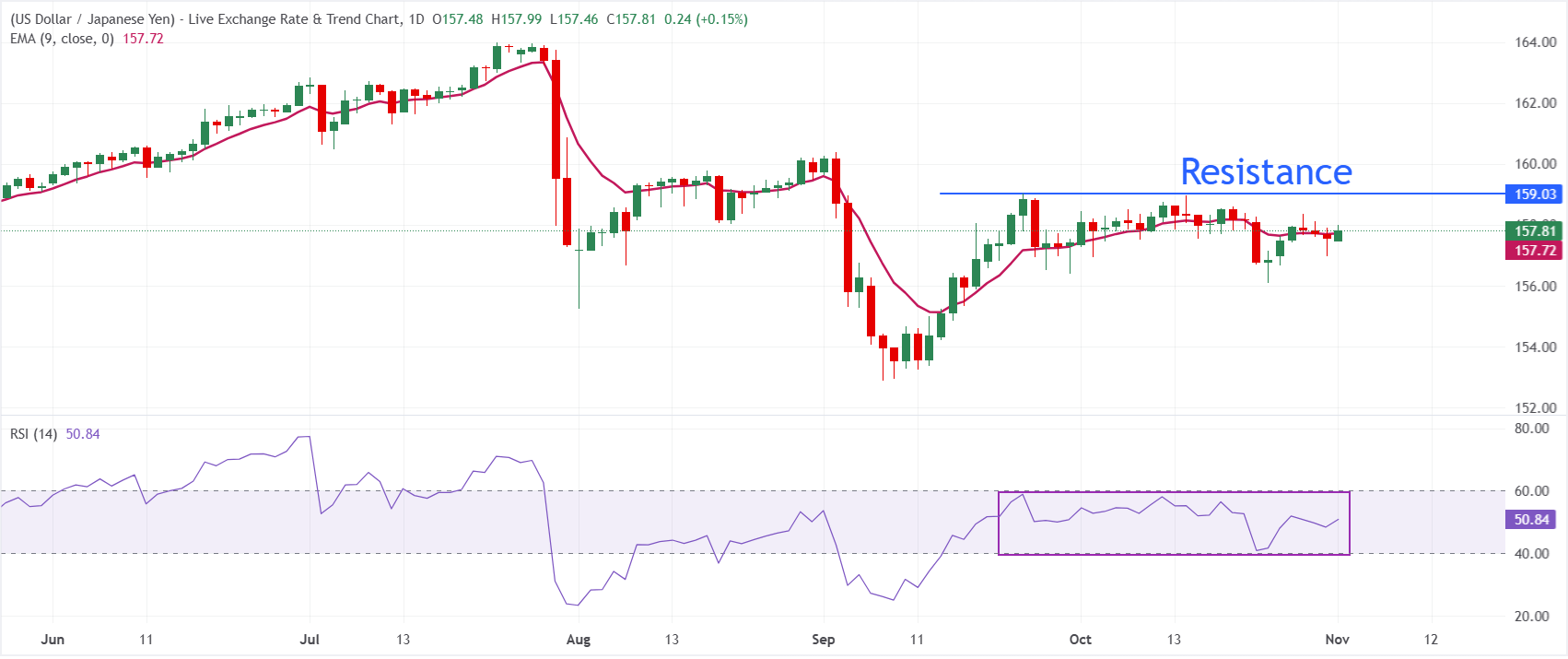
In the daily chart, USD/JPY trades at 157.77. The pair refletcs a braoder sideways trend as the 9-day Exponential Moving Average (EMA) at around 157.72 has been flat-lined for over a month.
The Relative Strength Index (RSI) at 50.81 sits near the neutral line, suggesting a balanced momentum amid a sideways trend.
On the downside, the major support is the October low at 156.08. Looking up, the September 24 high at 159.04 is the major hurdle for the pair.
(The technical analysis of this story was written with the help of an AI tool. Know more.)
Economic Indicator
BoJ Interest Rate Decision
The Bank of Japan (BoJ) announces its interest rate decision after each of the Bank’s eight scheduled annual meetings. Generally, if the BoJ is hawkish about the inflationary outlook of the economy and raises interest rates it is bullish for the Japanese Yen (JPY). Likewise, if the BoJ has a dovish view on the Japanese economy and keeps interest rates unchanged, or cuts them, it is usually bearish for JPY.
Read more.Last release: Fri Oct 30, 2026 03:03
Frequency: Irregular
Actual: 1.25%
Consensus: 1.25%
Previous: 1.25%
Source: Bank of Japan
Author

Sagar Dua
FXStreet
Sagar Dua is associated with the financial markets from his college days. Along with pursuing post-graduation in Commerce in 2014, he started his markets training with chart analysis.