US stocks crater again on Wednesday on hot inflation, new Trump tariffs
- NASDAQ caves on continued AI stock sell-off.
- NVDA, DELL give up 7% as market mulls peak AI earnings.
- Trump administration resumes trade war with tariffs on Asia, EU.
- PCE inflation for October was above September levels.


Investors are throwing in the towel on US equities once again on Wednesday. While a notably bearish trend has been in place since early October, Wednesday's sell-off was spurred on by higher US inflation figures and a new push by the White House to introduce tariffs on the European Union (EU) and about a dozen Asian nations.
A half hour into the session, the NASDAQ Composite plunged more than 4%, while the S&P 500 and Dow Jones Industrial Average (DJIA) were off 3% and 2%, respectively.
November bear market continues
Although the Trump administration already let it slip earlier in the week, on Wednesday the White House announced a new slate of tariffs on many of its biggest trading partners. The US government took the action after charging a dozen or so countries with alleged protectionist practices following an investigation.
The US will apply up to 15% on the EU, Japan, Switzerland, Taiwan and South Korea; up to 18% on Cambodia, Malaysia, Thailand, Bangladesh and Indonesia; up to 20% on China and Singapore; up to 25% on India; and up to 35% on Vietnam.
The previous set of tariffs that the Trump administration introduced in April 2025 was struck down by the US Supreme Court earlier this year.
US inflation data was also slightly worse on Wednesday than expected. The core Personal Consumption Expenditures (PCE) report for October, which is the Federal Reserve's (Fed) preferred gauge of inflation, showed inflation hitting 3.3%, above the 3.2% consensus and September's 3.1% reading. Headline PCE inflation of 3.8% was in line with the consensus forecast, but September's reading was revised up from 3.6% to 3.7%. Taken together, the PCE reading provides more evidence that the Fed will remain on its hiking path into next year.
Dell Technologies (DELL) revenue was up 103% YoY in the third quarter, but that wasn't enough for the market. Vague sentiment that many AI stocks are near peak earnings has sent the stock down 7% on Wednesday. Nvidia (NVDA) is also down 7%, with Monday's rally from Jensen Huang returning as CEO quickly being forgotten. While most Wall Street analysts don't believe AI stocks are at or near peak earnings, that concept has pervaded the narrative of late.
Another contributing factor to the recent bear market in equities is the rising value of the US Dollar. The US Dollar Index (DXY) is up 5% since its September lows and just under 20-month highs. A rising value for the Greenback gives foreign investors a good exit point for those wishing to exit their Dollar-denominated AI trades.
Relatively high US Treasury yields, of course, offer a safe haven to scared investors. Yields on the 2-year, 5-year and 10-year Treasuries have dropped more than 2% on Wednesday as investors make a rush toward safety.
S&P 500 probably has further to fall
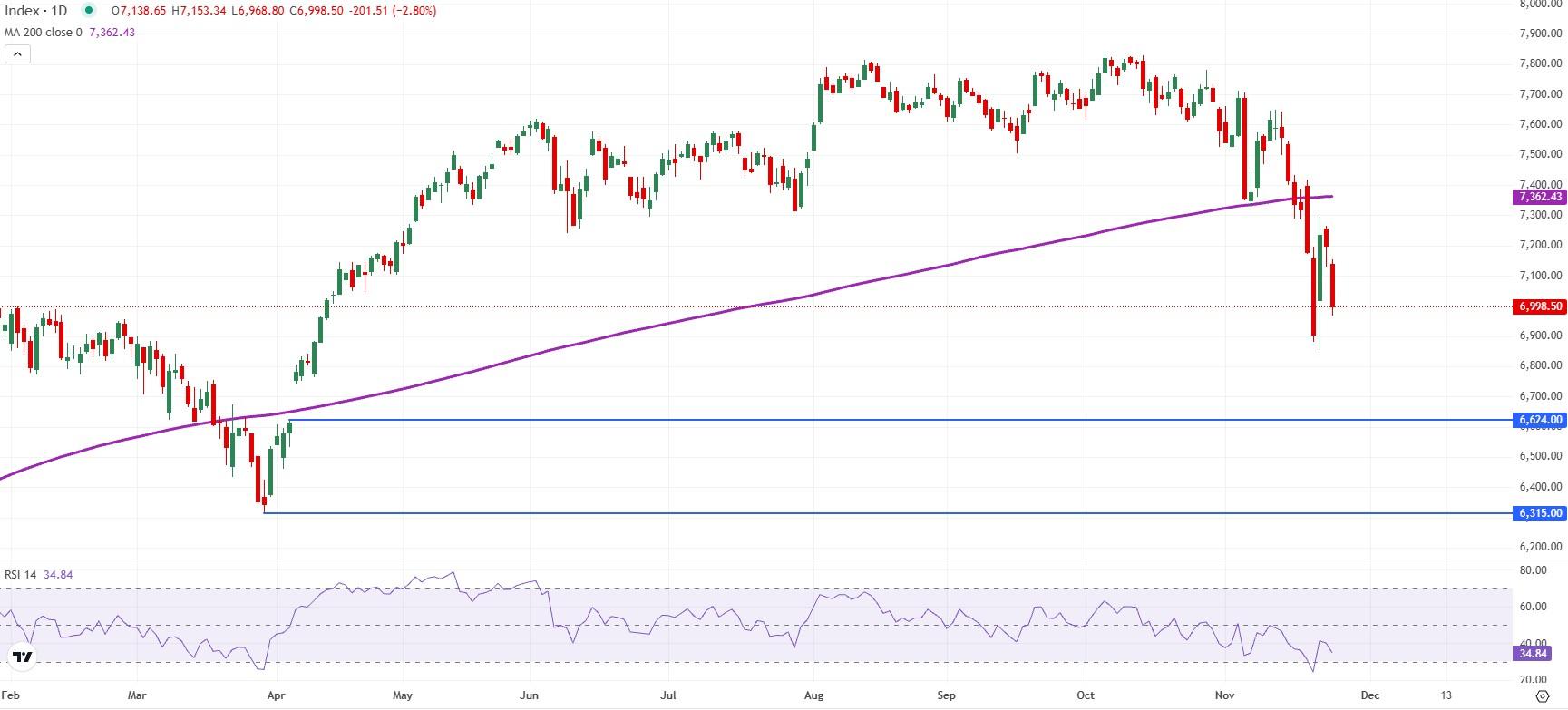
The bounce on Monday that saw the S&P 500 climb 4.75% off last Friday's dire plunge now looks like a dead cat bounce. The market is clearly in selling mode, and the sustained selling pressure doesn't seem likely to let up anytime soon.
As the index trades further away from the 200-day Simple Moving Average (SMA) near 7,362, investors should expect a further slide at least until the April 8 gap gets closed. Markets love to close gaps, particularly indices, and this one doesn't get closed until 6,624. That's about 6% lower than where the index is trading on Wednesday morning.
Of course, there's always the 7,000 psychological level just below the current index position, but that threshold was broken easily last Friday, this Monday and once again on Wednesday morning.
If the 6,624 level gets broken as well, bears will push to the March 30 low at 6,315, which accounts for the bottom of the sell-off that followed the outbreak of the US-Iran war.
Author
Clay Webster
FXStreet
Clay Webster grew up in the US outside Buffalo, New York and Lancaster, Pennsylvania. He began investing after college following the 2008 financial crisis.