US payrolls miss at 29K and the Dollar Index drops below 102.00
- DXY drops through 102.00 to a session low under 101.70 after US payrolls miss.
- US employers add 29K jobs in September, about a third of the 90K forecast.

US employers added 29K jobs in September against a forecast of 90K, and July and August were revised down by a combined 60K. The unemployment rate rose to 4.2%, and hourly pay grew 3.0% over the year against a 3.2% forecast.
Traders now see about a one-in-five chance of another rate hike on October 28, and the two-year Treasury yield, which moves most with Fed expectations, fell. The Dollar fell on a first estimate, and backward revisions have dragged July and August down into net loss territory. A lower US yield means less extra interest for holding Dollars over Euros, which make up 57.6% of the Dollar Index.
On the charts
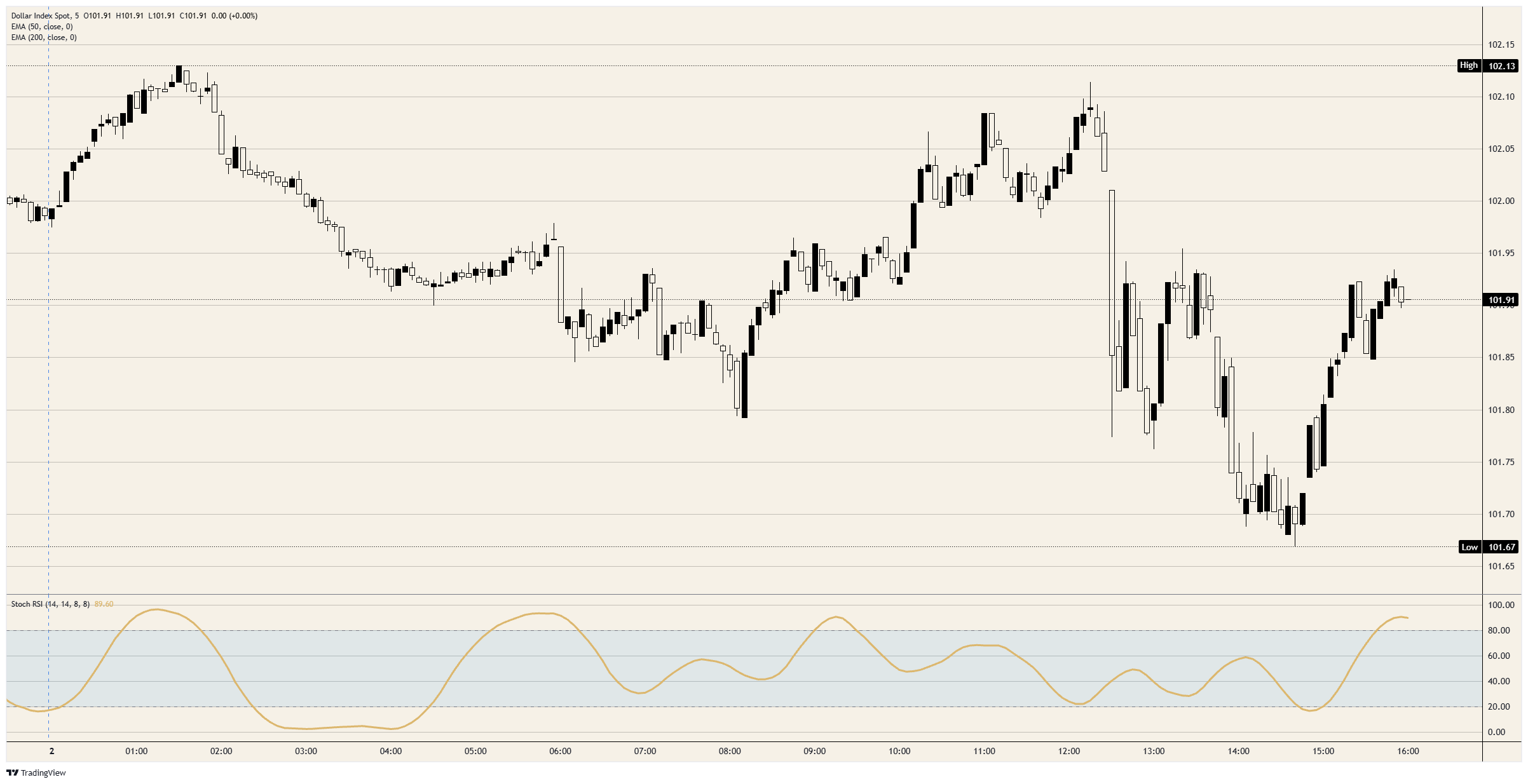
The Dollar Index had climbed to just above 102.10, near the day's high, in the bars before the release. In the release bar, it fell from 102.00 to the 101.80 area, back to where that climb started. A bounce stalled short of 102.00, the level it broke above on Thursday, and a second leg lower reached the day's low just under 101.70. The index has since recovered to near 101.90, the middle of the day's range.
DXY 5-minute chart
US Dollar FAQs
The US Dollar (USD) is the official currency of the United States of America, and the ‘de facto’ currency of a significant number of other countries where it is found in circulation alongside local notes. It is the most heavily traded currency in the world, accounting for over 88% of all global foreign exchange turnover, or an average of $6.6 trillion in transactions per day, according to data from 2022. Following the second world war, the USD took over from the British Pound as the world’s reserve currency. For most of its history, the US Dollar was backed by Gold, until the Bretton Woods Agreement in 1971 when the Gold Standard went away.
The most important single factor impacting on the value of the US Dollar is monetary policy, which is shaped by the Federal Reserve (Fed). The Fed has two mandates: to achieve price stability (control inflation) and foster full employment. Its primary tool to achieve these two goals is by adjusting interest rates. When prices are rising too quickly and inflation is above the Fed’s 2% target, the Fed will raise rates, which helps the USD value. When inflation falls below 2% or the Unemployment Rate is too high, the Fed may lower interest rates, which weighs on the Greenback.
In extreme situations, the Federal Reserve can also print more Dollars and enact quantitative easing (QE). QE is the process by which the Fed substantially increases the flow of credit in a stuck financial system. It is a non-standard policy measure used when credit has dried up because banks will not lend to each other (out of the fear of counterparty default). It is a last resort when simply lowering interest rates is unlikely to achieve the necessary result. It was the Fed’s weapon of choice to combat the credit crunch that occurred during the Great Financial Crisis in 2008. It involves the Fed printing more Dollars and using them to buy US government bonds predominantly from financial institutions. QE usually leads to a weaker US Dollar.
Quantitative tightening (QT) is the reverse process whereby the Federal Reserve stops buying bonds from financial institutions and does not reinvest the principal from the bonds it holds maturing in new purchases. It is usually positive for the US Dollar.
Author

Joshua Gibson
FXStreet
Joshua joins the FXStreet team as an Economics and Finance double major from Vancouver Island University with twelve years' experience as an independent trader focusing on technical analysis.

















