United States Dollar Index extends rally as Fed’s 50 bps rate hike prospects heat up
- The US Dollar Index jumps to near 102.52 as odds of a Fed 50 bps rate hike in December get traction.
- Fed’s Waller said before the US CPI release that higher or steady core figures could propel fears of a 50 bps interest rate increase.
- The US core CPI grew at a faster pace of 0.3% MoM in October vs. 0.2% estimates.


The US Dollar (USD) outperforms its major currency peers on Wednesday, as financial markets have started anticipating a bigger Federal Reserve (Fed) interest rate hike at the December policy meeting.
As of writing, the US Dollar Index (DXY), which gauges the Greenback’s value against six major currencies, trades 0.3% higher to near 102.52. This is the highest level seen in almost four weeks.
US Dollar Price Today
The table below shows the percentage change of US Dollar (USD) against listed major currencies today. US Dollar was the strongest against the Swiss Franc.
| USD | EUR | GBP | JPY | CAD | AUD | NZD | CHF | |
|---|---|---|---|---|---|---|---|---|
| USD | 0.27% | 0.25% | 0.19% | 0.26% | -0.05% | 0.20% | 0.51% | |
| EUR | -0.27% | -0.02% | -0.09% | -0.03% | -0.33% | -0.06% | 0.24% | |
| GBP | -0.25% | 0.02% | -0.06% | 0.00% | -0.31% | -0.06% | 0.26% | |
| JPY | -0.19% | 0.09% | 0.06% | 0.06% | -0.24% | 0.00% | 0.32% | |
| CAD | -0.26% | 0.03% | -0.00% | -0.06% | -0.30% | -0.06% | 0.26% | |
| AUD | 0.05% | 0.33% | 0.31% | 0.24% | 0.30% | 0.26% | 0.56% | |
| NZD | -0.20% | 0.06% | 0.06% | -0.00% | 0.06% | -0.26% | 0.32% | |
| CHF | -0.51% | -0.24% | -0.26% | -0.32% | -0.26% | -0.56% | -0.32% |
The heat map shows percentage changes of major currencies against each other. The base currency is picked from the left column, while the quote currency is picked from the top row. For example, if you pick the US Dollar from the left column and move along the horizontal line to the Japanese Yen, the percentage change displayed in the box will represent USD (base)/JPY (quote).
What led markets to factor in a jumbo Fed rate hike?
Analysts at MUFG note that the latest market rethink has been “to consider the prospect of a 50bp hike,” stressing that this shift is “only now being considered because of Waller’s comments prior to the CPI report rather than the CPI report itself.” They highlight that “Waller’s comment that a stronger CPI print may warrant a 50bp hike has sparked a debate over whether Waller had knowledge of the CPI print,” helping to push front-end yields higher and reprice Fed expectations.
According to MUFG, “the OIS market is now partially pricing the risk of a 50bp hike on 9th December,” after Waller argued that “the sticky inflation and energy risks warrant the reversal of the 75bps of cuts and hence why wait two meetings to do that.”
Even so, the bank cautions against assuming a larger move is now the base case. “We remain sceptical of the need to hike by 50bps at this stage and suspect the majority will see the better risk-reward in going by 25bps,” they write, pointing out that “we still have another payrolls report (but no further CPI prints, although it’s the day after) before the FOMC meeting.” MUFG adds that “a strong print plus a rebound in crude oil after the recent sharp drop would be one scenario of a possible more aggressive hike,” keeping alive the risk that markets lean further toward a 50bp outcome.
The Consumer Price Index (CPI) data on Tuesday showed that headline inflation grew at a faster pace of 0.4% Month-on-Month (MoM) in October against 0.3% estimates. In the same period, the core CPI – which excludes volatile food and energy items – arrived at 0.3%, higher than expectations of 0.2%.
US Dollar Index Technical Analysis
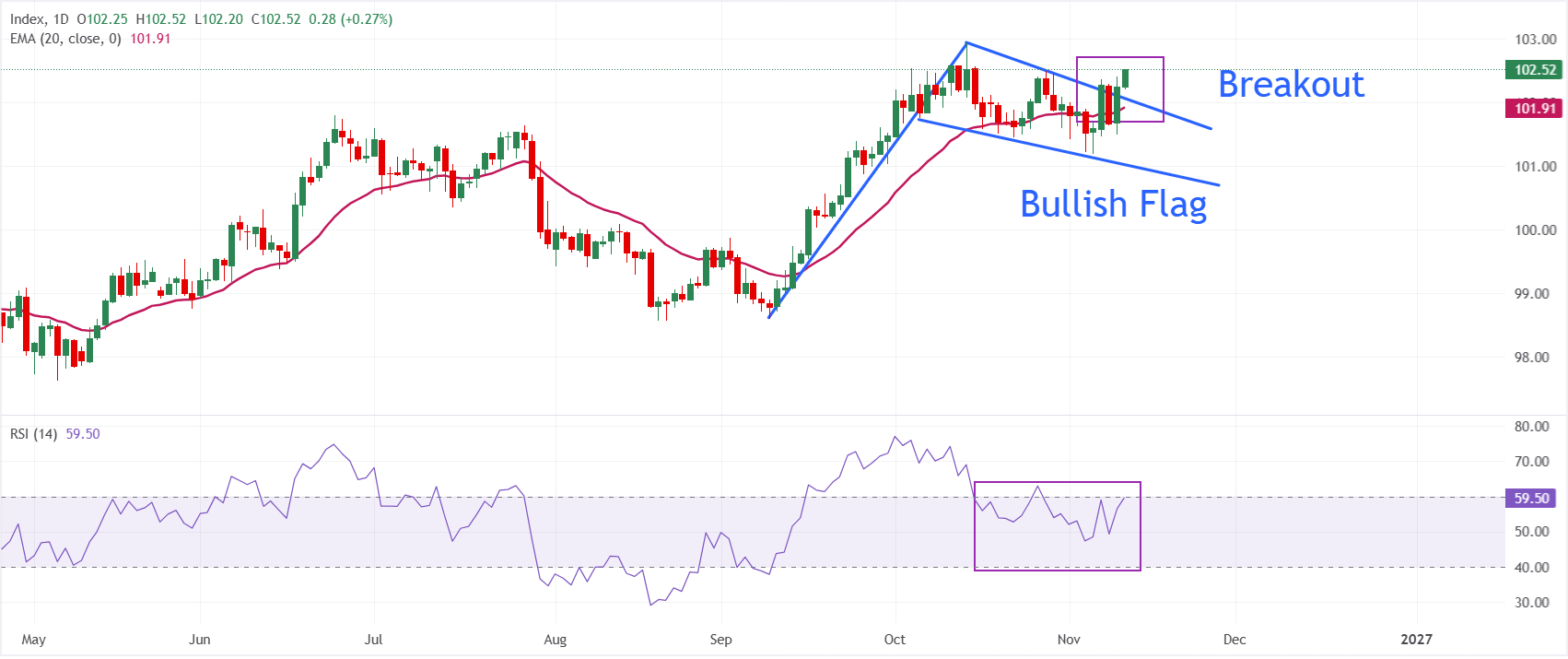
On the daily chart, US Dollar Index Spot trades at 102.52, holding a bullish bias amid the sustainability above the 20-day Exponential Moving Average (EMA) at 101.91 and the breakout of the Bullish Flag pattern.
The Relative Strength Index (RSI) around 59 keeps a mildly constructive tone rather than signaling overbought conditions.
On the downside, immediate support is located near the 102.50 area, with the EMA 20 at 101.91 reinforcing underlying demand. On the topside, the major clear resistance is the descending trend barrier around 102.94; a daily close above this level would strengthen the bullish case and open room for a more decisive extension of the recent advance.
(The technical analysis of this story was written with the help of an AI tool. Know more.)
US Dollar FAQs
The US Dollar (USD) is the official currency of the United States of America, and the ‘de facto’ currency of a significant number of other countries where it is found in circulation alongside local notes. It is the most heavily traded currency in the world, accounting for over 88% of all global foreign exchange turnover, or an average of $6.6 trillion in transactions per day, according to data from 2022. Following the second world war, the USD took over from the British Pound as the world’s reserve currency. For most of its history, the US Dollar was backed by Gold, until the Bretton Woods Agreement in 1971 when the Gold Standard went away.
The most important single factor impacting on the value of the US Dollar is monetary policy, which is shaped by the Federal Reserve (Fed). The Fed has two mandates: to achieve price stability (control inflation) and foster full employment. Its primary tool to achieve these two goals is by adjusting interest rates. When prices are rising too quickly and inflation is above the Fed’s 2% target, the Fed will raise rates, which helps the USD value. When inflation falls below 2% or the Unemployment Rate is too high, the Fed may lower interest rates, which weighs on the Greenback.
In extreme situations, the Federal Reserve can also print more Dollars and enact quantitative easing (QE). QE is the process by which the Fed substantially increases the flow of credit in a stuck financial system. It is a non-standard policy measure used when credit has dried up because banks will not lend to each other (out of the fear of counterparty default). It is a last resort when simply lowering interest rates is unlikely to achieve the necessary result. It was the Fed’s weapon of choice to combat the credit crunch that occurred during the Great Financial Crisis in 2008. It involves the Fed printing more Dollars and using them to buy US government bonds predominantly from financial institutions. QE usually leads to a weaker US Dollar.
Quantitative tightening (QT) is the reverse process whereby the Federal Reserve stops buying bonds from financial institutions and does not reinvest the principal from the bonds it holds maturing in new purchases. It is usually positive for the US Dollar.
Author
Sagar Dua
FXStreet
Sagar Dua is associated with the financial markets from his college days. Along with pursuing post-graduation in Commerce in 2014, he started his markets training with chart analysis.